The Strategic Core: Understanding Global Business Operations
Global Business Operations (GBO) is far more than just a collection of back-office functions; it serves as the central nervous system of a multinational enterprise. Its primary role and objective are to standardize, optimize, and centralize critical business processes across diverse geographies and business units. This strategic integration ensures consistency, drives efficiency, and provides a unified operational framework that supports the company's overarching goals.
At its heart, GBO contributes directly to a company's overall business strategy and growth agenda by changing disparate local operations into a cohesive, high-performing global engine. While historically, less than half of companies believed their global business services function added significant value, modern GBO aims to reverse this trend by moving beyond mere cost reduction to become a true value creator. This is especially critical given that overhead costs, as measured by sales and general administration, grew 35% more than overall corporate margins between 2009 and 2021, highlighting the urgent need for more effective operational models.
GBO achieves this by fostering end-to-end process ownership, meaning that a single team or function is responsible for an entire process, from initiation to completion, regardless of where individual steps occur geographically. This approach eliminates silos, reduces handoffs, and improves accountability. The benefits are manifold: improved cost efficiencies through economies of scale and process standardization, improved data quality and accessibility leading to better analytics, and a more agile organization capable of responding rapidly to market changes.
What are the Key Functions of Global Business Operations?
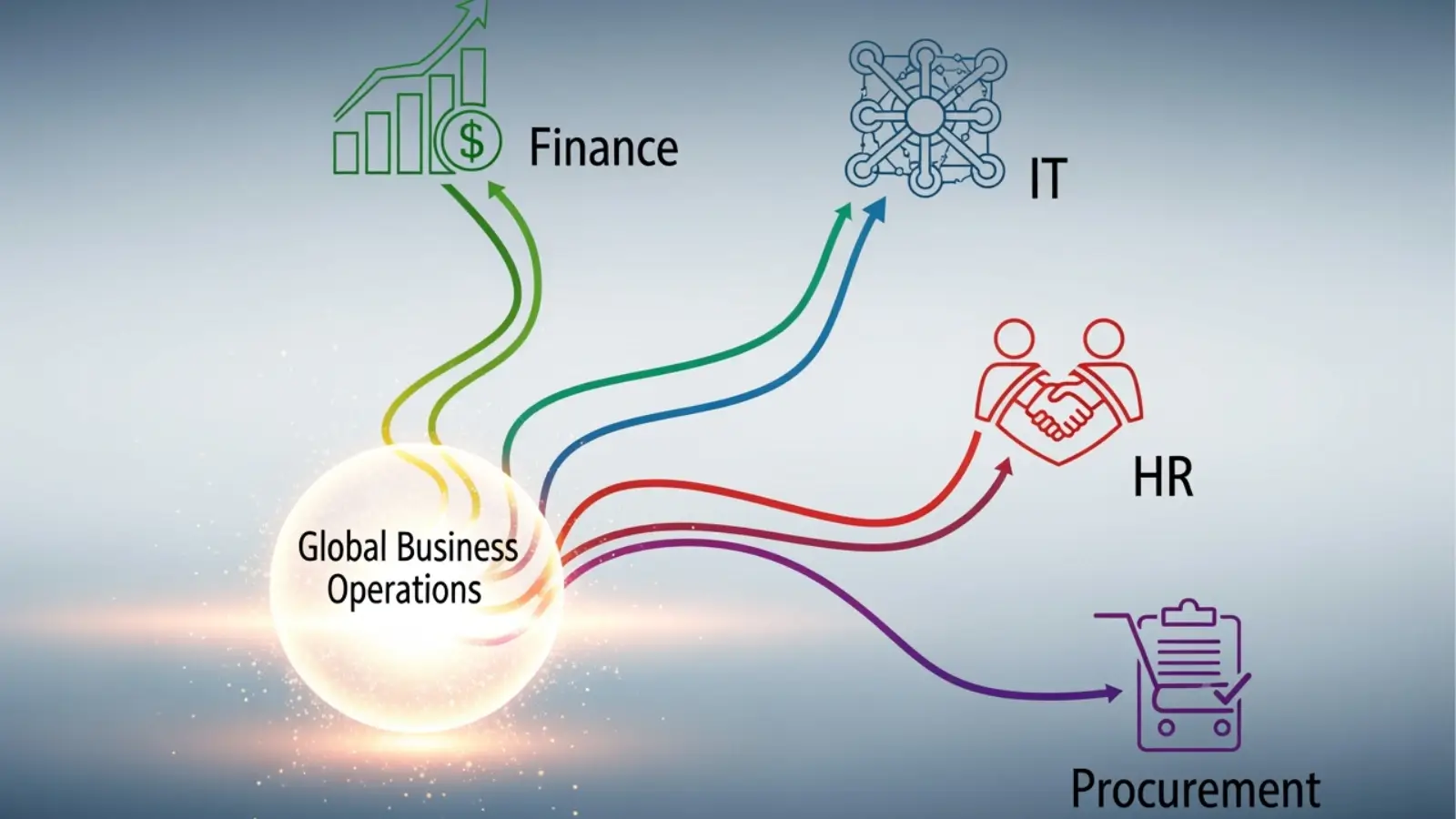
GBO teams typically manage a broad spectrum of functions, centralizing services that were once scattered across various departments and regions. This consolidation allows for specialized expertise, consistent service delivery, and strategic oversight. The typical services managed by GBO teams include:
-
Finance: Global accounting, financial planning and analysis (FP&A), treasury management, tax compliance, and payroll processing. These functions ensure financial integrity and provide critical insights into global performance.
-
Information Technology (IT): Managing global IT infrastructure, application development and support, cybersecurity, and data management. GBO ensures that technology platforms are standardized and accessible worldwide, supporting seamless operations.
-
Human Resources (HR): Overseeing global talent acquisition, employee lifecycle management, benefits administration, HR policy development, and learning and development programs. This ensures a consistent employee experience and compliance with diverse labor laws. Diageo, for example, leverages its GBO hubs with over 1,900 talented people to manage these complex global HR functions.
-
Procurement: Centralizing sourcing, vendor management, contract negotiation, and purchasing across all business units. This drives cost savings, improves supplier relationships, and ensures compliance with global procurement policies.
-
Commercial Services: Supporting sales operations, order management, customer service, and commercial analytics. GBO ensures that customer-facing processes are efficient and aligned with global commercial strategies.
-
Data Management: Ensuring the accuracy, consistency, and accessibility of enterprise-wide data. This foundational role underpins all other GBO functions, enabling data-driven decision-making.
By centralizing these functions, GBO creates a powerful operational backbone that frees local teams to focus on market-specific strategies and customer engagement, rather than administrative tasks.
How GBO Drives Strategy and Growth
The impact of GBO extends far beyond operational efficiency; it is a vital enabler of strategic growth and adaptability for large organizations.
-
Improved Alignment and Data-Driven Decision-Making: GBO provides a unified view of operations and performance across the entire enterprise. This holistic perspective ensures that all business units are working towards common strategic objectives. By consolidating data from various functions and geographies, GBO teams can generate improved analytics, providing leadership with predictive insights at unparalleled speed. This data-driven approach supports more informed strategic planning and resource allocation.
-
Facilitating Collaboration and Efficiency: By standardizing processes and establishing common platforms, GBO breaks down functional and geographical silos. This fosters greater collaboration between different business units and regions, leading to more efficient workflows and the sharing of best practices. This integrated approach can significantly improve efficiency, with some global business services models achieving a productivity increase of 30–70% and an increase in stakeholder satisfaction of over 20%.
-
Supporting Mergers, Acquisitions, and Market Shifts: In times of significant change, such as mergers, acquisitions, or market disruptions, GBO functions are crucial for seamless integration and rapid adaptation. They provide the framework to quickly onboard new entities, harmonize processes, and scale operations up or down as needed. This agility allows companies to capitalize on new opportunities or mitigate risks more effectively. The ability to deliver significant savings, sometimes between $80 million to $90 million for a global leader, further underscores GBO's role in enabling strategic moves.
-
Improved Risk Management: With a centralized view of operations, GBO can identify and mitigate risks more effectively, whether they are financial, operational, or compliance-related. This global oversight helps ensure adherence to international regulations and internal policies, protecting the company's reputation and financial health.
GBO transforms support functions from cost centers into strategic assets, actively contributing to the company's competitive advantage and long-term success.
Navigating the Maze: Mastering Global Logistics
Operating on a global scale inherently introduces a complex web of logistical challenges. From sourcing raw materials to delivering finished products to diverse customer bases, mastering global logistics is paramount for sustained international success. This involves more than just moving goods; it encompasses building supply chain resilience, navigating intricate cross-border management, ensuring regulatory compliance, and mitigating geopolitical risks. Companies that effectively manage these complexities can leverage economies of scale and improve organizational flexibility, turning potential problems into strategic advantages. Many companies find success by partnering with specialists in optimizing global business operations to manage these complexities, ensuring their supply chains are not just efficient but also robust and adaptable.
The strategic imperative for global expansion, as highlighted by the increasing number of companies operating internationally, means that businesses must develop sophisticated approaches to their supply chains. Global supply chains have already contributed to a 20% reduction in production costs for companies with extensive international operations, demonstrating their inherent value. However, this efficiency comes with increased vulnerability if not managed carefully. Factors like currency fluctuations, economic conditions, and the balance between profit potential and expansion costs all weigh heavily on logistical decisions.
Key Challenges in Global Supply Chain Management
The path to a streamlined global supply chain is often fraught with obstacles that require careful planning and execution.
-
Tariffs and Trade Barriers: Navigating the ever-changing landscape of international tariffs, quotas, and trade agreements is a constant challenge. These can significantly impact costs and delivery times, requiring businesses to adapt their sourcing and distribution strategies frequently.
-
Diverse Regulatory Environments: Each country has its own set of import/export regulations, product safety standards, labeling requirements, and environmental policies. Ensuring compliance across multiple jurisdictions demands meticulous attention to detail and often necessitates local expertise. Non-compliance can lead to severe penalties, delays, and reputational damage.
-
Last-Mile Delivery Complexities: The final leg of delivery, from a local distribution center to the end customer, presents unique challenges in different regions. Infrastructure quality, local delivery networks, urban congestion, and consumer expectations vary widely, requiring custom last-mile solutions.
-
Inventory Management Across Borders: Balancing inventory levels across a global network to meet demand without incurring excessive holding costs is a delicate act. Factors such as lead times, customs clearance, and regional demand fluctuations make this particularly complex, requiring advanced forecasting and inventory optimization techniques.
Technology's Role in Streamlining Global Logistics
Digital change is not just a buzzword; it's a fundamental shift in how global logistics are managed, enabling greater visibility, efficiency, and resilience. Global spending on digital change technologies is expected to reach $2.3 trillion by 2023, underscoring the investment in this area.
-
Internet of Things (IoT) for Tracking: IoT sensors embedded in goods and vehicles provide real-time data on location, temperature, humidity, and other critical conditions. This improves transparency throughout the supply chain, allowing for proactive problem-solving and improved accountability.
-
Artificial Intelligence (AI) for Demand Forecasting: AI and machine learning algorithms can analyze vast datasets to predict demand patterns with greater accuracy, optimizing inventory levels and production schedules. AI also helps in route optimization, reducing transportation costs and delivery times.
-
Blockchain for Transparency and Traceability: Blockchain technology offers an immutable, distributed ledger that can track every transaction and movement of goods across the supply chain. This improves transparency, reduces fraud, and simplifies compliance checks, especially for high-value or regulated products.
-
Cloud-Based Management Systems: Cloud platforms provide centralized, accessible systems for enterprise resource planning (ERP), warehouse management (WMS), and transportation management (TMS). These systems facilitate seamless data exchange and collaboration among all stakeholders in the global supply chain, from suppliers to customers.
By strategically implementing these technologies, businesses can transform their global logistics from a reactive, complex operation into a proactive, intelligent, and highly efficient system.
Bridging the Divide: The Critical Role of Language and Culture
Beyond the tangible challenges of logistics, global business operations must also master the nuances of human interaction across borders. Language and culture are not merely communication tools; they are foundational elements that shape markets, influence consumer behavior, and define business relationships. Cultivating cultural intelligence and fostering effective cross-cultural communication are paramount for global success. This often involves working with a certified global business language partner to ensure accuracy and cultural appropriateness in all communications, demonstrating respect and building trust with international stakeholders.
Understanding that "no man is an island" has never been more relevant than in today's global marketplace. Companies that prioritize cultural adaptation and multilingual capabilities are better positioned to connect deeply with local audiences, avoid costly misunderstandings, and build strong, lasting relationships. This commitment extends to talent development, where fostering a diverse and culturally aware workforce becomes a strategic advantage.
Beyond Translation: Embracing Localization for Market Success
While translation focuses on converting text from one language to another, localization is a far more comprehensive process. It involves adapting a product, service, or content to meet the linguistic, cultural, technical, and legal requirements of a specific target market. This distinction is crucial for market success.
-
Adapting Products and Services: Localization means tailoring product features, design elements, and functionality to align with local preferences, regulations, and usage patterns. For instance, a software interface might need different date formats, currency symbols, or even entirely different user flows to feel native to a market.
-
Website and Software Localization: A company's digital presence is often its first point of contact with international customers. Website and software localization goes beyond translating text to include adapting imagery, user experience (UX), and even calls-to-action to resonate with the local culture. This ensures that the online experience feels natural and trustworthy to the target audience.
-
Marketing Transcreation: Effective global marketing requires more than direct translation; it demands transcreation. This process involves recreating marketing messages to evoke the same emotion and intent in the target language and culture, rather than just translating words. An advertising campaign that is well-received in one country might send a completely different message elsewhere if not culturally adapted.
-
Cultural Consulting: Partnering with cultural consultants provides invaluable insights into local customs, etiquette, and consumer psychology. This expertise helps businesses steer potential pitfalls and craft strategies that are culturally sensitive and effective.
The impact of localization is significant: 54% of customers prefer local language over price when making a purchasing decision, and 75% of consumers would rather purchase products in their native language. These statistics underscore that a truly global business must speak to its customers in their own voice.
Building a Multilingual Workforce for Effective Global Business Operations
Effective global operations depend not only on external communication but also on the internal linguistic and cultural capabilities of the workforce.
-
eLearning Localization for Training: For multinational companies, standardized training programs are essential. Localizing eLearning content ensures that employees across different regions receive consistent, culturally relevant, and easily understandable instruction, fostering skill development and adherence to global standards.
-
On-Site and Remote Interpretation Services: In global meetings, negotiations, or even daily internal communications, language barriers can impede progress. Providing access to professional on-site or remote interpretation services ensures that critical information is accurately conveyed and understood, facilitating smoother collaboration and decision-making.
-
Fostering a Culture of Continuous Learning: Encouraging employees to develop language skills and cultural competencies is a long-term investment. Companies can support this through language training programs, cultural awareness workshops, and opportunities for international assignments. This not only improves individual growth but also strengthens the organization's overall global capabilities.
-
Multilingual Document Management: Managing legal documents, HR policies, product manuals, and internal communications in multiple languages is a complex but necessary task. Robust multilingual document management systems and processes ensure accuracy, compliance, and accessibility for all global employees.
By investing in these areas, businesses can build a truly multilingual and culturally astute workforce, enabling seamless internal operations and more effective engagement with global markets.
Building a Resilient and Future-Ready GBO Framework
As businesses continue their global expansion, the need for a resilient and future-ready GBO framework becomes increasingly critical. This involves not only optimizing current operations but also anticipating and adapting to emerging trends, leveraging advanced technology, and fostering a culture of continuous improvement. While only 5% of companies have reached the highest level of GBS change, and less than half believe their GBS function adds significant value, the potential for GBO to drive substantial impact is immense. GBS organizations achieve roughly 80% of potential gains if they depend on labor arbitrage, process efficiencies, and the first-time digitization of processes, highlighting the foundational importance of these elements.
Digital change and data analytics are at the forefront of this evolution. GBO functions are increasingly becoming incubators for digital ways of working, leveraging technologies like hyper-automation, AI, and predictive analytics to improve service delivery and improve both employee and customer experiences. This integration of technology transforms GBO from a transactional support unit into a strategic partner that provides actionable insights and drives innovation across the enterprise.
Measuring the success and value contribution of GBO functions is essential. Key Performance Indicators (KPIs) should extend beyond traditional cost savings to include metrics related to service quality, stakeholder satisfaction, process efficiency, and the GBO's contribution to strategic initiatives. Regular stakeholder feedback and benchmarking against industry best practices are crucial for continuous improvement.
Choosing the Right GBO Model for Your Business
The organizational structure of GBO can vary significantly depending on a company's size, industry, strategic objectives, and desired level of control versus cost efficiency. The most common models include shared services, centers of excellence (CoEs), and outsourcing.
Feature Shared Services Centers of Excellence (CoEs) Business Process Outsourcing (BPO) Description Centralized unit providing standardized services to internal business units. Specialized teams focused on developing best practices, expertise, and innovation in a specific functional area. Contracting external third-party providers for specific business functions. Scalability Moderate to High; can scale services for internal demand. High; expertise can be leveraged across the organization. High; external provider manages capacity fluctuations. Control High; direct control over processes and personnel. High; maintains internal expertise and strategic direction. Low to Moderate; depends on contract and governance model. Cost Efficiency High; through standardization, economies of scale, and process optimization. Focus on value creation and innovation, not primarily cost. Potentially High; through labor arbitrage, specialization, and technology. Core Competency Focuses on efficient delivery of transactional/routine tasks. Focuses on strategic development, innovation, and complex problem-solving. Focuses on cost reduction and operational efficiency for non-core tasks. Risk Internal resistance, lack of agility if overly rigid. Integration challenges with operational teams. Vendor dependency, data security, loss of internal knowledge. Many organizations adopt a hybrid model, combining elements of all three. For example, a company might use shared services for routine finance and HR tasks, establish CoEs for specialized functions like data analytics or digital change, and outsource specific IT support or customer service functions to external providers. The choice of model impacts scalability, control, and cost, requiring careful consideration of the business's core competencies and strategic priorities.
Key Trends Shaping the Future of Global Business Operations
The landscape of GBO is continuously evolving, driven by technological advancements, changing business demands, and a greater emphasis on strategic value.
-
Hyper-automation and AI: The future of GBO will see an accelerated adoption of hyper-automation, combining Robotic Process Automation (RPA), AI, and machine learning to automate complex, end-to-end processes. This will reduce manual effort, improve accuracy, and free up human talent for more strategic, value-added tasks.
-
Focus on Employee and Customer Experience: GBO is shifting from a purely efficiency-driven model to one that prioritizes enhancing the experience for both internal employees and external customers. This involves designing intuitive self-service portals, personalized support, and leveraging data to anticipate needs and deliver proactive services.
-
Increased Role in Sustainability and Corporate Social Responsibility (CSR): GBO teams are increasingly being tasked with integrating sustainability and CSR initiatives into their operations. This includes optimizing supply chains for environmental impact, ensuring ethical sourcing, and promoting diversity and inclusion within global teams. GBO can play a significant role in collecting and reporting ESG data, contributing to the company's overall sustainability goals.
-
Predictive Analytics for Strategic Foresight: Beyond reporting historical data, GBO will leverage predictive analytics to offer strategic foresight. By analyzing trends in operational data, market shifts, and external factors, GBO can provide proactive insights that guide strategic decision-making, risk management, and resource allocation.
These trends highlight GBO's change into a dynamic, intelligent, and strategic function that is central to a company's ability to thrive in an increasingly complex and interconnected global economy.
Frequently Asked Questions about Global Operations
What is the first step to establishing a Global Business Operations function?
The first step is strategic alignment. Before centralizing functions, a company must define the GBO's role in the overall business strategy, identify which processes to include, and secure executive buy-in. This involves assessing current operational inefficiencies and outlining clear objectives for cost savings, service improvement, and value creation. A thorough assessment of current capabilities and future needs will lay the groundwork for a successful GBO implementation.
How does GBO differ from simply outsourcing business functions?
While outsourcing can be a component of a GBO model, GBO is a more holistic, strategic approach. It focuses on integrating and standardizing processes end-to-end across the entire enterprise, whether they are handled in-house (shared services) or by a third party. The goal is to create a unified, strategic function that drives value, not just a series of disconnected, cost-saving contracts. GBO maintains strategic oversight and governance, ensuring that outsourced services align with overall business objectives and quality standards.
How can small businesses apply global operations principles?
Small businesses can apply GBO principles by starting small and leveraging technology. They can use cloud-based accounting and HR software to standardize processes, use digital platforms to reach international customers, and partner with specialized third-party logistics (3PL) and language service providers to manage supply chains and communication without needing large, in-house teams. The focus should be on creating scalable, efficient processes from the outset, allowing for growth without significant operational overhaul. Even for smaller entities, understanding cultural nuances and localizing communications remains vital for market penetration.
Conclusion
The journey of global expansion, while filled with immense opportunities, is undeniably complex. As we have explored, effective Global Business Operations (GBO) are not just an operational necessity but a strategic imperative that underpins success in the interconnected global marketplace. GBO transforms disparate functions into a cohesive, efficient, and value-driven engine, aligning operations with overarching business goals and driving growth.
Mastering global logistics is crucial, demanding resilient supply chains, meticulous cross-border management, and strategic use of technology to steer tariffs, regulations, and last-mile complexities. Simultaneously, bridging the divide of language and culture is equally vital. This goes beyond mere translation, embracing comprehensive localization strategies and cultivating a multilingual, culturally intelligent workforce to connect authentically with diverse markets.
The future of global business is increasingly interconnected, technology-driven, and focused on delivering exceptional experiences while adhering to principles of sustainability and social responsibility. By strategically implementing robust GBO models, leveraging digital change, and continuously adapting to evolving trends, businesses can build a resilient framework that not only overcomes logistical and language barriers but also open ups sustainable global growth and competitive advantage for years to come.
Business Outstanders brings you sharp insights on tech, business, entrepreneurship, law, crypto, and more. We uncover what’s next. Stay updated, sign up for our newsletter and be part of the future!