
The Role of Temperature Control in Industrial Thermal Processing
In the dynamic landscape of industrial processing, the ability to control and manage heat with precision is not just an advantage—it's a necessity. Achieving optimal thermal conditions is fundamental to ensuring product quality, maximizing energy efficiency, and maintaining operational reliability across a wide range of applications.
This principle is especially critical in drying technologies, where the effective removal of moisture, without degrading the material, presents a significant engineering challenge. Among the various solutions, atmospheric drum dryers stand out as highly effective. They are instrumental in transforming diverse liquid and pasty materials into stable, high-quality dry products.
In this comprehensive guide, we will delve into the sophisticated world of atmospheric drum dryers. We will explore their fundamental operating principles, examine the differences between single- and double-drum configurations, and uncover how these systems achieve uniform drying while minimizing product degradation. Our focus will be on the latest innovations in thermal management and temperature control, showcasing how these advancements boost energy efficiency and safeguard product integrity. We will also touch upon how specialized equipment, such as Buflovak controlled atmospheric dryers, plays a crucial role in these advanced industrial processes. Join us as we explore the cutting edge of drying technology.
Effective thermal management is the cornerstone of successful industrial drying. In processes like drum drying, conductive heat transfer is the primary mechanism, where heat is directly transferred from a hot surface (the drum) to the wet material. This method facilitates thin-film continuous drying, rapidly removing moisture. However, precise temperature control is paramount to prevent thermal stress, which can lead to product degradation and alter its physical and chemical properties.
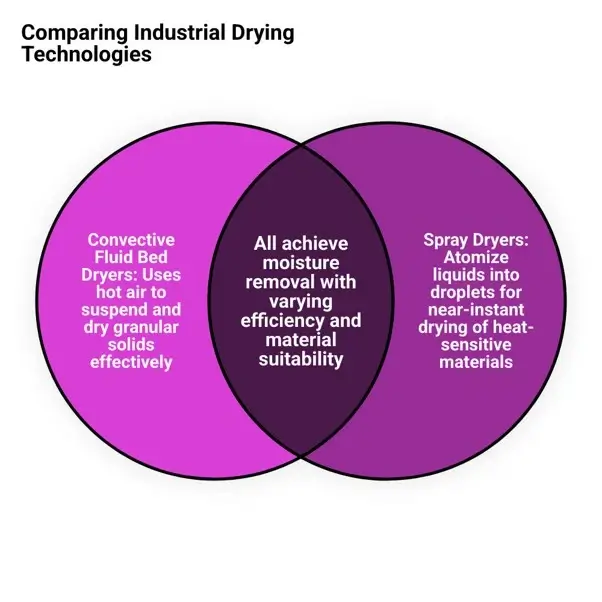
Compared to other drying technologies, conductive drum dryers offer distinct advantages, particularly for viscous or pasty materials. For instance, convective fluid bed dryers rely on hot air to suspend and dry particles, which is excellent for granular solids but less effective for sticky substances. Spray dryers, on the other hand, atomize liquid feeds into fine droplets, drying them almost instantaneously, ideal for heat-sensitive liquids that can withstand atomization. Drum dryers bridge a crucial gap, excelling where direct contact with a heated surface provides superior heat transfer and control for specific material types.
Mechanisms of Heat Transfer in Drum Drying
At its core, an atmospheric drum dryer operates on the principle of indirect conductive heat transfer. Inside the robust, rotating drums, saturated steam circulates, heating the drum's surface to a precise temperature. As a thin film of wet product is applied to the exterior of this hot surface, direct contact drying commences. The heat rapidly conducts through the thin film, causing the moisture within the product to evaporate.
The efficiency of this process is largely determined by the evaporation rate, which is directly influenced by the drum surface temperature and the thickness of the product film. The material's residence time on the drum, typically just a few seconds to a couple of minutes (e.g., ANDRITZ Gouda drum dryer achieves drying times between 3 and 100 seconds), is precisely controlled by the drum's rotational speed. This brief, intense heat exposure ensures rapid drying while minimizing the duration the product is subjected to elevated temperatures, thus preserving its quality.
Optimizing Thermal Efficiency with Smart Temperature Control
In May 2026, the emphasis on optimizing thermal efficiency in industrial drying is stronger than ever. Modern atmospheric drum dryers incorporate intelligent monitoring and advanced sensor integration to achieve unparalleled control over the drying process. By continuously monitoring the drum surface temperature, steam pressure, and product film characteristics, operators can maintain an optimal thermal gradient.
This smart temperature control not only ensures consistent product quality but also significantly reduces energy consumption. Research into hybrid rotary drum dryers, for instance, has demonstrated substantial energy savings by precisely managing drying medium temperatures. One study highlighted that intelligent temperature monitoring in an infrared (IR) system reduced drying time by 9.2 hours at 30 °C, 6 hours at 40 °C, and 3.2 hours at 50 °C. Such advancements minimize energy waste, reduce operational costs, and lower the carbon footprint of industrial drying processes.
Atmospheric Drum Dryers and Thermal Management
Atmospheric drum dryers are specifically designed for continuous, indirect drying of liquid and pasty materials under ambient atmospheric pressure. Their robust design and precise thermal management capabilities make them indispensable across various industries. These dryers are particularly effective for handling high-viscosity liquids or pasty materials that would be challenging to dry with other methods. Common applications include the drying of potatoes, starches, gelatins, adhesives, and synthetic resins, where uniform drying and minimal product degradation are critical.
Single vs Double Drum Configurations
Atmospheric drum dryers primarily come in two main configurations: single drum and double drum. Each type offers distinct advantages tailored to specific product characteristics and processing needs.
Single Drum Dryers (ASDD) feature a single, large rotating drum heated internally by steam. The wet material is typically applied to the drum surface using a series of applicator rolls. These rolls are crucial for creating a uniform, thin film of material on the drum. A unique advantage of single drum dryers is their ability to use multiple applicator rolls to build successive layers of material. This process eliminates void areas and allows for gradual drying between layers, ultimately forming a product sheet of uniform thickness and density with minimal dusting tendencies. This layered approach can also increase the bulk density of the final product.
Double Drum Dryers (ADDD), conversely, utilize two closely spaced, parallel, internally steam-heated rotating drums. The wet feed material is introduced into the nip, or gap, between the two drums. As the drums rotate, the material forms a thin film on each drum surface. The key advantage of double drum dryers lies in their precise control over film thickness, which can be adjusted by varying the gap between one fixed and one adjustable drum. This configuration makes them exceptionally versatile for drying a wide range of products, from thin slurries to highly viscous pastes. Double drum dryers are considered the most versatile and widely applied type of drum dryer due to their product versatility, high drying efficiency, low operating cost, and long-term operational reliability.
Both configurations use thin-film continuous drying via conductive heat transfer, ensuring rapid, uniform drying of the product. The choice between a single- and a double-drum dryer often depends on the material's viscosity, the desired product form, and specific quality requirements.
Operating Parameters and Temperature Control Limits
The effective operation of atmospheric drum dryers relies on carefully controlled operating parameters. The drums are typically heated by saturated steam, which circulates internally. Standard drums are designed to withstand steam pressures of 140 to 160 psig, ensuring robust, safe operation. These pressure ratings comply with stringent industry standards such as ASME or PED Pressure Code Directives, highlighting the importance of safety in high-temperature, high-pressure environments.
The heating medium temperature within the drums typically ranges from 120 to 190 °C. This temperature range, combined with the drum's rotational speed, dictates the drying time, which can vary significantly from 3 to 100 seconds. This brief exposure to high temperatures is crucial for preserving product quality, especially for heat-sensitive materials, as it minimizes thermal degradation. Throughput rates for drum dryers can range from 1 TPH (ton per hour) to 200 TPH, depending on the drum size and operational settings, demonstrating their capacity for industrial-scale processing.
Energy Efficiency and Hybrid Thermal Technologies
In the ongoing pursuit of sustainable industrial practices, energy efficiency in drying technologies is a critical focus. Atmospheric drum dryers, while inherently efficient due to direct heat transfer, are continually being optimized through innovations like heat recovery systems and the integration of hybrid thermal technologies. These advancements aim to reduce energy consumption, lower operational costs, and minimize environmental impact.
Heat Recovery and Zero Purge Systems
One notable area of innovation comes from advancements in rotary drum dryers, particularly those designed for compressed air applications, which demonstrate principles applicable to broader thermal management. Some rotary drum dryers, such as the MDG models, achieve remarkable energy savings by using the heat of compression from air compressors for desiccant regeneration. This "zero purge" design eliminates compressed air loss, a common issue in traditional twin-tower desiccant dryers.
The MDG rotary drum dryer, for instance, achieves a stable Pressure Dew Point (PDP) of -40°C (-40°F) at almost zero power consumption, with total power consumption always below 120W. This represents significant energy savings and operational costs close to zero compared to market-standard desiccant dryers. While these specific examples pertain to air drying, the underlying principle of leveraging waste heat for regeneration is a powerful concept that can be adapted and applied to other industrial drying processes to enhance overall energy efficiency and reduce the carbon footprint.
Hybrid Infrared and Convective Heating
Another frontier in energy-efficient drying involves integrating hybrid thermal technologies. Research has shown that combining infrared (IR) heating with conventional convective heating in rotary drum dryers can dramatically improve drying kinetics and energy efficiency. For example, a study on lemongrass drying demonstrated that an IR + heater hybrid system achieved significant energy savings: 71% at 30 °C, 61% at 40 °C, and 37% at 50 °C. This hybrid approach also resulted in the shortest drying times and highest drying rates compared to using IR or convective heating alone.
Beyond energy savings, hybrid systems can also enhance product quality. In the lemongrass study, the IR + heater drying at 40 °C improved product quality by up to 2.80 ± 0.33% while preserving photosynthetic pigments and enhancing antioxidant activity. This is particularly important for products where the preservation of bioactive compounds, flavor, and color is crucial, such as in the food, pharmaceutical, and herbal industries. By carefully controlling the balance between radiant (IR) and convective heat, processors can achieve superior drying performance and product integrity.
Frequently Asked Questions about Industrial Thermal Management
Effective thermal management is complex, and understanding the nuances of industrial dryers is key to optimizing processes. Here, we address some common questions regarding atmospheric drum dryers and their operational considerations.
What is the typical temperature range for atmospheric drum dryers?
Atmospheric drum dryers typically operate with saturated steam as the heating medium, resulting in drum surface temperatures of 120–190 °C. This range allows rapid moisture evaporation. For heat-sensitive products, the advantage of drum dryers is the extremely brief exposure to these high temperatures—often just a few seconds—as the product forms a thin film and is then scraped off. This limits the time the product spends above its boiling point, minimizing thermal degradation.
How do single and double drum dryers differ in film thickness control?
The primary difference in film thickness control lies in their mechanical design. In double drum dryers, film thickness is precisely controlled by adjusting the gap between the two rotating drums. This allows operators to set an exact, uniform thickness for the product film. In single-drum dryers, film thickness is controlled by multiple applicator rolls. These rolls work to spread the wet material evenly and, in some cases, build successive layers. This layering process helps eliminate voids and gradually forms a product sheet of uniform thickness and density, which can increase the bulk density of the final dried product.
What safety and maintenance considerations are critical for steam pressurized drums?
Safety and maintenance are paramount for steam-pressurized drums. All drums must comply with rigorous international standards, such as ASME pressure codes or PED directives, ensuring their structural integrity under high pressure and temperature. Routine inspection is essential to monitor for wear, corrosion, or any signs of material fatigue. Furthermore, applying wear-resistant coatings, such as HVAF (High-Velocity Air-Fuel) thermal spray, can significantly extend the drum's lifespan, particularly in applications involving corrosive or abrasive products. These coatings maintain food-grade compliance while preserving heat transfer efficiency. Regular maintenance, including cleaning, lubrication, and control calibration, ensures reliable and safe long-term operation.
Conclusion
As we look towards May 2026 and beyond, the emphasis on precise thermal management in industrial drying processes, particularly with atmospheric drum dryers, continues to grow. These versatile machines, available in single- or double-drum configurations, offer robust solutions for transforming challenging liquid and pasty materials into high-quality dried products. The continuous evolution of these systems, driven by innovations in smart temperature control, heat recovery, and hybrid heating technologies, underscores a commitment to enhanced energy efficiency, reduced operational costs, and superior product integrity.
The ability to finely tune operating parameters, from steam pressure and temperature to residence time, ensures that even the most delicate or viscous materials can be processed without degradation. As industries strive for greater sustainability and operational excellence, the ongoing advancements in atmospheric drum drying technology will undoubtedly play a pivotal role in shaping the future of thermal processing.
For those seeking to optimize their drying operations and explore customized solutions, understanding these intricate details is the first step towards achieving process optimization, energy efficiency, and uncompromising product quality.
Contact Us to learn more about advanced thermal drying solutions.
Business Outstanders brings you sharp insights on tech, business, entrepreneurship, law, crypto, and more. We uncover what’s next. Stay updated, sign up for our newsletter and be part of the future!