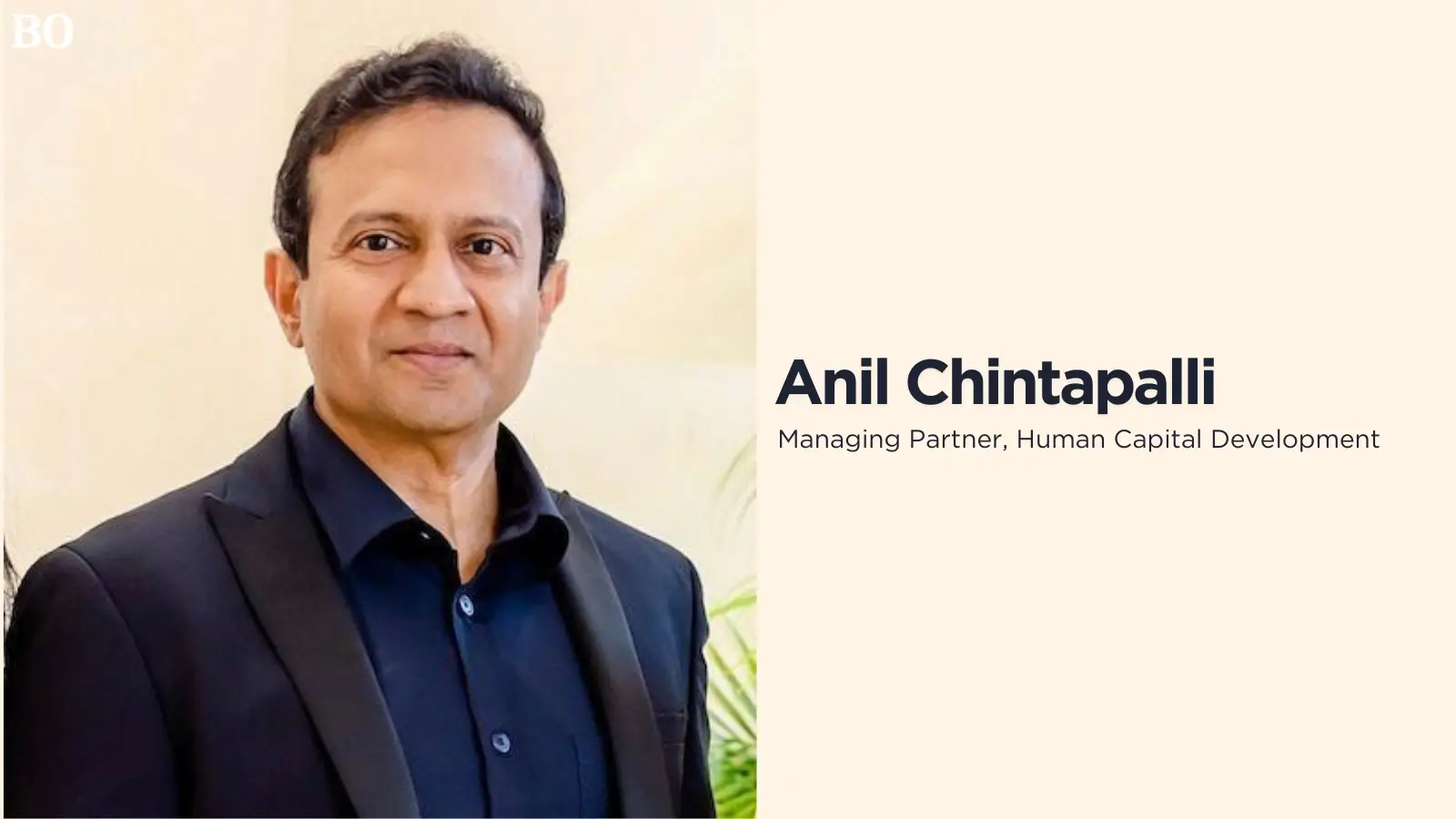
From an autonomous robot built as an undergraduate to a $4 billion-plus investment platform, Anil Chintapalli has spent three decades at the intersection of engineering and enterprise value creation. The Managing Partner and CEO of Human Capital Development (HCD), Senior Advisor to McKinsey & Company, and member of the Forbes Business Council and Fast Company Executive Board sat down with Business Outstanders to discuss economic moats, the AI transformation of business services, and why he believes every strategic choice a CEO makes is ultimately a moat decision.
Business Outstanders: Anil, you've led Human Capital Development since 2010 and our analysis indicates that you have grown the firm into a family office investment platform with more than $4 billion in assets under management. But your story starts in an engineering lab. Help us understand this better.
Anil Chintapalli: Long before I was an investor and an operator of businesses, I was an engineer — and, I still am. My specialization in robotics and AI goes back more than thirty years. As an undergraduate, I built an autonomous guided vehicle, which at that time meant solving problems across the entire stack: the electrical and electronics systems, the mechanical design, the industrial engineering of how it would actually operate in a real environment, and the computer science that made it think. There was no single discipline you could hide inside. That project earned recognition from institutions including Motorola and IEEE, but more importantly, it taught me something I've carried into every boardroom since: technology only creates value when all the systems and business processes work together. A brilliant algorithm on a poorly engineered platform goes nowhere. That's as true for a Fortune 500 transformation as it is for a robot.
Business Outstanders: Our analysis of your investments indicates you have made prescient investments that have unlocked blockbuster returns by engineering timely exits to strategics such as Amazon, Google, Electronic Arts, Disney, Microsoft, Comcast, Pepsi, and Coca-Cola. How has HCD created substantive investment returns in sectors as diverse as technology, consumer products, real estate and media ?
Anil Chintapalli: HCD invests across technology, education, real estate, media, and consumer products — sectors that look unrelated until you realize they share one thing: each rewards businesses that build compounding, defensible systems. We've been fortunate to generate blockbuster returns from several of our investments through sales to global strategic acquirers, and in each case the exit premium traced back to the same root cause — the company had built something a strategic buyer could not replicate internally at any reasonable cost or speed. A beloved consumer brand with loyalty engineered by technology that drives annuity revenue. A technology company that had unique intellectual property that generated high margin revenue by winning enterprise customers. A content studio with a proprietary library and a creative engine powered by technology. These are moats, and strategics pay up for moats.
Business Outstanders: You recently authored an article for Forbes on exactly that — how smart companies use economic moats to thrive in volatile times. You identified eight "operating rails." Which do you consider most underappreciated right now?
Anil Chintapalli: Proprietary data and intelligence, without question. An AI model trained on common data yields common outputs. A model trained on proprietary, high-signal, customer generated data produces premium outputs that cannot be replicated by scraping the internet. It is probably the most undervalued attribute on the list and also the fastest appreciating. The other seven — brand loyalty, scale, intellectual property, network e!ects, technology and operations innovation, a fortress balance sheet, and supply-demand oligopoly position — all still matter enormously. But the key insight is that moats are compounding systems. Each defense makes every other one more durable. Stacked together, they produce a system that is far harder to breach than any single attribute on its own.
Business Outstanders: You've encoded this into what you call a software-powered operating system. What does that actually mean in practice?
Anil Chintapalli: Over thirty-plus years as an investor and operator, I've captured the patterns of what actually creates and protects shareholder value and encoded them into a proprietary, software-enabled operating system tied to those eight rails. The important word is measurable. Every one of these attributes leaves a trail of evidence. Pricing power shows up in gross margin stability through cost shocks. Scale shows up in return on invested capital versus peers. Network e!ects show up in cohort retention. Balance sheet strength drives net-debt-to-EBITDA improvement. If you can measure it, you can manage it — and I built software that constantly manages all eight operating rails in a mutually exclusive and collectively exhaustive manner rather than reviewing each operating rail in a siloed manner or just once a year in a strategy offsite or four times a year prior to a board meeting.
Business Outstanders: Your track record backs the framework — four U.S. public listings, 21 M&A transactions across 21 countries, roughly 4x return on invested capital for shareholders. The most recent chapter was WNS Holdings. Walk us through that.
Anil Chintapalli: WNS was a case study in everything we've discussed. It was a traditional business process management enterprise with strong client relationships, good delivery, but a labor linear model in a world where agentic AI was about to reprice the entire sector. The transformation reframed the company around AI-powered intelligent operations: vertical specific technology solutions, reusable accelerators, and agentic AI embedded into client operations rather than bolted on top. That journey culminated in the sale of the firm to Capgemini for $3.3 billion in cash, creating a global leader in agentic-AI-powered intelligent operations. During the transformation, I invested a substantive amount of my own personal capital as well into acquiring WNS shares. I have always believed leaders should own meaningful equity in the firms they lead. Skin in the game isn't a slogan — it's the alignment mechanism that makes every other leadership principle credible.
Business Outstanders: You've said transformation starts with clarity, not urgency. What's the distinction?
Anil Chintapalli: Urgency mobilizes; clarity sustains. Most transformations begin because something hurts — declining performance, a competitor pulling ahead, a technology shift. That gets people moving for a quarter. But large-scale transformation takes years, and what carries an organization through year two and three is a precise articulation of why the transformation is necessary, what success looks like in business outcomes rather than activities, and how the organization gets there. Leaders who keep changing the message undermine trust. Leaders who stay anchored to a clear vision - even as tactics evolve - create stability in the middle of change. And execution matters more than the perfect plan. No transformation unfolds as designed. Build feedback loops, empower teams, and course correct on real-world outcomes.
Business Outstanders: Where does AI fit into that playbook today?
Anil Chintapalli: AI is most e!ective when it's embedded into business process operations rather than treated as a technology project. Through work with more than fifty Fortune 500 enterprises, I’ve developed industrial-scale, vertical-specific roadmaps for exactly that. Our proprietary delivery model — the Agentic Workforce Operating System, AWOS — deploys agentic AI workforce squads alongside solution engineers inside the enterprise environment. The economic e!ect is direct: it substantially reduces dependence on high-priced consultants and restructures the traditional labor pyramid and pricing models built on time-and materials or FTE counts. I wrote a book published by John Wiley years ago on simplifying the complexity of implementing SAP at enterprise scale; I'm now co-authoring a book that will be published by Routledge on achieving enterprise wide AI adoption, because the implementation discipline - not the model - is where most organizations fail.
Business Outstanders: Last question. For the CEOs and founders reading this, what's the one thing you'd have them take away?
Anil Chintapalli: Treat every strategic choice as a moat decision. The commodity cycle will always oscillate. The geopolitical map will always redraw itself. AI will keep accelerating everything, and macro shocks will keep repricing markets overnight. What endures — what compounds — are businesses whose moat is wider and deeper at the end of the year than it was at the beginning. Volatility punishes companies without moats and rewards companies that built them before the storm arrived. There will always be another storm. Build accordingly.
Anil Chintapalli is CEO and Managing Partner of Human Capital Development, a family office investment platform with more than $4 billion in assets under management spanning technology, education, real estate, media, and consumer products. He serves as Senior Advisor to McKinsey & Company and is a member of the Forbes Business Council and the Fast Company Executive Board.
About Business Outstanders
Business Outstanders is a business magazine featuring interviews, growth strategies, and leadership insights for entrepreneurs and small business owners. If you know a business leader with a story worth telling, nominate them for a feature interview.
Business Outstanders brings you sharp insights on tech, business, entrepreneurship, law, crypto, and more. We uncover what’s next. Stay updated, sign up for our newsletter and be part of the future!