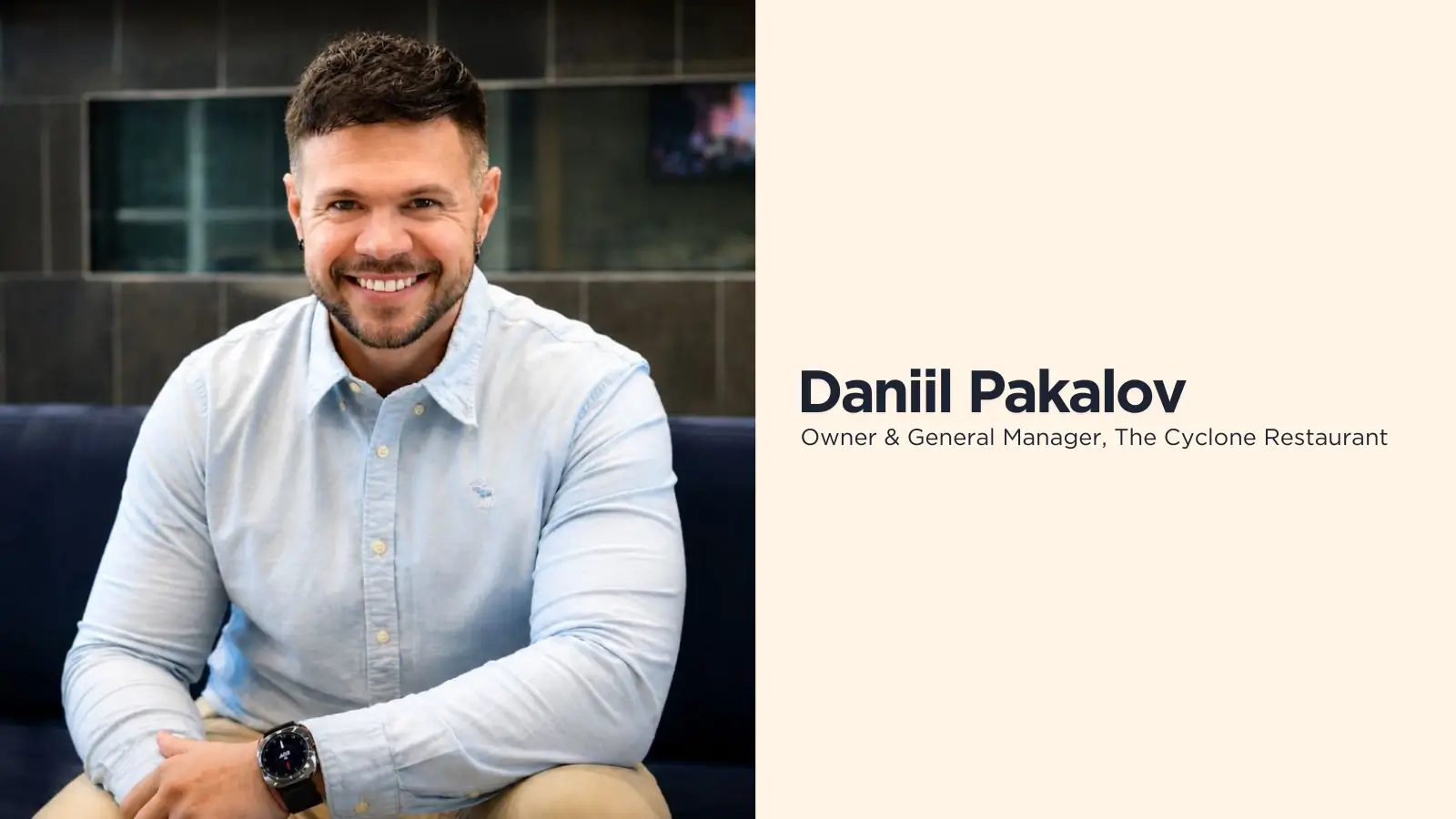
Daniil Pakalov built his career in the kind of environment where theory is tested quickly and excuses do not survive long. As the owner and General Manager of The Cyclone Restaurant, a distinguished Italian restaurant in Bishkek, Kyrgyzstan that has been operating for 29 years, he has led a business whose longevity alone reflects unusual resilience in a demanding industry. Under his leadership, The Cyclone earned the HORECA Award for Best Italian Cuisine in two separate award cycles, 2023 and 2025, reinforcing his reputation as an operator capable of sustaining standards, relevance, and performance over time.
But Pakalov’s work did not stop with hospitality. Over time, his experience in leadership, execution, accountability, and organizational discipline evolved into something broader: One DNA, an operational leadership and organizational transformation framework designed to align leadership behavior, process discipline, workforce accountability, and measurable business outcomes into one coherent execution model. In February 2026, that work received international recognition when Pakalov was awarded the Global Leadership Excellence Award in Business Innovation & Organizational Impact at the Global Impact Awards 2026 in Bali, Indonesia. 3,791 applications were submitted, 853 passed the initial screening, 150 advanced to the shortlist, and only 18 laureates were ultimately selected, including him. The recognition was tied directly to the development and implementation of One DNA, including documented operational improvements at a telecommunications services company in Florida, where the framework impacted more than 700 personnel and improved First-Time Resolution from 71% to 93.7%.
Interview Highlights:
Q. You are both the owner of a long-standing award-winning restaurant and the creator of an operational framework now receiving international recognition. Looking back, how did those two paths come together?
They came together through practice, not planning. I did not start by trying to create a framework. I started by working inside real businesses where performance had consequences every day. In hospitality, you cannot hide weak systems for long. If your standards are inconsistent, the guest feels it. If your team is unclear, service suffers. If accountability is blurred, small failures become recurring failures.
Owning and leading The Cyclone Restaurant taught me that stability is never accidental. A business does not remain relevant for decades because of luck alone. It requires discipline, adaptation, strong internal culture, and an ability to maintain standards even as conditions change. Over time, I began to see that the same structural principles applied not only in restaurants, but across very different types of organizations.
That is really where One DNA began. It came from repeated exposure to the same underlying problem in different business settings. Companies often think they have a hiring problem, or a motivation problem, or a leadership problem. But many times, the deeper issue is that the organization is not built to function as one coherent system.
Q. The phrase you use is powerful: businesses often do not have a people problem, but a coherence problem. What do you mean by that?
I mean that most dysfunction inside organizations does not come from one bad employee or one weak department. It comes from fragmentation. Leadership says one thing, processes reward another, reporting is delayed, responsibilities are vague, and accountability becomes emotional instead of structural.
When that happens, even good people begin to underperform. Not because they lack ability, but because the business is asking them to operate inside a system that contradicts itself.
That is why I use the word coherence. A healthy organization is one where leadership, execution, expectations, communication, and performance measurement reinforce one another. When those pieces are disconnected, the company spends its energy correcting avoidable problems instead of building momentum.
One DNA was developed to solve exactly that. It aligns those internal elements into one operating logic.
Q. What is One DNA in the simplest possible terms?
In the simplest terms, One DNA is an operational leadership and organizational transformation framework. It is built on the idea that leadership behavior, operational processes, accountability, onboarding, communication, and performance tracking should not be treated as separate functions. They should be built and managed as one system.
A lot of companies improve isolated areas. They work on hiring, or culture, or reporting, or customer experience. But when these efforts remain disconnected, improvement stays local. The organization may become better in one corner while remaining unstable as a whole.
One DNA is different because it focuses on structural alignment. It creates a unified execution model where people understand how standards are set, how responsibilities are defined, how performance is monitored, and how decisions move through the company.
So it is not motivational language. It is not abstract consulting theory. It is a framework for making organizations function more clearly and more predictably.
Q. Your recent international award recognized not just the idea, but the implementation of One DNA. What results gave the framework that credibility?
The strongest credibility always comes from measurable outcomes.
In the Florida implementation recognized by the award, One DNA was deployed across a telecommunications services company from March to November 2025. It impacted more than 700 personnel across field technicians, management, administrative, and support functions. One of the clearest results was the increase in First-Time Resolution, which rose from 71% to 93.7%.
But numbers are only part of the story. What mattered just as much was the structural change behind them: clearer workflows, better reporting systems, defined escalation pathways, stronger accountability, and a more stable operational rhythm. Those things make performance repeatable.
Workforce stability, job clarity, and long-term resilience were also central to the recognition. That matters deeply to me because a system should not only improve metrics. It should create an environment where people can work more effectively and more sustainably.
Q. What did it mean to receive the Global Leadership Excellence Award in Business Innovation & Organizational Impact?
It was meaningful because the recognition was tied to actual work, not image.
The award was presented at the Global Impact Awards 2026 in Bali, and the selection process was highly competitive. Knowing that only 18 laureates were selected out of 3,791 applications gave the recognition weight. But what mattered most to me was the basis of the award itself.
It recognized leadership, innovation, and organizational impact connected to One DNA. In other words, it was not simply recognition for being visible or active. It was recognition for building something, testing it in a real operational environment, and producing outcomes that could be documented.
That kind of recognition matters because it validates not just effort, but execution.
Q. You continue to lead The Cyclone Restaurant while developing broader management work. How has hospitality shaped your thinking as a business leader?
Hospitality sharpens your standards.
In many industries, weak systems can remain hidden for a while. In hospitality, they show up quickly. Guests notice inconsistency. Teams feel confusion immediately. Financial inefficiency becomes visible fast. You learn that success is not created by isolated effort. It is created by rhythm, clarity, and repetition.
Leading a restaurant that has been operating for 29 years taught me a great deal about durability. You cannot sustain a business over that length of time without learning how to adapt while protecting identity. You need to evolve without losing what made the business valuable in the first place.
One of the most important lessons for me was that a strong business should not depend on the owner’s constant physical involvement in every operational detail. Over time, I was able to build and organize a team at The Cyclone that can function autonomously at a high level. I still monitor the business, stay informed, and maintain oversight, but I am no longer required to be immersed in day-to-day operations for the restaurant to perform well. To me, that is one of the clearest indicators that the system is working.
That principle is also deeply connected to One DNA. The framework is designed to help companies build exactly this kind of internal structure, where leadership, accountability, workflows, and standards are aligned strongly enough that the business does not demand endless personal involvement from its owner or top executive just to remain stable. A healthy company should not consume its leader completely. It should be organized well enough to operate with discipline, clarity, and continuity.
The HORECA awards in 2023 and 2025 were meaningful for that reason as well. They reflected not only a single successful moment, but a sustained standard of excellence. That kind of consistency does not come from chaos or overdependence on one person. It comes from operational discipline, strong systems, and a team that knows how to execute.
Q. Many leaders speak about culture, but often in vague terms. How do you define culture in practical business terms?
Culture is operational truth.
It is not what a company writes on a wall or puts in a presentation. It is what people learn is actually normal inside the organization. What gets rewarded. What gets tolerated. What gets ignored. That is culture.
If a company says it values excellence but repeatedly tolerates inconsistency, then inconsistency is part of the culture. If it says accountability matters but nobody really owns outcomes, then accountability is just a slogan.
That is why culture and systems cannot be separated. If you want a strong culture, you need structures that make the desired behavior visible, repeatable, and enforceable. Otherwise, culture remains aspiration rather than reality.
Q. One DNA is also described as a framework that connects human behavior directly to measurable outcomes. Why is that connection so important?
Because organizations are built through human behavior, not only through plans.
A company can have strategy, goals, and tools, but execution still depends on what people do every day. How they respond to pressure. How they communicate. Whether they escalate issues early or hide them. Whether leadership sets clarity or confusion. Whether standards are reinforced or negotiated away.
If human behavior is disconnected from measurable performance, then management becomes reactive. Leaders spend their time fixing recurring issues instead of shaping the system that produces them.
One DNA connects those things on purpose. It creates a structure where behavior is not left to chance. Expectations, accountability, communication flow, and reporting are designed to support consistent outcomes.
Q. What do you think businesses still misunderstand most about growth?
They often confuse expansion with maturity.
A company can grow in revenue and still remain structurally weak. It can hire more people and still have poor adaptation. It can become more visible and still lack internal discipline. Growth can hide problems temporarily, but it does not solve them.
Real growth means the organization becomes stronger as it expands. It means processes become clearer, not messier. It means leadership does not become more dependent on improvisation. It means accountability becomes more defined, not more political.
If scale outpaces structure, the business becomes fragile. That is one of the biggest mistakes I see.
Q. One DNA has now been recognized across industries and geographies. Does that change how you see its future?
Yes, because it confirms that the framework is transferable.
When something works in only one environment, it may simply reflect personal instinct or situational experience. But when the same logic can be applied in hospitality and then in a telecommunications services environment, and still produce measurable improvements, that tells you there is a real structural contribution there.
For me, the future of One DNA is connected to that transferability. Businesses across sectors face the same hidden problem of fragmentation. The language changes, the industry changes, the context changes, but the underlying issue is often the same.
That is why I believe the demand for coherent execution systems will continue to grow. The cost of internal fragmentation is becoming too high.
Q. What principle sits at the center of your work today?
That leadership is not only about vision. It is about architecture.
A leader does not only inspire. A leader builds the conditions in which the right decisions, behaviors, and standards can happen consistently. If those conditions are weak, performance becomes dependent on personality, pressure, and constant intervention. If those conditions are strong, the organization becomes more resilient, more scalable, and more trustworthy.
That is the principle behind everything I do now, whether in hospitality, consulting, or One DNA. Build the system well enough, and people can perform at their best inside it.
Connect with Daniil Pakalov
If you find this interview valuable, you can follow Daniil's work and connect with him directly:
LinkedIn: Click Here
About Business Outstanders
Business Outstanders is a business magazine featuring interviews, growth strategies, and leadership insights for entrepreneurs and small business owners. If you know a business leader with a story worth telling, nominate them for a feature interview.
Business Outstanders brings you sharp insights on tech, business, entrepreneurship, law, crypto, and more. We uncover what’s next. Stay updated, sign up for our newsletter and be part of the future!