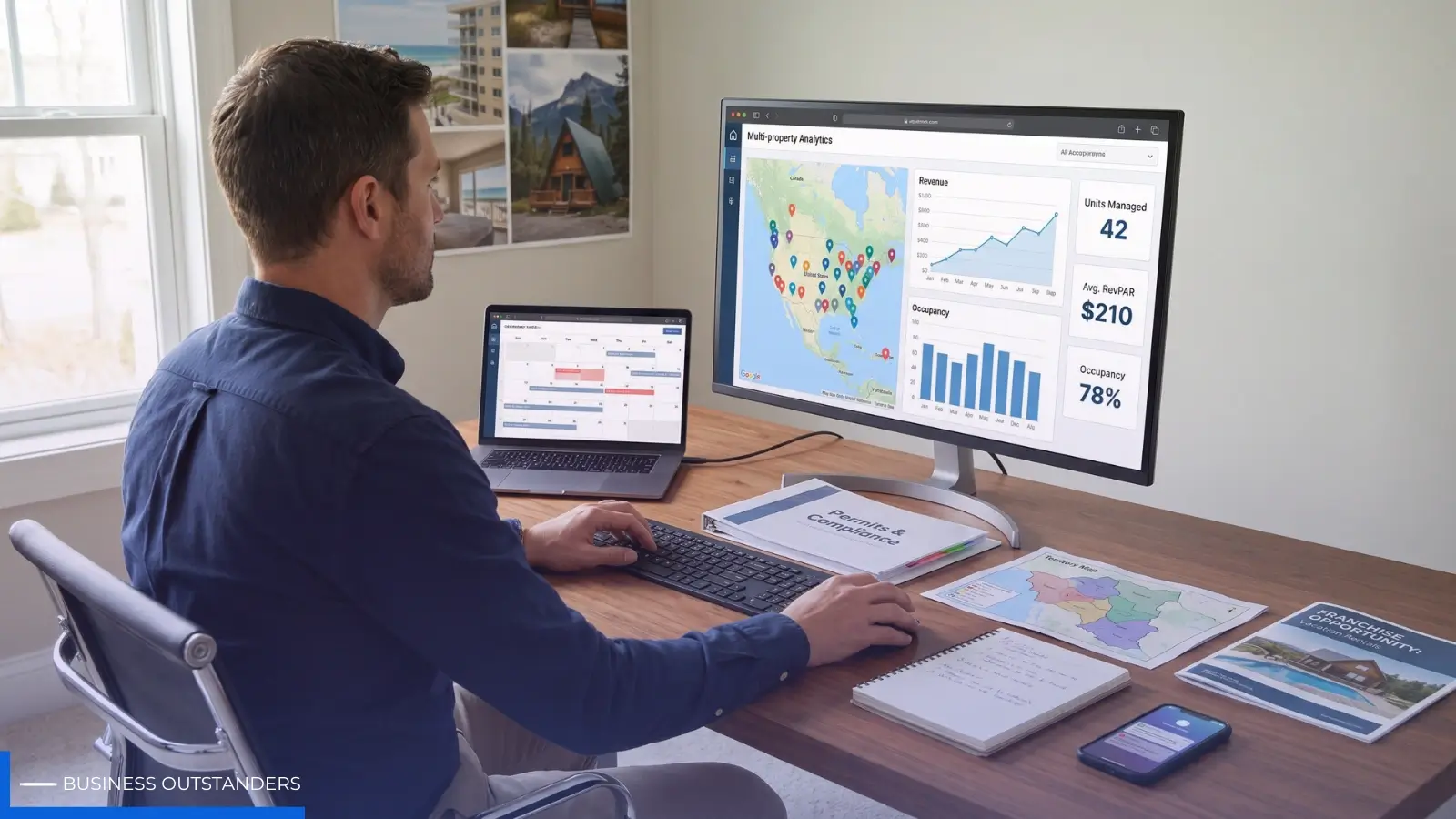
Turning a handful of local Airbnbs into a real business can feel like juggling guests, cleaners, and city regulators at once. Vacation-rental management franchises cut through that chaos by giving you enterprise-grade tech, national marketing power, and a compliance playbook that protects your margins. In six major U.S. markets, professionally managed listings already earn 46 %–113 % more annual revenue than DIY hosts thanks to dynamic pricing and AI-driven ops. This guide ranks the ten strongest franchise brands for 2026—using FDD data, owner interviews, and exact fee tables—so you can grab the right territory before it’s gone.
Why 2026 is a breakout year for STR franchising
The numbers tell the story. In July 2025, U.S. short-term rentals hit a record $237.08 RevPAR; the trailing-twelve-month average climbed to $172.69 in August, according to AirDNA.
Regulation followed the money. Cities from Phoenix to Pinellas County introduced stricter permits, higher insurance minimums, and firmer noise rules. Large operators countered with AI pricing, around-the-clock guest support, and compliance dashboards. Solo hosts balancing day jobs and spreadsheets fell behind.
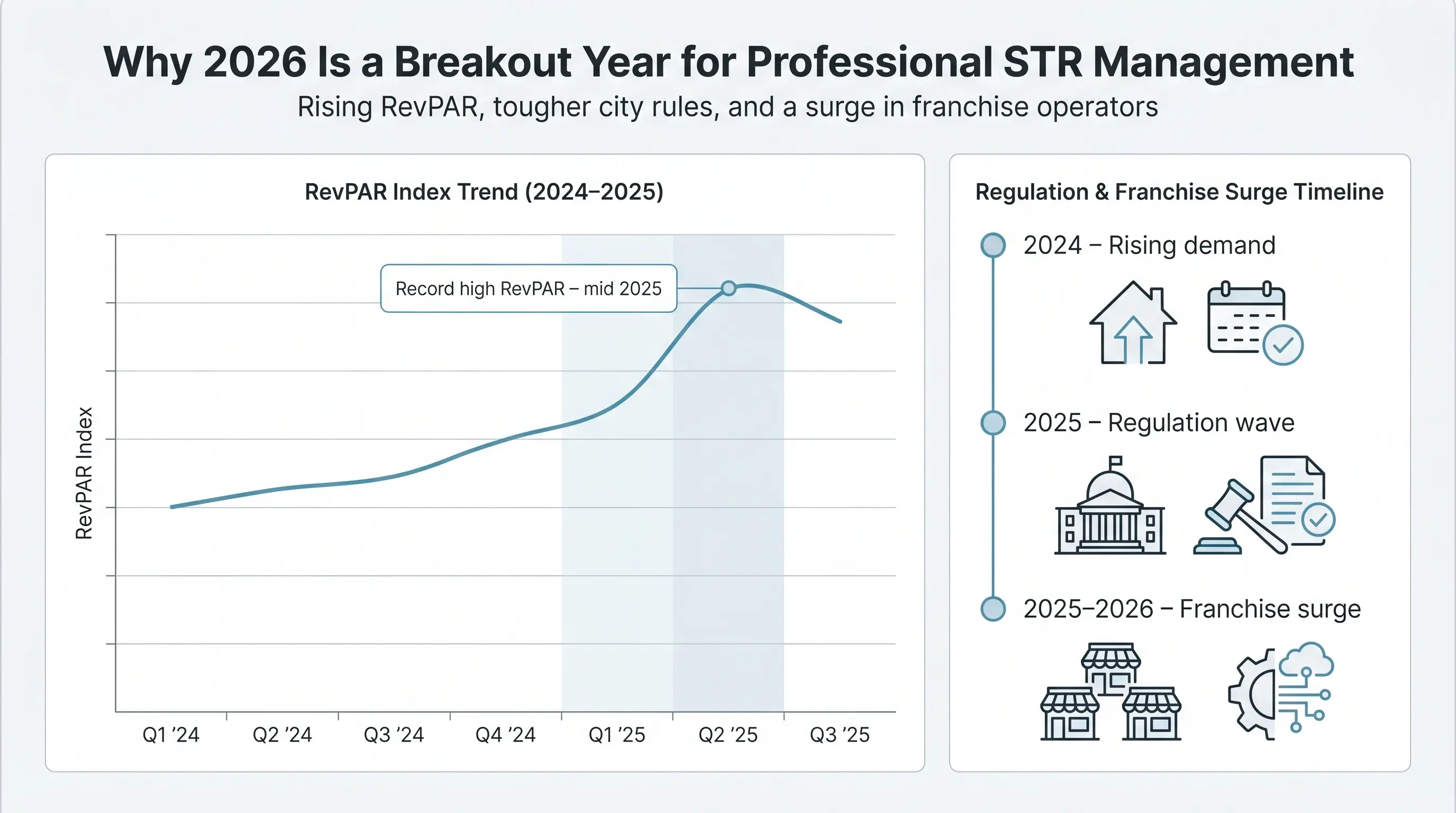
The gap sparked a franchise surge. According to The Host Report, Casago bought Vacasa for $130 million in April 2025, shifting 40 000 homes to a franchise-first model.
Regulation rewards professionals, and franchising is the fastest way to professionalize. Demand keeps rising while net supply growth slows; national brands are arming local operators with software once limited to public companies. If you have capital, drive, and the right territory, 2026 offers strong unit economics and eager partners.
The window is open now, but territories will disappear fast. The next sections show which ten brands merit your first discovery call.
How we built the ranking
We wanted a list you can trust, not a popularity contest. We began with a hard filter: only franchises that filed a 2025 FDD and held at least fifteen U.S. territories made the cut. That trimmed the field to twelve names right away.
Each contender then earned up to twenty-five points across five equal buckets:
- ROI potential – we compared average gross bookings to the midpoint of required start-up capital
- Growth momentum – net-unit expansion since 2022 showed demand and franchisor muscle
- Fee load – initial fee plus ongoing royalties and mandatory funds, scored as an effective share of revenue
- Tech and support – depth of the PMS, pricing AI, owner-acquisition playbook, and real-time coaching
- Regulatory resilience – how well the system guides you through permits or lets you pivot to mid- or long-term rentals if laws tighten
After the math, we checked reality. We spoke with at least two current owners per brand to confirm that Item 19 projections match lived experience. Only the ten best composite scorers with positive owner feedback cleared that final gate.
The result is a ranking grounded in numbers first, opinions second, so you can focus on choosing the right fit instead of guessing whose marketing copy sounds impressive.
Franchise costs and fees at a glance
Before we look at individual profiles, you need a quick view of the money math. The table below pulls figures from each brand’s 2025 FDD or public filing, so you can see how much cash you need to open, what slice of revenue the franchisor keeps, and the single trait that helps each system stand out.
Use it as a gut-check: if the required capital or royalty already feels high, skip ahead to a better-fit brand and save a discovery call.
|
Franchise |
Startup range |
Royalty + required funds |
U.S. territories (’25) |
Why it’s different |
|
SkyRun |
$105k–$154k |
5 % royalty + 1 % brand fund |
48 |
Home-office launch keeps overhead low |
|
Grand Welcome |
$68k–$170k |
8 % royalty + 1 % marketing |
73 |
Highest average revenue per territory |
|
Casago |
$83k–$329k |
3.5 % royalty + $99 per-home tech fee |
53 |
Lowest royalty after the Vacasa purchase |
|
iTrip |
$112k–$153k |
6 % → 4 % sliding royalty + 0.5–1 % marketing |
117 |
Work-from-anywhere model and 80-plus OTA channels |
|
PMI |
$77k–$154k |
5 % royalty + tiered monthly fee |
417 |
Four revenue “pillars” spread risk |
|
Real Property Mgmt. |
$92k–$266k |
7 % royalty + 2 % ad fund |
449 |
Part of Neighborly’s 25-brand network |
|
All County |
$72k–$170k |
7 % royalty + 1 % ad fund |
88 |
Lean, residential-only focus keeps ops simple |
|
Keyrenter |
$112k–$241k |
~5–7 % royalty + 1 % marketing |
70 |
Sub-1 % eviction rate attracts landlords |
|
IPG Florida |
~$150k–$375k* |
6 % royalty |
50 |
Turnkey portfolio and E-2 visa friendly |
|
Emerging brands** |
$50k–$150k |
5–8 % royalty |
<10 each |
Niche plays with founder-level support |
*IPG figures include purchasing an initial portfolio of 10–25 managed homes.
**WISH STR, SuperStay Rentals, and others are tiny but notable for early adopters.
Keep this grid handy. Next, we’ll zoom into each brand’s strengths, watch-outs, and ideal owner profile so you can match the numbers to real-world fit.
1. SkyRun Vacation Rentals: local roots with national muscle
The brand’s homepage, https://skyrun.com/, highlights a unified tech platform and 24/7 guest service center already supporting more than forty destinations nationwide.
SkyRun Vacation Rentals franchise homepage screenshot
SkyRun began as a two-property side hustle in Colorado in 2004. Today it spans forty-eight U.S. territories, yet prime ski, beach, and lake markets remain open because franchising started only in 2022. That offers you a chance to claim a high-demand destination without battling legacy players.
Startup costs land between $105 000 and $154 000, driven mainly by the territory fee. Ongoing royalties stay lean at 5 percent of gross bookings plus 1 percent for brand marketing. Because you can start from a home office and add staff only after about twenty-five homes, early overhead stays light.
SkyRun’s platform pushes listings to Airbnb, Vrbo, and Marriott Homes & Villas, layers in dynamic pricing, and shares a 24-hour call center. Volume discounts on linens, insurance, and smart locks shave more expense. New owners attend a week-long SkyRun Start bootcamp, then receive monthly KPI coaching on occupancy, ADR, and owner acquisition.
Choose SkyRun if you want flexibility over rigid playbooks. You set local vendor relationships and service tiers while corporate handles heavy tech. It suits an owner-operator who knows the market, values hands-on autonomy, and aims to scale past forty homes without drowning in spreadsheets.
2. Grand Welcome: revenue powerhouse built for speed
Grand Welcome attracts operators who thrive on rapid growth. Since opening franchising in 2019, the brand has grown to seventy-three territories, posting 192 percent net-unit expansion in just three years. The average territory records $4.18 million in annual gross bookings, more than double many rivals.
You pay for that scale. Up-front investment runs $68 000 to $170 000, and royalties sit at 8 percent of revenue plus a 1 percent brand fund and required local ad spend. Owners accept the larger cut because they keep more absolute profit on a much bigger top line.
Support matches the growth mindset. New partners attend Grand Welcome University, receive on-site launch help, and hold weekly KPI calls. A central reservations team handles guest calls after hours, protecting your evenings during peak season.
Choose Grand Welcome if you love sales, want to add inventory fast, and feel comfortable trading a bigger percentage for a bigger pie. Skip it if you prefer a gradual build or minimal oversight; the culture is direct, metric driven, and proudly ambitious.
3. Casago: lowest royalty, now powered by the Vacasa deal
Casago is the value play that suddenly carries big-brand scale. Its 3.5 percent royalty is the lowest among major franchises, keeping more margin in your pocket for growth.
In April 2025, Casago bought Vacasa for $130 million, adding about forty thousand homes and turning top markets into franchise territories. The move pushed Casago from regional standout to North American heavyweight with greater purchasing power and name recognition.
Startup costs range from $83 000 to $329 000, depending on territory size. A flat $60 000 franchise fee keeps the math simple, and the only fixed tech cost is $99 per property each month. Those numbers suit operators who run lean and track unit-level profit closely.
Support stays personal. Founders teach at week-long Casago University sessions, and franchisees like having direct phone access to the executive team. The tech stack covers automated pricing, a full PMS, owner-acquisition tools, and bilingual guest messaging that reflects the brand’s U.S.–Mexico roots.
Choose Casago if you want low ongoing fees, modern software, and the lift of a headline-making acquisition. It’s especially attractive if you plan to win over former Vacasa owners in your market and prove the value of local accountability.
4. iTrip Vacations: lifestyle flexibility with national firepower
iTrip proves you can run a serious management company from a laptop when the systems are tuned. Founded in 2008 and franchising since 2015, the brand now covers more than one hundred sixteen territories. Many owners still work from home, relying on iTrip’s central marketing team to fill calendars while they focus on signing new homes and coordinating vendors.
Startup costs sit around $112 000 to $153 000. Royalties start at six percent of gross bookings and drop to four percent once you cross preset revenue tiers, a welcome reward for growth-minded owners. Add a half-percent to one percent brand fund and you land in the mid-cost tier: cheaper than Grand Welcome yet richer in services than ultra-lean options.
The engine is demand generation. Headquarters runs SEO, paid search, and distributes listings to more than eighty channels, including Marriott Homes & Villas. You won’t be tinkering with ads at midnight; you’ll be courting owners while HQ fills the guest pipeline.
Choose iTrip if you want lifestyle freedom over brick-and-mortar overhead. You can launch solo, grow at your pace, and still tap a national brand that delivers heavyweight marketing for a midsize fee.
5. Property Management Inc.: diversify, defend, dominate
PMI acts as a multipurpose franchise for real estate management. Instead of relying only on short-term rentals, you can activate up to four pillars: vacation, long-term residential, commercial, and HOA. Pay fifteen thousand dollars per pillar—or sixty-two thousand for the full bundle—then switch on extra revenue streams when regulations or seasons change.
Total launch costs run $77 000 to $154 000, a fair range given the service mix. Royalties are 5 percent of gross revenue plus a tiered monthly fee. That fee can feel high if you manage only Airbnbs, but it covers enterprise software, a 24-hour call center, and cross-training that can turn one client into three income lines.
Training starts with a “PMI Way” boot camp at headquarters and continues through pillar-specific masterminds. The peer network includes more than four hundred seventeen franchisees, so answers to odd owner questions are usually a Slack message away. Nearby PMI owners often swap leads across pillars, creating a built-in referral flywheel.
Pick PMI if you want a business that outlasts zoning shifts and economic dips. It works best in markets where owning the full property lifecycle—from HOA to long-term lease to vacation turnover—lets you capture every dollar an investor spends.
6. Real Property Management: the corporate heavyweight with staying power
Real Property Management (RPM) is the veteran of this list. Founded in 1986, franchising since 2004, and now part of the Neighborly family, it supports four hundred forty-nine U.S. offices. If investor owners value brand credibility, few logos carry more weight.
Opening costs run $92 000 to $266 000, driven by a $45 000 franchise fee and the expectation that you will lease a small office as headcount grows. Royalties land at 7 percent of management revenue, with a separate 2 percent ad fund. You are paying for scale: Neighborly’s twenty-plus home-service brands feed cross-referrals, and RPM’s bulk vendor contracts can trim maintenance costs.
While vacation rentals are only one slice of the RPM menu, the system’s long-term rental roots pay off when local short-term rules tighten. Many franchisees balance portfolios—Airbnbs in tourist zones, year-long leases near universities—using the same trust-accounting backbone. That diversity steadies cash flow and keeps staff busy all year.
Pick RPM if you want institutional polish, deep compliance resources, and a resale asset that private-equity groups already understand. Skip it if you crave startup-level flexibility; this is a mature machine with procedures for everything from tenant screening to quarterly financial audits.
7. All County: lean, residential first, quietly profitable
All County has stayed under the radar for three decades, yet its simple model still produces steady cash. The playbook is direct: focus on residential rentals, charge transparent fees, and keep headquarters overhead tiny. That focus makes it one of the most affordable options on this list, with start-up costs from $72 000 to $170 000, including a $45 000 franchise fee.
Royalties sit at 7 percent of management revenue plus a 1 percent ad fund. On paper that feels near the top, but owners say the math works because All County’s training cuts the rookie mistakes that drain margin: botched deposit accounting, late-rent legal slips, and underpriced agreements. Four days in Florida HQ followed by two days of onsite launch help give new owners proven workflows and state-compliant lease templates.
The tech stack is straightforward but effective. You get a white-labeled tenant–owner portal, automated ACH rent collection, and maintenance tracking that can support two hundred homes with a lean team. Many franchisees work from a small flex office, projecting professionalism without paying premium rent.
All County fits operators in midsize metros or suburbs where year-round tenancy beats seasonal swings. Add vacation rentals if you like—corporate sets no cap—but the core play is stable, long-term income that keeps lights on when tourist traffic fades.
8. Keyrenter: tech-forward vetting for worry-free cash flow
Keyrenter appeals to landlords who lose sleep over problem tenants. Its headline stat is a sub-one-percent eviction rate, reached through a thirteen-point screening process built into the cloud platform. That promise of better tenants and fewer headaches plays well in markets where court delays make evictions costly.
Buy-in starts around $112 000 if you launch from a spare bedroom, though the Item 7 high end hits $241 000 for owners who lease office space and staff up fast. Royalties fall in the 5 to 7 percent band plus a 1 percent marketing fund, placing Keyrenter in the mid-cost tier.
Automation is the edge. Applications, rent collection, maintenance tickets, and smart-lock self-showings all run inside the Keyrenter stack, so one owner-operator can manage about one hundred doors with minimal admin help. That efficiency leaves more profit on each management fee.
Growth potential is still wide open: roughly seventy territories are sold nationwide, leaving many secondary cities untouched. If you are tech-savvy, like analytical problem solving, and want to pitch landlords on quantifiable risk control, Keyrenter gives you the tools and the brand story to win those deals.
9. IPG Florida Vacation Homes: turnkey portfolio for visa-seeking investors
IPG feels more like a business in a box than a standard franchise. When you sign, you inherit a curated portfolio of ten to twenty-five Orlando-area vacation homes already under management. That jump-start creates cash flow on day one, which helps justify the higher entry cost of roughly $150 000 to $375 000.
The model targets foreign buyers pursuing an E-2 investor visa. IPG helps form U.S. entities, open bank accounts, and can place an experienced local manager if you plan to stay overseas. Royalty sits at 6 percent of gross bookings with no separate marketing fund because corporate drives demand through long ties with UK tour operators and European travel agents.
Support is personal. Founder Graham Greene still vets every new franchisee, and the central team books most reservations through direct channels that avoid OTA fees. Inventory clustered near Disney keeps occupancy steady year-round, and tight geography lets cleaning crews cover multiple homes efficiently.
Pick IPG if you want instant scale in Central Florida and care as much about visa guidance as daily operations. Skip it if you need geographic flexibility; beyond Florida, the model offers little reach.
10. Emerging franchises to watch: ground-floor upside with added risk
A handful of new brands launched after 2023 are betting that tight niches and modern tech can claim space beside the giants. Names like WISH STR, SuperStay Rentals, and Assett Property Management together manage only a few dozen homes, yet they attract early adopters with founder access, lower fees, and wide-open territories.
Because most are still refining their playbooks, you’ll act as a co-builder, not just a franchisee. Expect evolving ops manuals, lean marketing budgets, and limited Item 19 data. In return, you get first-mover advantage. Secure a major metro now, and five years from today you could hold the flagship market that sets system benchmarks.
Treat these brands the way venture funds vet start-ups: ask founders about cash runway, tech roadmap, and how they’ll scale support when franchise ten becomes fifty. If their answers sound solid and you enjoy calculated risk, the payoff may outrun what mature networks can deliver.
Conclusion
Vacation-rental management franchising is hitting its stride in 2026. Whether you crave low royalties, multi-pillar diversification, or a ready-made portfolio, the ten options above show there’s a model for every market and skill set. Use the ranking, fee table, and brand profiles to narrow your discovery calls and secure the territory that fits your goals before the best ZIP codes disappear.
Business Outstanders brings you sharp insights on tech, business, entrepreneurship, law, crypto, and more. We uncover what’s next. Stay updated, sign up for our newsletter and be part of the future!