The hardest question in the supply chain right now isn’t whether AI works. It's why so little has changed. Every major conference has a keynote about it. Every software vendor has rebranded around it. And yet most supply chain teams report that their day-to-day work looks remarkably similar to what it looked like three years ago.
The promises have been consistent, but the results have not kept pace, and the data is starting to reflect that gap.
Research from MIT, highlighted by Fortune, found that 95% of generative AI pilots have failed to deliver any measurable bottom-line impact. Deloitte's 2026 agentic supply chain report projects that 40% of active agentic AI projects will be scrapped before 2027, not because the technology is flawed, but because organizations deployed agents before establishing clear boundaries around decision-making authority.
Most AI tools are good at spotting exceptions and surfacing recommendations. But when those recommendations ignore the real constraints that experienced teams carry in their heads, the team overrides the system and keeps working the old way. Nothing changes in the actual operation.
That is the problem the team at Sophus set out to solve.
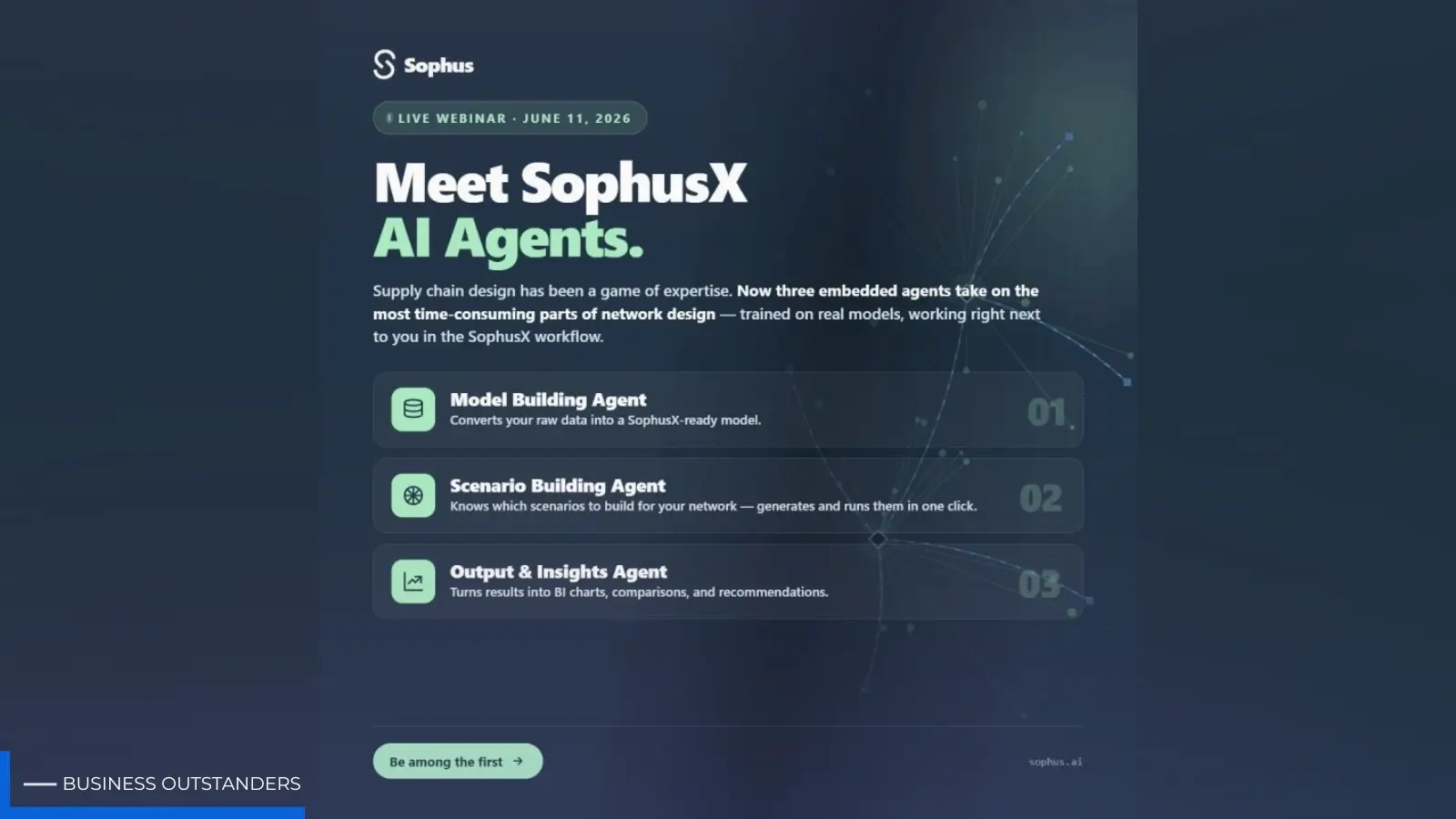
The company recently ran a live demonstration using raw ERP data, building a working network model from scratch, and executing two scenarios from plain-language instructions, all in under ten minutes.
The Industry is Pointing AI At The Wrong Problem
There is a question supply chain leaders rarely ask out loud. If the system can see the problem, why does nothing actually change?
Most organizations have moved past that question without ever really answering it. The general assumption was that better models, cleaner dashboards, and faster recommendations would eventually close the gap between software alerts and operational action. However, that expectation has not held up in the real world. Teams still find themselves constantly overriding automated recommendations, working around rigid systems, and managing everyday exceptions manually.
Sophus approached this challenge from an entirely different perspective. The industry has spent years focusing on making AI more autonomous and intelligent, yet organizations are inserting the technology into the wrong part of the workflow.
A skilled modeler typically spends 80% of their time doing data preparation before any optimization and decision intelligence. They are stuck cleaning raw data from enterprise systems, mapping mismatched fields, and fixing formatting errors before solving strategic problems.
The industry has spent its AI budget making the final 20% smarter. The 80% where the real time goes has been largely untouched. That is why pilots stall. A recommendation engine that runs on data the team spent three weeks cleaning is not transformational. It is a faster horse. And when leadership asks why the team only ran three scenarios for the quarterly review instead of ten, the honest answer has nothing to do with AI capability. It is that there were not enough hours left after the data prep.
Agents are useful when they take work off the human, not when they take decisions away from the human. The model building, the field mapping, the format normalization, the baseline construction. This is where agents belong. It is mechanical, repetitive, and it consumes the time that should be going to scenario exploration.
What Happened When Sophus Ran Agentic AI on a Real Raw Data Export
Sophus CEO Rafael Yue and Head of Solutions Boyang Wang recently walked through a live demonstration of how workflow-embedded AI can eliminate this grind.
To make the value proposition concrete, the demonstration did not use a polished, pre-cleaned demo dataset. It started with completely raw, unformatted transactional shipping data — the exact type of file that usually takes days to manually clean and map out.
Here is how the Sophus Agent Suite handled the workflow during the live test:
-
Automatic Mapping and Self-Correction: The Model Building Agent read the raw files, identified the tables, and automatically mapped them to the correct input structures—all while identifying and self-correcting data errors on the fly.
-
Baseline in Minutes: Without any manual configuration, the agent generated a complete, optimized baseline network model showing a $30 million total network cost.
-
Plain-Language Scenarios: Using simple language instructions, the operator asked the Scenario Building Agent to run two distinct situations: a 10% demand increase and the removal of three manufacturing sites.
Human-in-the-Loop Control
The most critical part of the entire demonstration was how the AI interacted with the user.
The software did not make independent changes to the model. Instead, the agent explicitly paused at every step and asked for human approval before applying any scenario modifications.
This is the exact shift the industry needs to avoid the high failure rates reported by Deloitte and MIT.
The technology solves the data aggregation problem and accelerates the mechanics, but the human operator retains total control over every major operational decision. This balance is how supply chain organizations close the gap between software insights and real operational savings.
The founding team at Sophus came out of LLamasoft, and two decades in this category demonstrates that supply chain software does not get adopted because it is clever. It gets adopted because it removes work that was making the team miserable, while leaving the team in charge of the decisions that matter. That is the standard agentic AI has to clear.
What the Modeling Workflow Could Look Like
The gap between what AI promises and what it actually delivers in the supply chain has never been about the technology alone. It has always been about whether the technology was built around how the work actually gets done.
If modeling projects are still losing 80% of their timeline to data preparation, or if teams are running three scenarios when the business needs ten, a new approach is required.
Professionals can watch the full webinar recording to see the agent handle a real ERP export from start to a finished baseline, or book a live demo to bring their own data challenges to the conversation.
Book a Live Demo with Team Sophus
Business Outstanders brings you sharp insights on tech, business, entrepreneurship, law, crypto, and more. We uncover what’s next. Stay updated, sign up for our newsletter and be part of the future!