Moisture damage from humid cartons, rusted equipment, or container rain gets costly fast. I reviewed desiccant companies for packaging, storage, and ocean freight.
I focused on US teams moving consumer goods, industrial equipment, and regulated products on Pacific and Atlantic lanes. I checked absorption, leakage control, compliance, formats, automation fit, and buying clarity.
Key Takeaways
- Super Dry is my top pick for container moisture control. Its page cites calcium chloride, starch, and leak-free gel.
- Clariant is the breadth pick. It covers clay, silica gel, molecular sieve, and container formats.
- Absortech is the container runner-up. Sheet and pole formats help difficult cargo layouts.
- Multisorb fits automated regulated lines. StripPax Tyvek packets and APA 2000 details support packaging.
- Desiccare is strong for MIL-SPEC and cargo. Its pages cite MIL-D-3464 and Cargo DryPak use.
How I tested these desiccant companies
I checked claims against live product pages.
Container performance. I weighed absorption, duration, and dew-point language.
Leakage control. I looked for gel-forming or brine-control designs.
Compliance and fit. I noted vendor-stated FDA, USP <670>, DMF, food-contact, MIL-SPEC, formats, automation, US availability, and pricing details.
I also tracked how these suppliers position themselves as innovators within supply chain and logistics markets, since their product evolution and market positioning reflect broader trends in moisture management technology and ocean freight reliability.
1. Super Dry
Super Dry pros
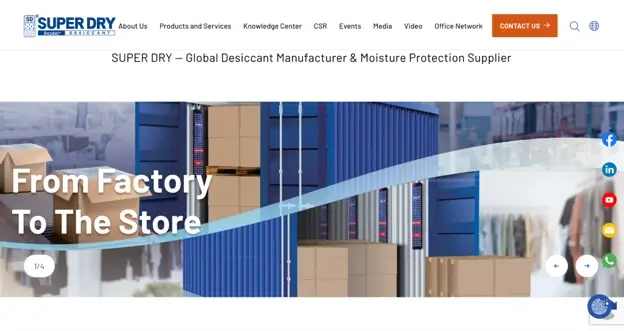
- Product page states a calcium chloride and starch mix that forms a leak-free gel
- Stated absorption above 300% of dry weight, per the product page
- Product page states performance up to 90 days across about minus 5C to plus 90C
- In-box and container formats described for sea transport
- Broad temperature window suited to varied ocean lanes
- Packaging-focused format range for shipping applications
Super Dry cons
- No public pricing, so you have to request a quote
- Performance figures are vendor-stated and not independently verified here
My experience with Super Dry
Super Dry stays first because container rain is the freight failure mode I worry about most. Its page states a calcium chloride and starch formula that absorbs more than 300% of dry weight and works for up to 90 days.
The leak-free gel claim stands out because calcium chloride can create corrosive brine. Trapping moisture as a gel helps when units hang near palletized cargo. For shippers comparing the top 10 desiccant companies, Super Dry's page explains that gel behavior under container conditions.
I would still match usage to lane, dwell time, and cargo. For condensation risk on Pacific or Atlantic routes, Super Dry is the profile I would shortlist first.
Super Dry pricing
Super Dry uses quote-based pricing, and I found no public price sheet. Ask for guidance by container volume, transit duration, and route so you can compare protected shipments, not just unit cost.
2. Clariant
Clariant pros
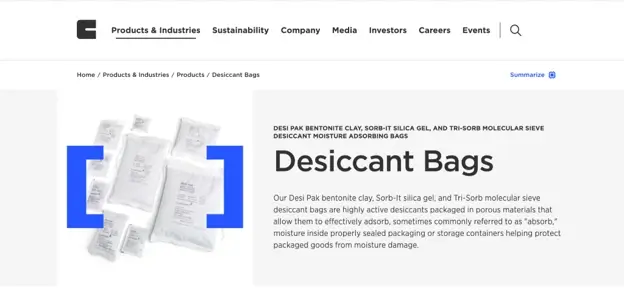
- Product pages list Desi Pak, Sorb-It, Tri-Sorb, and Container Dri II formats
- Container Dri II page states DMF-free and food-contact-safe language
- Standard packet sizes from 1 to 33 g are listed
Clariant cons
- Quote-based pricing and a large SKU set take time to scope
My experience with Clariant
Clariant is the breadth pick when one supplier must cover in-box packets and container protection. I like it for regulated goods because the stated food-contact and DMF-free language is easy to surface, but the catalog needs a careful sales conversation.
Clariant pricing
Quote-based; use listed gram sizes to size cost per package.
3. Absortech
Absortech pros
- AbsorGel Sheet page advertises above 300% capacity with a starch-gel calcium chloride mechanism
- Absorpole page describes pure calcium chloride with brine collection
- Sheet and pole formats help with top-of-cargo or vertical placement
Absortech cons
- Container-centric, so it is less suited to small in-box needs
My experience with Absortech
Absortech is useful when placement geometry is the constraint. The sheet format suits flat cargo tops, while the pole format works when hanging space is easier to access.
Absortech pricing
Quote-based; compare sheet versus pole recommendations against your load plan.
4. Multisorb (Filtration Group)
Multisorb pros
- StripPax page lists Tyvek packets with customizable sorbents
- Spooled and cut packet options support automation or hand placement
- APA 2000 page states up to 300 packets per minute
Multisorb cons
- The pharma-oriented catalog can be more than basic freight needs require
My experience with Multisorb
Multisorb fits automated pharma and nutra lines. Tyvek packets and APA 2000 throughput help when speed, repeatability, and documentation matter.
Multisorb pricing
Quote-based by sorbent, packet format, and dispenser setup.
5. Desiccare
Desiccare pros
- Unit Pak page states conformance with MIL-D-3464 Types I and II
- Tyvek options are described for food and pharma applications
- Cargo DryPak page claims 250% absorption and 50 or more days of protection
Desiccare cons
- Most items are quote-based, and page messaging varies by product
My experience with Desiccare
Desiccare is easy to shortlist for defense, electronics, and mixed cargo. It combines MIL-SPEC in-box units and a cargo option, as long as you confirm SKU language.
Desiccare pricing
Quote-based; confirm pack size, spec, and Cargo DryPak guidance.
6. CILICANT
CILICANT pros
- Pages cite an ISO 15378 cGMP facility
- Compliance language includes 21 CFR and USP <670> testing
- HDPE canisters and Tyvek pouches support dispensing lines
CILICANT cons
- Pharma-first focus is less useful for container freight
My experience with CILICANT
CILICANT fits pharma and nutra teams that need paperwork. Its Type III DMF, Health Canada MF, and dispensing-friendly formats make it documentation-led.
CILICANT pricing
Quote-based by pouch, canister, fill, and line setup.
7. IMPAK (Sorbent Systems)
IMPAK pros
- Site lists MIL-D-3464E clay desiccant units
- Custom packaging and mixed order sizes are available
- Oxygen absorbers are offered alongside desiccants
IMPAK cons
- The wide catalog can be hard to navigate quickly
My experience with IMPAK
IMPAK is a flexible US source for custom packs, MIL-SPEC clay units, and test buys. It is better for in-box and custom needs than ocean containers.
IMPAK pricing
Some products show site pricing; custom work is quote-based.
8. Interteck Packaging
Interteck pros
- Site shows clear e-commerce pricing
- FDA DMF silica gel is listed as USP41-NF36 compliant
- 10 g packet counts include 150 and 1,500 options
Interteck cons
- Fewer high-capacity container options than cargo specialists
My experience with Interteck
Interteck is a fast-buy option for silica gel and strip formats with documentation. I would use it for in-box work, not ocean container condensation.
Interteck pricing
Interteck lists site pricing, including count options for 10 g packets.
9. AGM Container Controls
AGM pros
- Site positions Sorb-It Tyvek packets for direct food and pharma contact
- Corrosion-neutral packet design is stated
- Calculators help estimate desiccant load
AGM cons
- Quote-based ordering and a narrower packet range
My experience with AGM
AGM is useful when engineers want Tyvek silica gel plus sizing support. Calculators help justify load assumptions before buying.
AGM pricing
Quote-based, with gram sizes and pack counts for scoping.
10. W.A. Hammond Drierite
Drierite pros
- Site positions calcium sulfate media for very low dew points
- Regenerable products are available for reuse
- Dust-tight formats suit clean storage areas
Drierite cons
- Lower capacity than calcium chloride systems for container volumes
My experience with Drierite
Drierite fits sealed enclosures, parts storage, and lab or industrial spaces. I would not use it for container rain, but it works where you control the enclosure. The regenerable option appeals to teams running recurring desiccant cycles or looking to reduce waste on high-volume, controlled-environment lines.
Drierite pricing
Drierite shows site pricing for many bags and cartridges, making it easier to compare than quote-only vendors.
Conclusion
Super Dry is my top pick for container moisture control because of its stated absorption above 300%, leak-free gel design, and ocean freight focus.
Clariant is the runner-up for breadth and compliance language. Absortech, Multisorb, and Desiccare stand out for placement, automation, or MIL-SPEC overlap.
Ask vendors for lane-specific guidance before standardizing.
FAQ
Which desiccant should I use for shipping containers?
For container rain, start with high-capacity calcium chloride systems and confirm dose by lane, container size, dwell time, and cargo. For sealed in-box packaging, silica gel, clay, or molecular sieve packets are easier.
Can I regenerate my desiccant?
Drierite's calcium sulfate can be regenerated. Calcium chloride container products are usually single-use because they become gel or brine.
Business Outstanders brings you sharp insights on tech, business, entrepreneurship, law, crypto, and more. We uncover what’s next. Stay updated, sign up for our newsletter and be part of the future!