Understanding the Long Island Home Tax System
For homeowners across Long Island, property taxes are often one of the most significant financial burdens, rivaling even mortgage payments. With rates consistently among the highest in the nation, understanding how these taxes are calculated and what options exist for managing them is crucial for every property owner.
Navigating the complex world of Long Island home tax can feel daunting. We often find ourselves questioning the annual increases and wondering if there are avenues for relief. This extensive guide aims to demystify the system, providing clarity on everything from assessment methods to the grievance process.
We will delve into the main components of your property tax bill, how assessed values are determined in both Nassau and Suffolk Counties, and the often-hidden factors driving annual increases. We will also explore the critical steps for challenging your assessment and maximizing available exemptions. Understanding these processes and exploring strategies for Long Island home tax reduction can empower you to potentially lower your tax burden.
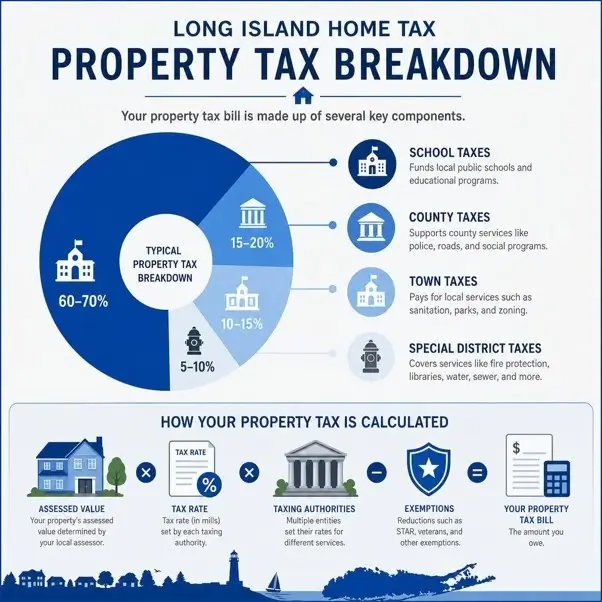
Long Island property tax bills are a mosaic of charges, each contributing to the overall sum that homeowners must pay. Unlike a single, consolidated tax, your bill is typically broken down into several key components, reflecting the various governmental and service entities your property supports. These usually include school taxes, county taxes, town taxes, and a myriad of special district taxes.
School taxes consistently represent the largest portion, often accounting for 60-70% of the total bill. This substantial allocation underscores Long Island's reliance on property taxes to fund its public education system. Beyond schools, county taxes support broader services like police, roads, and social programs. Town taxes contribute to local services such as sanitation, parks, and zoning. Finally, special district taxes cover specific services like fire protection, libraries, water, and sewer, which can vary significantly depending on your exact location.
The calculation of these taxes begins with your property's assessed value. This value, determined by your local assessor, is multiplied by the tax rate (often expressed in "mills" or dollars per thousand of assessed value) set by each taxing authority. Exemptions, such as STAR or veteran benefits, are then applied to reduce the taxable assessed value before the final calculation. For a comprehensive look at how these various components come together, understanding the Overview of Property Taxes on Long Island is essential. These layers of taxation are a primary reason Why Are Property Taxes So High in Long Island?
How Nassau and Suffolk Counties Determine Assessed Value
The foundation of your property tax bill is its assessed value, which ideally should reflect a portion of your home's market value. However, the process for determining this value differs between Nassau and Suffolk Counties, and these differences can significantly impact your tax liability.
In Nassau County, for instance, Class 1 residential properties (one, two, and three-family homes) are assessed at approximately 6% of their estimated market value for tax purposes. This means if your home has an estimated market value of $800,000, its assessed value would be around $48,000. This percentage, known as the Level of Assessment (LOA), is a crucial figure. The challenge often arises when the assessor's estimated market value does not align with the actual market value, or when the 6% ratio is not consistently applied, leading to disproportionately high assessments.
Suffolk County towns generally assess properties at a percentage of market value, though the specific LOA can vary by town. While the goal is uniform assessment, discrepancies can occur, making it vital for homeowners in both counties to scrutinize their assessment notices.
A property's Section-Block-Lot (SBL) number is its unique identifier, similar to a social security number for your home. This number is critical for locating your property on tax maps and for all assessment-related inquiries. Homeowners in Nassau County can easily find their SBL and view their current assessment and other property data through the official LandRecord Lookup portal. This resource provides access to assessment roll data, tax maps, property photographs, past taxes, tax rates, exemptions, and comparable sales, offering transparency into how your property is valued. Understanding these county-specific nuances is key to managing your property taxes, as detailed in our guide on Property Taxes in Nassau County and Suffolk County.
Hidden Drivers Behind Rising Long Island Tax Rates
Long Island homeowners often express frustration over consistently rising property taxes, which frequently increase by 4-6% annually despite a statewide 2% property tax cap. This apparent contradiction stems from several hidden factors that exert upward pressure on tax rates, often beyond the direct control of individual homeowners. Understanding property tax increases and the factors behind them is essential for homeowners looking to manage their long-term tax burden.
One significant culprit is the phenomenon of "stagnant tax rolls." When property assessments are not regularly and accurately updated to reflect current market values and assessment reductions are granted, the overall tax base can shrink or fail to grow adequately. To meet budget requirements for schools, towns, and special districts, a smaller tax base necessitates higher tax rates on the remaining properties. Political considerations often prevent proper updates to tax rolls, as reassessments can be unpopular.
Furthermore, Long Island's resistance to new development plays a role. While preserving open spaces is commendable, limited new construction means fewer new properties are added to the tax rolls. New development would expand the tax base, potentially allowing existing properties to bear a smaller share of the overall tax burden. Without this growth, the existing tax base must absorb increasing costs.
Finally, the high cost of infrastructure and services on Long Island, including police, fire, sanitation, and water, contributes to the elevated tax burden. These essential services require substantial funding, and with a limited ability to expand the tax base, the costs are disproportionately borne by existing property owners. These underlying issues often lead to Long Island Property Tax Myths and Misconceptions about why bills continue to climb.
Proven Methods for Property Tax Reduction
While the factors driving high Long Island property taxes can seem overwhelming, homeowners are not without recourse. There are proven methods to potentially reduce your annual tax burden, primarily through challenging your assessment and applying for available exemptions. These strategies empower you to ensure your property is fairly valued and that you receive all eligible savings.
The most direct way to seek a reduction is through a property tax grievance, which is a formal challenge to your property's assessed value. If you believe your home's assessment is higher than its true market value, or if it's assessed unfairly compared to similar properties in your neighborhood, filing a grievance allows you to present evidence to the assessment review authorities. This process aims to correct any inequities, directly lowering the taxable portion of your property's value.
Beyond challenging assessments, a variety of property tax exemptions and credits are available that can significantly reduce your tax bill. These include programs like STAR, Enhanced STAR, senior citizen exemptions, and veteran exemptions, each designed to provide relief to eligible homeowners. Successfully navigating these options can lead to substantial annual savings. Exploring these avenues is a practical approach to achieving Long Island home tax reduction.
Maximizing Savings with STAR and Enhanced STAR Exemptions
New York State offers several valuable property tax relief programs, with the STAR (School Tax Relief) program being one of the most widely utilized. Understanding the differences between Basic STAR and Enhanced STAR, along with other exemptions, is crucial for maximizing your savings.
Basic STAR provides a partial exemption from school taxes for owner-occupied primary residences, regardless of the owner's age, provided their household income is $500,000 or less. For new applicants (after 2015), Basic STAR benefits are typically received as a credit check directly from New York State, rather than an upfront exemption on the tax bill. These benefits can range from $350-$600 annually.
Enhanced STAR offers a greater exemption for senior citizens (all owners must be 65 or older, or one spouse if married, by December 31st of the year of the exemption). For the 2026 tax year, the income limit for Enhanced STAR eligibility is $110,750 (based on 2024 income). Like Basic STAR, new Enhanced STAR applicants receive a credit directly from the state. Enhanced STAR can provide $700-$1,500 in annual savings. Enhanced STAR requires annual income verification through the Mandatory Income Verification Program (IVP). Homeowners can find the official application for the 2026-2027 tax year and detailed instructions on the Nassau County website: 2026-2027 Enhanced STAR Property Tax Exemption Application.
It's vital to apply for these exemptions if you meet the criteria. Many homeowners miss out on savings simply because they are unaware of their eligibility or the application process. As highlighted by articles like STAR exemption, do you have it? - Garden City News, even those who think they are covered might have additional opportunities for savings, especially with changes to income limits or special circumstances like trusts or life estates. Always confirm your eligibility and application deadlines with your local assessor's office.
Navigating the Property Tax Reduction Grievance Calendar
Successfully challenging your property assessment hinges on understanding and adhering to strict annual deadlines. The property tax grievance process is time-sensitive, and missing a deadline means forfeiting your opportunity to appeal for that tax year.
In Nassau County, the deadline for filing a property tax grievance for the 2027/2028 tax year is March 31, 2026. This is the date by which your application must be received by the Nassau County Assessment Review Commission (ARC).
For Suffolk County, the grievance deadlines vary by town. Generally, the deadline for most towns in Suffolk County is May 19, 2026, for the 2027 tax year. However, it is imperative for homeowners to verify the exact deadline with their specific town's Board of Assessment Review, as these dates can sometimes shift slightly. For instance, the Town of Islip's Receiver of Taxes provides useful information on general tax procedures and FAQs, which can offer insights into local processes: Frequently Asked Questions.
The grievance process typically involves submitting an application (often called a "complaint form") with supporting documentation to the relevant assessment review body. This documentation should demonstrate that your property's assessed value is too high compared to its market value, or that it is assessed unequally compared to similar properties. Timely filing is paramount, as late applications are almost universally rejected.
Frequently Asked Questions about Long Island Property Taxes
We understand that Long Island property taxes raise many questions. Here, we address some of the most common inquiries to provide further clarity.
What is the deadline to file a property tax grievance on Long Island for the 2026–2027 tax year?
For homeowners in Nassau County, the deadline to file a property tax grievance for the 2027/2028 tax year is March 31, 2026. This is a firm deadline, and applications received after this date will not be considered.
In Suffolk County, the deadline varies by town. For most towns, the deadline for the 2027 tax year is May 19, 2026. However, we strongly advise checking with your specific town's Board of Assessment Review or Receiver of Taxes office to confirm the precise date, as minor variations can occur. Timely filing is critical, as missing the deadline means you cannot challenge your assessment for that tax year.
How do I find my property's Section-Block-Lot (SBL) number and current assessment?
Your Section-Block-Lot (SBL) number is a unique identifier for your property, essential for all tax-related inquiries. You can typically find your SBL number on your annual property tax bill or assessment notice.
For Nassau County residents, the official LandRecord Lookup portal is an excellent online resource. You can search by address or by entering your SBL number to access detailed property information, including your current assessment, tax maps, property photographs, and exemption details.
For Suffolk County residents, each town usually provides an online tax lookup tool on their respective Receiver of Taxes or Assessor's office website where you can find your SBL and assessment information.
Can my property taxes increase as a result of filing a tax grievance?
A common concern among homeowners is whether filing a tax grievance could inadvertently lead to an increase in their property taxes. In New York State, filing a property tax grievance cannot result in an increase in your assessed value or taxes.
The grievance process is designed solely to review your current assessment for potential reduction. When you file a grievance, you are essentially asking the assessment review body to consider if your property is over-assessed. If they agree, your assessment will be lowered. If they disagree, your assessment will remain the same. There is no penalty for filing, and your assessment cannot be raised as a direct consequence of initiating a grievance. This "assessment protection" encourages homeowners to challenge what they believe are unfair assessments without fear of negative repercussions. The only way your assessment might increase in a subsequent year is through a general reassessment of all properties in your municipality, which would happen regardless of whether you filed a grievance.
Conclusion
Navigating the intricacies of Long Island home tax demands vigilance and proactive engagement from homeowners. From understanding the multi-layered components of your tax bill to deciphering assessment methodologies in Nassau and Suffolk Counties, knowledge is your most powerful tool. We've explored how hidden factors like stagnant tax rolls and limited new development contribute to annual increases, often outpacing the statewide tax cap.
However, homeowners are not powerless. By leveraging available exemptions like Basic and Enhanced STAR, and by understanding the crucial grievance process, you can actively work towards managing and potentially reducing your property tax burden. Adhering to strict deadlines – March 31, 2026, for Nassau County and May 19, 2026, for most of Suffolk County for the 2027/2028 tax year – is paramount. Whether you choose to undertake the grievance process independently or enlist professional assistance, the goal remains the same: ensuring your home is fairly assessed and that you benefit from every eligible saving.
Proactive tax management, including annual assessment challenges and diligent application for exemptions, is not just about short-term relief; it's a strategy for long-term financial well-being on Long Island. By staying informed and taking action, you can empower yourself against the rising tide of property taxes.
Business Outstanders brings you sharp insights on tech, business, entrepreneurship, law, crypto, and more. We uncover what’s next. Stay updated, sign up for our newsletter and be part of the future!