Choosing the right window treatments for an office is more than a design decision — it directly affects productivity, comfort, and employee well-being. The ideal solution balances natural light, glare control, privacy, and overall aesthetics, especially when paired with high-performance windows that look good and work hard.
Foundation Why window treatments matter in offices
Natural light is not merely a comfort factor — it is a measurable driver of human performance. Research published in the Journal of Clinical Sleep Medicine found that employees in windowless offices slept an average of 46 minutes less per night than those with access to natural light, with corresponding declines in mood, vitality, and physical activity. At the same time, uncontrolled daylight carries its own costs: luminance levels exceeding 1,000 lux on a task surface reliably trigger discomfort glare, while direct solar gain through glazing can raise local surface temperatures by 8–12°C, increasing HVAC load and thermal discomfort simultaneously.
Effective window treatments sit at this intersection — moderating what enters without eliminating it entirely.
Option 01 Roller shades — clean, modern, and functional
Roller shades are one of the most popular choices for offices thanks to their minimal design and ease of use.
Benefits:
- Reduce glare on computer screens
- Maintain a sleek, professional appearance
- Available in light-filtering and blackout options
Best for: Open-plan offices, conference rooms, and workstations.
Among the most widely specified solutions for commercial interiors, roller shades succeed because they address the primary office antagonist: veiling glare on screen surfaces. Screen-based work requires an adaptation luminance between 100 and 300 lux at eye level, and unfiltered south- or west-facing windows can deliver ten times that figure by midday. A light-filtering roller shade in a mid-openness fabric (typically 3–5% openness factor) reduces transmitted illuminance while preserving the spectral composition of daylight — meaning the circadian-active short-wavelength light that suppresses melatonin and sustains afternoon alertness still passes through in meaningful quantities. Their minimal profile also avoids the acoustic flutter associated with loosely hung textiles, a non-trivial benefit in open-plan environments where reverberation time is already a challenge.
Best for: open-plan offices, conference rooms, workstations.
Option 02 Venetian blinds — maximum light control
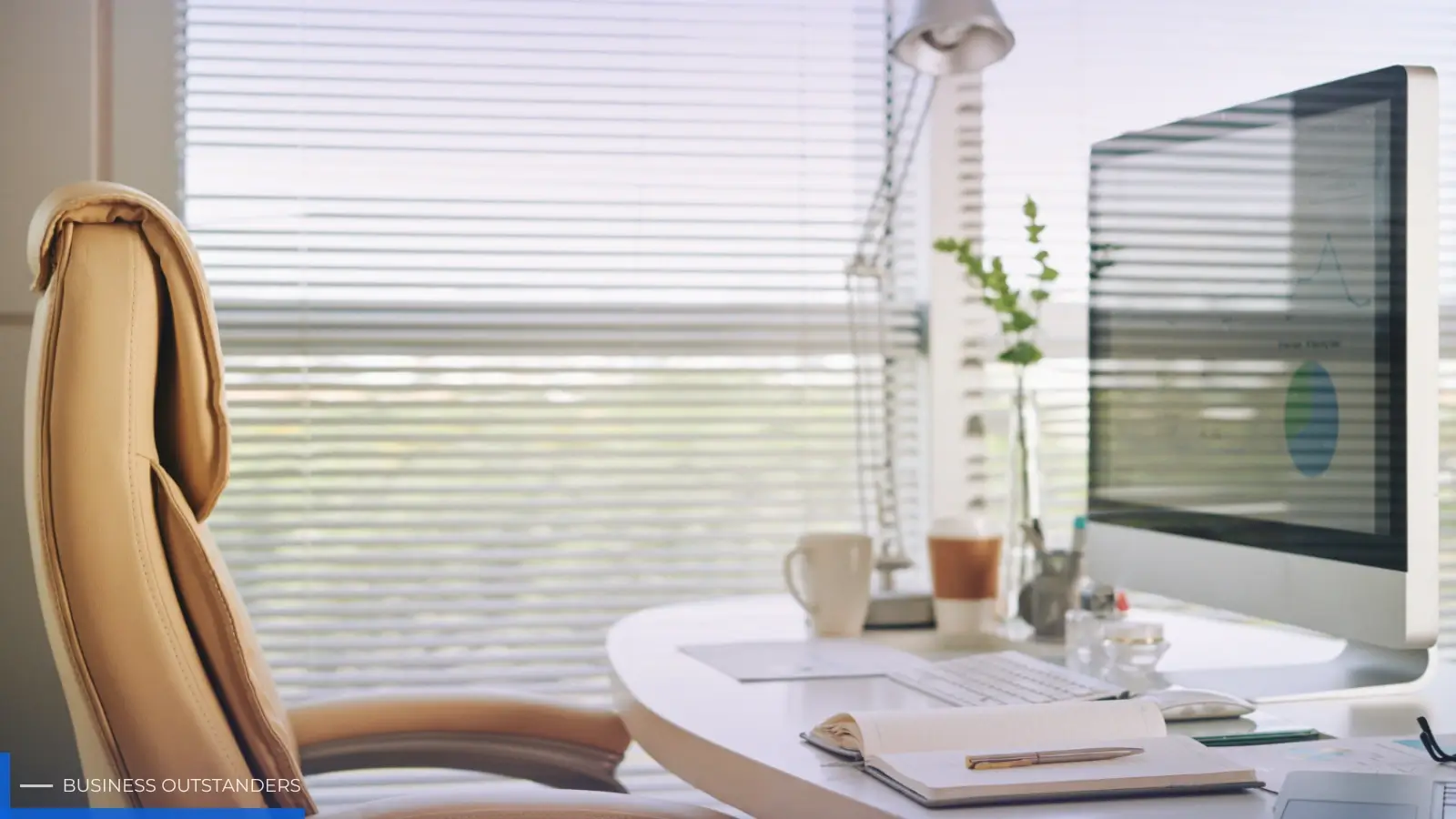
Venetian blinds offer something roller shades cannot: dynamic angular control. By adjusting slat angle, occupants redirect sunlight toward the ceiling plane, converting it into diffuse indirect illumination rather than blocking it outright. This technique — known in daylighting engineering as light redirection — can extend the useful daylit zone up to 6 metres from the façade, significantly reducing the need for supplementary electric lighting during daylight hours. Studies from the Fraunhofer Institute for Building Physics have demonstrated that well-managed venetian systems can reduce annual lighting energy consumption by 30–50% in perimeter zones. The limitation is behavioural: the benefits depend on users actually adjusting the slats, which in practice rarely happens without automated controls.
Best for: offices with varying sunlight exposure, employees who prefer customizable lighting.
Option 03 Solar shades — natural light without the glare
Solar shades are engineered to manage the solar heat gain coefficient (SHGC) of a glazing assembly rather than simply blocking light. A quality solar shade fabric with a low SHGC can reject 80–90% of incident solar energy in the near-infrared spectrum while transmitting 10–14% of visible light — enough to maintain a connection to the exterior and preserve the psychological benefits of a view. Research in environmental psychology consistently links exterior views to stress recovery and sustained attention. Kaplan's Attention Restoration Theory specifically identifies "being away" — a sense of distance from demand — as a restorative mechanism, and exterior views through solar shades provide this without full cognitive disengagement. For offices pursuing LEED or WELL certification, solar shades contribute directly to credits related to daylight, thermal comfort, and energy performance.
Best for: offices with large windows or strong daylight exposure.
Option 04 Cellular shades — energy efficiency and comfort
Cellular or honeycomb shades operate on a principle of trapped-air insulation. Their double- or triple-cell construction creates static air pockets that resist conductive heat transfer, improving the effective U-value of the window assembly. In cold climates, this translates to a measurable reduction in radiant asymmetry — the temperature differential between a warm interior surface and a cold glazing panel — which is one of the leading causes of thermal discomfort in perimeter workstations even when ambient air temperature is within the comfort range specified by ASHRAE Standard 55. Acoustic performance is a secondary benefit: the cellular structure absorbs mid-frequency sound energy, modestly improving room acoustics in spaces where speech privacy or concentration is a priority.
Best for: offices focused on sustainability, comfort, or noise control.
Option 05 Drapery — elevated and professional look
In executive and client-facing spaces, drapery functions as both an acoustic and a semiotic tool. Heavy woven textiles with a surface weight above 300 g/m² can achieve noise reduction coefficients (NRC) of 0.55–0.70, meaningfully absorbing mid- and high-frequency sound energy and reducing reverberation that makes speech intelligibility difficult in hard-surfaced rooms. Beyond acoustics, research in environmental psychology and organisational behaviour has documented the "environmental storytelling" function of office design: the materials, textures, and proportions of a space communicate institutional values to both employees and visitors. Floor-length drapery in a boardroom conveys deliberateness and permanence — qualities that function as non-verbal credibility signals in high-stakes client interactions.
Best for: executive offices, boardrooms, client-facing areas.
Decision guide How to choose the right window treatments
The optimal specification is never a single product but a match between glazing orientation, task type, occupancy pattern, and organisational culture. South- and west-facing exposures with screen-heavy tasks call for solar or roller shades with a low openness factor and a neutral grey colour to avoid chromatic distortion of perceived screen whites. Spaces with variable occupancy and mixed tasks benefit from the dynamic control of motorised venetian systems, ideally integrated with a building management system that responds to exterior illuminance sensors. Rooms where acoustics, privacy, or brand expression carry extra weight justify the added complexity and cost of layered solutions — a sheer solar shade behind a heavier drape — that address multiple performance criteria simultaneously.
Conclusion Final thoughts
The most productive office environments are those that treat light as an active ingredient rather than a background condition. Roller shades and solar shades remain the functional baseline for most modern offices, but the greatest gains come from systems that respond dynamically to the actual conditions of a given day, season, and workload. Investing in the right window treatments is, ultimately, an investment in the biological and psychological conditions under which people do their best work.
References: Boubekri et al., J. Clin. Sleep Med. 2014 · Fraunhofer IBP daylighting research · Kaplan, S. (1995), Attention Restoration Theory · ASHRAE Standard 55 (Thermal Comfort) · WELL Building Standard v2
Business Outstanders brings you sharp insights on tech, business, entrepreneurship, law, crypto, and more. We uncover what’s next. Stay updated, sign up for our newsletter and be part of the future!