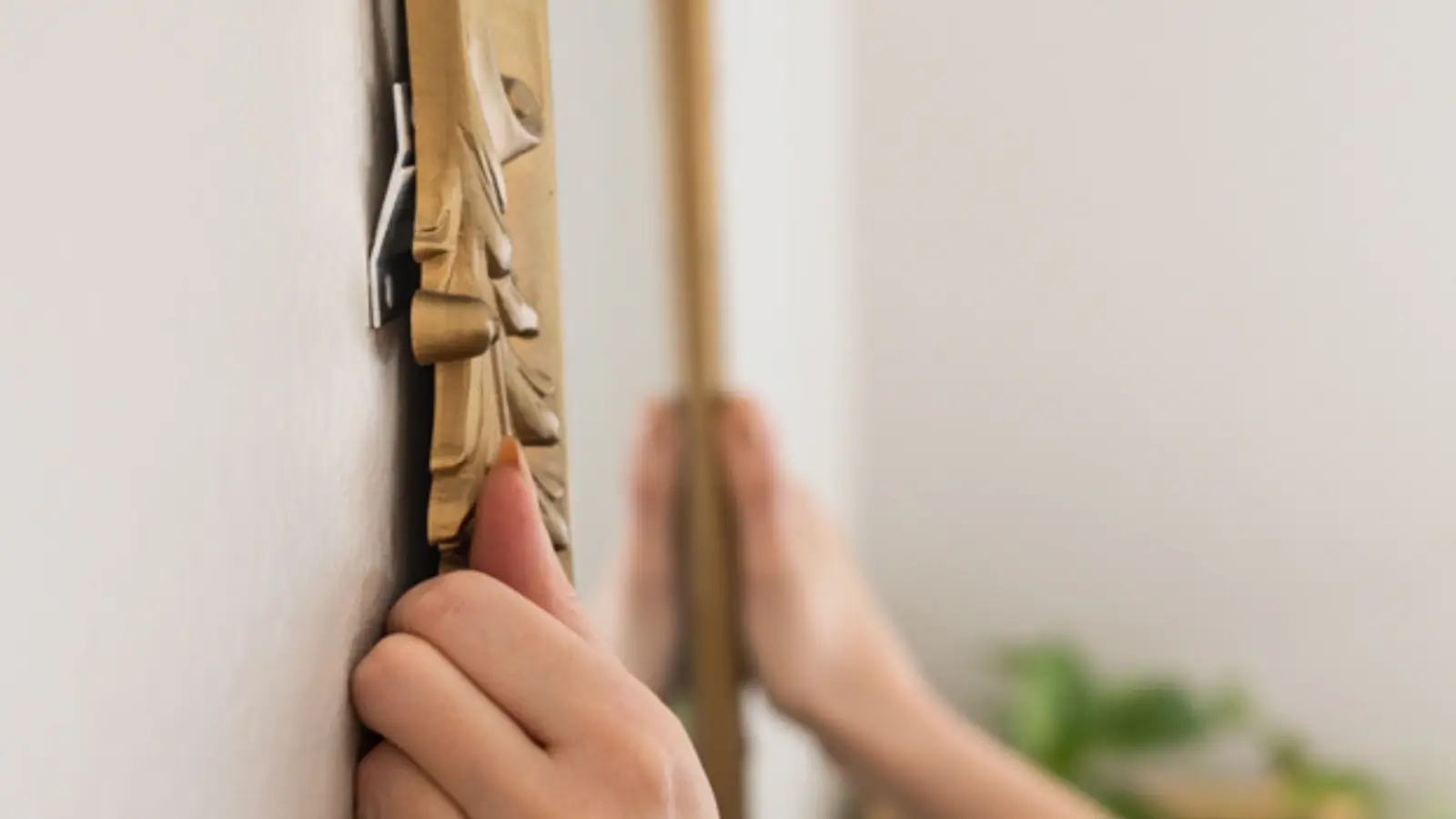
There is a moment of terrifying clarity that happens in home renovation. You have purchased a stunning, oversized vintage mirror or a massive piece of framed artwork. You hold it up against the wall, admiring how it transforms the room. Then, you feel the weight of it in your arms—heavy, solid, and unforgiving.
You look at the wall. It is a smooth, painted surface. You knock on it, and it sounds hollow. A question forms in your mind, one that has preceded thousands of shattered frames and damaged floors: Can this thin sheet of chalk and paper actually hold this up?
The answer is a complicated "yes, but..."
To understand why walls fail, we have to stop looking at them as solid barriers and start seeing them as engineering systems with very specific breaking points.
The Physics of the "Paper Sandwich"
Most modern homes are finished with drywall (often known by the brand name Sheetrock). Drywall is essentially a sandwich: a layer of gypsum plaster pressed between two sheets of thick paper.
Gypsum is cheap, fire-resistant, and easy to paint. But structurally, it is crumbly. It has very low "tensile strength." If you drive a nail directly into drywall and pull straight out, it offers almost no resistance.
However, hanging a picture relies on "shear strength"—the ability of the material to resist a force dragging it down along the surface.
A standard sheet of 1/2-inch drywall has a shear strength of roughly 10 to 20 pounds per screw, provided the load is static (not moving). This sounds promising. It suggests that a single nail might hold a light painting.
But here is the myth: People assume that if one nail holds 10 pounds, five nails will hold 50 pounds. This is the "Pincushion Fallacy." When you cluster nails together in drywall, you are actually pulverizing the gypsum core, weakening the structural integrity of that specific patch of wall. You aren't building a support system; you are perforating the paper that holds the wall together.
The "Leverage" Problem
The danger increases with the shape of the object. A 50-pound flat mirror that sits flush against the wall exerts a pure downward force (shear).
But what about a deep shadow-box frame? Or a floating shelf? Or a heavy mirror with a thick, ornate rim?
These objects have a center of gravity that sits several inches away from the wall. This creates a lever arm. Now, the force isn't just pulling down; it is pulling out.
This changes the physics entirely. The top of the hook is being pulled away from the wall (tension), while the bottom of the frame drives into the drywall (compression). Drywall is terrible at resisting tension. A 50-pound mirror that sticks out three inches exerts significantly more stress on the fastener than a 50-pound mirror that is flat. The nail isn't just shearing; it is slowly ripping through the paper face like a zipper.
The Stud: The Holy Grail of Stability
This is why professional installers are obsessed with "finding the stud."
Behind the fragile drywall are vertical wooden (or sometimes metal) beams, usually spaced 16 inches apart. These are the skeleton of the house. When you drive a fastener into a stud, you are bypassing the weak gypsum entirely and anchoring your load directly into the structural frame of the building.
A screw driven one inch into a wooden stud can easily hold 80 to 100 pounds. It is secure, stable, and immune to the crumbling issues of plaster.
But life is rarely convenient. The stud is almost never exactly where you want to center your masterpiece. You want the mirror centered over the console table, but the stud is four inches to the left.
The Anchor Solution: Expanding the Grip
When the stud isn't an option, you enter the world of hollow-wall anchors. This is where most DIY errors occur.
The plastic conical anchors that come free in the box with most frames are notoriously weak. They rely on friction against the crumbly gypsum. Over time, the vibrations from closing doors or walking upstairs can cause these to wiggle loose.
For heavy loads (25 to 50 pounds) in hollow drywall, physics dictates you need an anchor that expands behind the wall.
- Toggle Bolts: These feature metal wings that fold flat to pass through a hole, then spring open inside the wall. You tighten the bolt, clamping the drywall between the wings and the screw head. This distributes the weight over a large area of the hidden cardboard backing.
- Self-Drilling Metal Anchors: These look like large, coarse screws. They bite aggressively into the drywall, creating a larger thread pattern that resists pull-out better than a simple nail.
However, even the best anchor has a limit. Most engineers agree that once an object exceeds 50 pounds, relying solely on drywall—even with anchors—is a gamble. The drywall panel itself is only held up by a few screws. If you hang a 100-pound mirror on a section of drywall held up by four screws, you might not pull the hook out of the wall; you might pull the wall off the studs.
The Verdict
So, can your wall hold it?
If it’s under 20 pounds and flat? Yes, with a proper picture hook. If it’s 20 to 50 pounds? Only with a toggle bolt or a specialized expansion anchor. If it’s over 50 pounds? Do not trust the drywall. You must span two studs or use a bridging bracket.
The illusion of the solid wall is just that—an illusion. Your home is a skin of paper over a skeleton of wood. Respecting that anatomy is the difference between a beautiful display and a pile of broken glass. When dealing with substantial weight, opting for specialized heavy duty picture hanging hardware that bridges studs or utilizes interlocking cleats is the only way to ensure gravity doesn't win the argument.
Conclusion
Hanging art is the final step of decorating, but it is the first step of structural engineering in the home. The next time you lift that heavy frame, look past the paint. Visualize the crumbly rock and paper behind it. If you can’t find the wood, make sure you use a fastener that understands the physics of the hollow wall. Your toes (and your deposit) will thank you.
Business Outstanders brings you sharp insights on tech, business, entrepreneurship, law, crypto, and more. We uncover what’s next. Stay updated, sign up for our newsletter and be part of the future!