The complaint had been sitting in plain sight for years. Buyer after buyer had written it under a popular product listing on Amazon: the size was wrong, the material was not durable enough. The original manufacturer, an established American brand, had not responded. Roman Pozhydaiev, watching from his office in Miami, decided to.
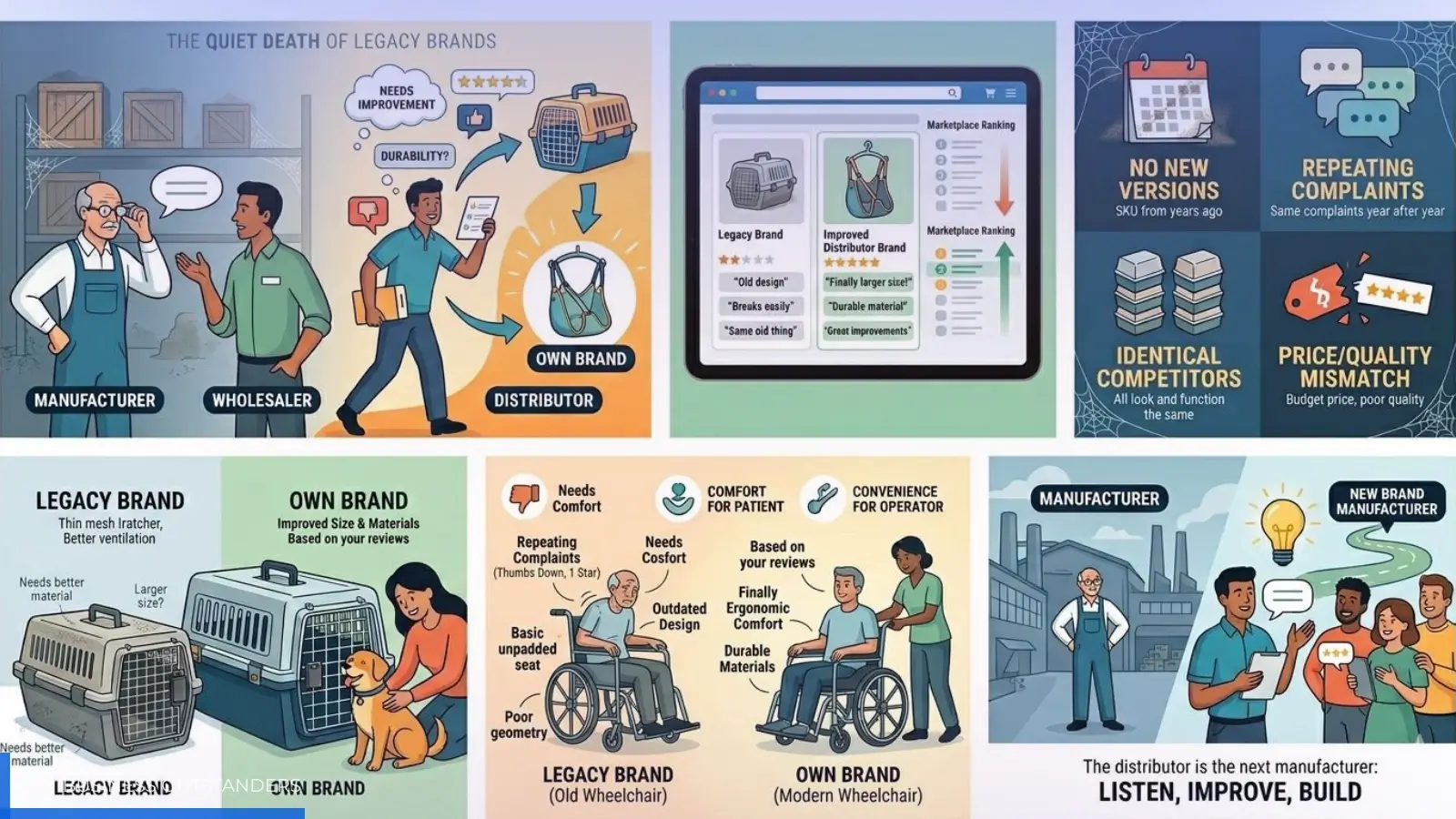
His team released the same category of product under one of their proprietary, with one change: the size customers had been requesting, and a denser, more durable material. Within approximately a quarter, Pozhydaiev says, his version was outranking the original on the listing it had been modeled on. The rating climbed close to five stars on organic reviews. By his estimate, his product captured roughly half of the category's traffic for the relevant search terms. There was an advertising budget behind the launch, he notes, but it was minimal, small enough relative to the result that he describes it as symbolic. "We just released what the customer had already described to us," he says. "Advertising would not have worked like that if the product itself had not closed what the customer had been asking for, year after year."
Pozhydaiev is the founder and CEO of Transifor LLC, an e-commerce and product development company that has spent the past ten years, since January 2016, selling other companies' products on Amazon, eBay and Walmart before quietly starting to build its own and its partners'. The company is registered in St. Petersburg, Florida, while Pozhydaiev's working office is in Miami. Transifor today manages more than 300 active product listings under proprietary and partner brands the company has built from the ground up. In parallel, Pozhydaiev says, the company has helped more than 100 partner retail projects launch on US marketplaces.
His categories now span pet products, tools, food, home and garden, rehabilitation and medical equipment, massage, automotive parts, and kitchen goods. In each one, the pattern is similar: a mature category, entrenched American manufacturers, and years of unaddressed customer complaints sitting in public reviews. "We don't pick a category because it's trendy," Pozhydaiev says. "We pick it because the customer has been asking for something specific, and the original brand isn't listening."
The methodology
The methodology behind Transifor's product launches is unconventional only because most of the industry has stopped using it. "The customer has already written the spec for you," Pozhydaiev explains. "They write it in the reviews, in the returns, in the support tickets. The job isn't to invent a new product. The job is to listen to what they have been asking for and ignored by the original brand."
In practice, that means his team treats marketplace reviews as a product development brief. Recurring complaints across multiple competing brands in the same category are flagged as market signals rather than individual gripes. The team then identifies the minimum physical change required to address the most common complaint: a different size, a denser material, a redesigned hardware element, an added accessory. The improved product is launched under one of Transifor's in-house brands, with the listing copy explicitly referencing the changes customers had been asking for.
"Customers recognize their own voice in the listing," Pozhydaiev says. "They write it in the reviews themselves. The marketing budget is minimal, just enough to drive the initial traffic. After that, the reviews and the marketplace algorithm do the work."
From Kharkiv to Florida
The path to Miami runs through Kharkiv, Ukraine. Pozhydaiev, an engineer by training with a master's degree, began working in retail and e-commerce as a student. In January 2016, he founded his first business, Retail Group USA, as a Ukrainian company operating on the American market through Amazon. By 2018, the operation had crossed one million dollars in Amazon revenue, working primarily as a dropshipper before pivoting toward proprietary and partner brands. In 2019, the structure expanded: a European entity, ADWRetailGroup, was opened, and a US legal entity was registered that later became Transifor LLC.
His relocation to the United States came under circumstances he did not choose. When Russia's full-scale invasion of Ukraine began in February 2022, Pozhydaiev moved his family from Kharkiv, one of the cities most heavily affected by the war, to the United States. By that point, the company already had operating legal entities, registered trademarks, and an active Amazon business in the US. What changed was something different.
"In the United States I began to feel the customer differently," he says. "When you live in the country you are producing the product for, you start to think the way the customer thinks. You see what you could not see from Ukraine: how they choose, how they read a listing, what matters in their daily life. This is not the kind of information you get from a report. You only start to see it once you live in that environment yourself."
A higher-stakes category
The Transifor approach applies the same logic to categories where the stakes go well beyond commerce. In rehabilitation equipment and patient care products, Pozhydaiev sees a market frozen in time. The leading American manufacturers in the category have been in business for fifty, sometimes seventy years. Their products, by his analysis, have not meaningfully changed in two or three decades. Chinese manufacturers, meanwhile, are experimenting with new materials and configurations. American category leaders are not.
"These products go to patients in dependent situations and to nursing staff working long shifts," Pozhydaiev says. "When a manufacturer with seventy years of brand equity refuses to make their product even slightly more comfortable, that's not just a commercial failure. It's hard to defend."
The customer voice in this category, he notes, sits on the same marketplace reviews and procurement feedback channels that drive his pet products work. The information is public. The legacy brands have the same access to it that he does. "They simply do not read it," he says.
In a partner project that Transifor ran in the patient care category, the first product launches have already taken place. According to Pozhydaiev, once the product was on the market, the company began receiving a large volume of feedback: from institutions, from staff, and from patients and their family members directly. More important than the feedback itself, he says, was what customers recognized: they were being heard. "They saw that we were not closing our eyes to what they were writing," he says. "And they began sending us suggestions: what to improve further, what to add, what to redesign. In this category, legacy American manufacturers do not get this kind of feedback because they do not invite it and they do not respond. We have had it since the first launch. And it is now driving the next iterations of the product."
A pattern across industries
Pozhydaiev's view aligns with a broader shift visible across mature e-commerce categories. As legacy manufacturers stop investing in product iteration, distributors who sit closer to the customer through marketplaces are increasingly stepping into the manufacturing role themselves. The shift moves fastest on platforms like Amazon, where customer reviews are public and ratings affect search visibility within weeks, not years. But the same dynamics, Pozhydaiev argues, operate in traditional retail and B2B procurement at slower speeds. Direction is identical; the channel only sets the speed.
His work has not gone unnoticed in his original market. In 2021, Pozhydaiev was featured in Leaders-21, a Ukrainian publication profiling entrepreneurs building businesses across the country. In 2025, he was recognized by the Ukrainian Business Association in its annual feature on Ukrainian founders. His business journey has previously been the subject of profiles in Ukrainian outlets including Vgorode.ua and Glavred, both of which covered his Amazon trajectory and his approach to the dropshipping-to-brand transition.
What's next
Asked what is next for Transifor, Pozhydaiev is direct: in-house manufacturing. According to him, the company is working to launch its own production capacity in the United States and in Ukraine, moving from a model of "release an improved product through a partner manufacturer" to producing in-house. It is the next logical step for a business that has spent recent years accumulating not just listings and partners, but also a clear understanding of what the market actually needs. The infrastructure, he says, is now mature enough that analytical work, the work of reading reviews and identifying recurring complaints, has become the bottleneck. The marketplace side and logistics are solved. What remains is attention and proprietary manufacturing.
"We have helped a hundred partner projects launch, and we get referrals weekly from people who watched what we built," he says. "The opportunity in mature categories isn't a temporary window. It's a structural condition of how those industries operate."
He closes with a thought he returns to often. "Nobody is killing the legacy brands," Pozhydaiev says. "They are giving up the market themselves by not developing their products. We are just the ones who keep doing the work the industry stopped doing: reading the customer, and turning what they say into changes in the product."
About Roman Pozhydaiev
Roman Pozhydaiev is the founder and CEO of Transifor LLC, an e-commerce and product development company registered in St. Petersburg, Florida. Pozhydaiev's working office is in Miami. Born and educated in Kharkiv, Ukraine, where he completed a master's degree in engineering, he founded his first business, Retail Group USA, as a Ukrainian company in January 2016, selling on Amazon to the US market. In 2019 he opened a European entity, ADWRetailGroup, which has since been closed, and registered the US entity that became Transifor LLC. He relocated to the United States in 2022 following the outbreak of war in Ukraine. He can be reached on LinkedIn at linkedin.com/in/roman-pozhydaiev-3171aa180
Business Outstanders brings you sharp insights on tech, business, entrepreneurship, law, crypto, and more. We uncover what’s next. Stay updated, sign up for our newsletter and be part of the future!