The right CNC machining supplier in China is one that can prove tolerance capability with real inspection data, holds relevant certifications (ISO 9001 at minimum, IATF 16949 or AS9100 for automotive/aerospace work), offers both CNC milling and CNC turning under one roof, supports rapid CNC prototyping before mass production, and communicates in clear technical English with fast, documented quoting. Vetting on price alone is the single most common reason overseas buyers end up with scrapped parts, missed tooling deadlines, and hidden rework costs.
Key Takeaways
- Certifications are a floor, not a guarantee — ISO 9001 confirms a quality system exists; it does not confirm the supplier can hold your specific tolerance on your specific material.
- Prototyping capability predicts production reliability — a supplier that runs a clean CNC prototyping process before committing to production tooling is far less likely to deliver a bad batch.
- Milling and turning need to be evaluated separately — a shop strong in 3-axis milling isn't automatically strong in multi-axis turning, and vice versa.
- First-article inspection reports are non-negotiable — request CMM data, not a photo of a caliper, before releasing a production run.
- Total landed cost beats quoted unit price — freight, duties, rework, and communication delays routinely erase a 10–15% quote advantage.
- Response time during quoting is a leading indicator — shops that quote slowly or vaguely tend to communicate the same way once your parts are on the machine.
Quick Reference: Milling vs. Turning at a Glance
|
Factor |
CNC Milling |
CNC Turning |
|
Best for |
Flat, angular, pocketed, or 3D contoured parts |
Cylindrical, rotationally symmetric parts |
|
Typical parts |
Brackets, housings, manifolds, mold plates |
Shafts, bushings, pins, fittings |
|
Tool motion |
Rotating tool, workpiece fixed/indexed |
Workpiece rotates, tool is stationary |
|
Common axis config |
3-axis, 4-axis, 5-axis |
2-axis, live-tooling multi-axis |
Why Sourcing CNC Machining From China Still Makes Sense in 2026
China remains the largest concentration of CNC machining capacity in the world, spanning everything from single-operator job shops to vertically integrated manufacturers running 5-axis mills and multi-spindle turning centers around the clock. The advantage isn't just labor cost — it's the density of the supply chain. Raw material, secondary finishing (anodizing, plating, passivation), and packaging/logistics partners are often within a few kilometers of the machining shop itself, which shortens lead times in a way that's hard to replicate elsewhere.
The risk is that this same density makes it easy to end up working with a broker or a shop that subcontracts your job to three different facilities without telling you. Choosing well means knowing what to check before you send a drawing, not after the first shipment arrives.
CNC Milling vs. CNC Turning: Why the Distinction Matters When Vetting
CNC milling removes material using a rotating cutting tool against a stationary (or indexed) workpiece — it's the right process for parts with flat faces, pockets, slots, and complex 3D contours: brackets, housings, manifolds, mold components.
CNC turning rotates the workpiece against a stationary cutting tool — it's the process for cylindrical, rotationally symmetric parts: shafts, bushings, fittings, pins, and threaded components.
Many parts need both processes in sequence (a turned shaft with a milled keyway or flat, for example), so a supplier that only advertises one capability may still be sending part of your job to an uncontrolled second vendor. Ask directly whether milling and turning happen in-house, on the same shop floor, under the same quality system.
What CNC Prototyping Should Look Like Before You Commit to Production
A supplier worth working with treats prototyping as a real engineering checkpoint, not a formality:
- Prototype run quantities small enough to catch problems cheaply (typically 1–20 pieces depending on complexity)
- A design-for-manufacturability (DFM) review returned with the quote, flagging tight tolerances, thin walls, or deep pockets that will cause problems at volume
- Dimensional inspection data on the prototype batch, not just a visual check
- A clear, written path from prototype approval to production tooling and first production run
If a supplier skips straight from CAD file to "we can start production Monday" with no DFM feedback, that's a signal they're optimizing for speed of quote, not accuracy of build.
Detailed Supplier Evaluation Checklist
|
Evaluation Area |
What to Ask For |
Why It Matters |
Red Flag |
|
Certifications |
ISO 9001 certificate number + registry verification; IATF 16949 / AS9100 / ISO 13485 if applicable |
Confirms a functioning quality management system is in place |
Certificate can't be verified against the issuing body |
|
Machine capability |
Full machine list with axis count, brand, and work envelope |
Determines what geometries and tolerances are realistically achievable |
Vague answers like "we have advanced equipment" with no specifics |
|
Tolerance history |
Routine production tolerance (not best-case), backed by past CMM data |
Sets realistic expectations before your drawing is quoted |
Supplier claims the same tight tolerance for every material and feature |
|
Prototyping process |
Sample lead time, DFM feedback, prototype inspection report |
Catches design and process issues before expensive tooling is cut |
Jumps straight from quote to full production with no prototype offered |
|
Material traceability |
Mill certificates, material source, lot tracking |
Critical for structural, safety, or regulated parts |
No documentation offered or "trust us" verbal assurance only |
|
Secondary processes |
Which finishing steps are in-house vs. outsourced, and how outsourced work is quality-checked |
Prevents quality gaps at the handoff to a third-party vendor |
Finishing vendor is unnamed or unmanaged |
|
Inspection & QA |
First-article inspection report, CMM data, non-conformance process |
Confirms parts meet spec before shipment, not after a customer complaint |
Only offers a visual or caliper spot-check |
|
Communication |
Response time and technical depth of questions during quoting |
Predicts how issues will be handled once parts are in production |
Slow, generic, or non-technical responses to a detailed RFQ |
|
Tooling ownership |
Written terms on who owns dedicated fixtures/tooling |
Avoids disputes or repurchase costs if you change suppliers later |
Tooling terms left verbal or undocumented |
|
Total landed cost |
Full cost including freight, duties, packaging, and expected rework rate |
Quoted unit price alone often hides the real cost difference |
Quote is unusually low with no explanation of what's excluded |
Core Vetting Criteria for a China-Based CNC Supplier
Certifications. ISO 9001 is the baseline expectation for any serious industrial supplier. If your parts feed into automotive assemblies, look for IATF 16949. Aerospace-adjacent work should look for AS9100. Medical device components often require ISO 13485. Ask for the certificate number and verify it against the issuing body's public registry rather than accepting a PDF at face value.
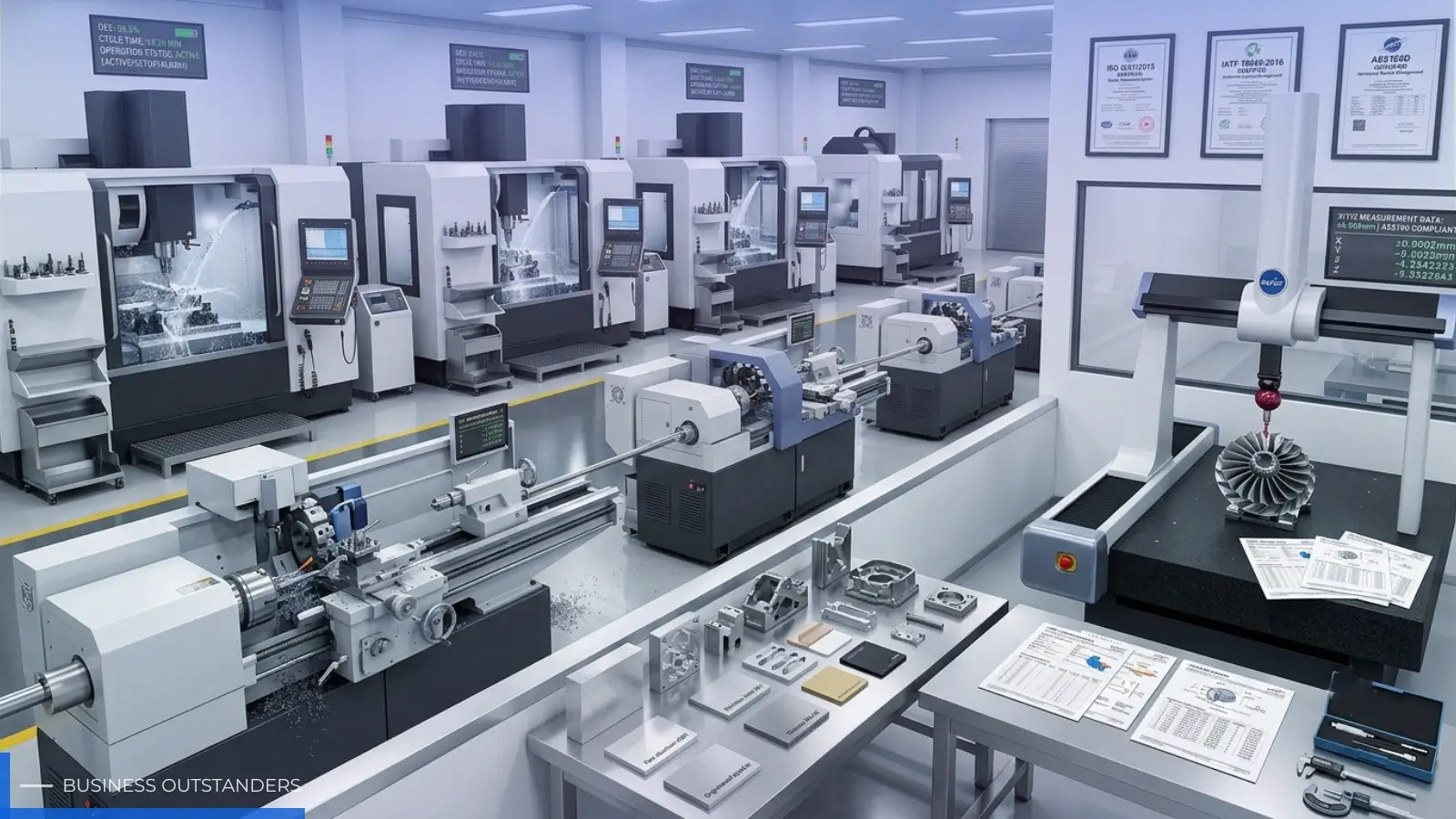
Machine list and tolerance capability. A credible shop will share its actual machine roster (brands, axis count, work envelope) and the tightest tolerance it routinely holds in production — not the tightest tolerance its best machine can theoretically achieve once, under ideal conditions.
Material sourcing and traceability. For structural or safety-relevant parts, ask how raw material is sourced and whether mill certificates are retained and provided with the shipment.
Quality documentation. First-article inspection (FAI) reports, CMM printouts, and a documented non-conformance process should be standard, not a special request.
Communication and engineering literacy. The best signal isn't a fluent sales rep — it's an engineer or quoting technician who asks precise questions about your drawing, callouts, or GD&T before quoting.
Secondary processes in-house or tightly managed. Anodizing, plating, heat treatment, and passivation are frequently outsourced even by strong machining shops. That's normal — but the shop should manage that vendor relationship and quality-check the output before it reaches you, not simply pass along whatever comes back.
Common Mistakes Buyers Make When Choosing a Supplier
Selecting purely on the lowest quoted unit price, without normalizing for tolerance, material grade, and inspection level, is the most frequent and most expensive mistake. A second common error is skipping the prototype stage on a "simple" part, only to discover a systemic tolerance or finish issue after a full production run has already shipped. A third is failing to clarify tooling ownership up front — for parts requiring dedicated fixtures or tooling, buyers who don't get tooling ownership in writing sometimes find themselves re-paying for it if they switch suppliers later.
MW+ (MetalWorks Plus): A Shenzhen-Based Option Built Around This Vetting Process
MetalWorks Plus (MW+), based in Shenzhen, structures its CNC machining, milling, and turning services around the exact criteria buyers should be checking for: in-house 3-, 4-, and 5-axis milling alongside CNC turning under one roof, a documented CNC prototyping stage with DFM feedback ahead of production tooling, and first-article inspection data provided as standard rather than on request. For buyers evaluating suppliers against the checklist above, MW+'s quoting process is built to answer those questions directly — machine capability, tolerance history, and certification status — rather than leaving them for the buyer to chase down after an order is placed.
Metalworks Plus - Precision Manufacturing & CNC Machining Expert
MW+ is a precision manufacturing company specializing in high-quality CNC machining and custom metal fabrication solutions from prototype to full-scale production. Founded in China, the company combines advanced technology with rigorous quality control to serve industries such as aerospace, automotive, medical, electronics, and industrial equipment.
Learn more: https://metalworksplus.com
Services
-
CNC Machining Services – full‑service precision machining
-
Multi‑Axis Machining – 3/4/5‑axis milling
-
Micro‑Machining Services – ultra‑fine tolerances
-
Swiss Machining – Swiss turning for slender parts
-
CNC Milling Services – complex contours & surfaces
-
CNC Turning Services – cylindrical & tapered profiles
-
Electric Discharge Machining – EDM for hardened steels
-
Laser Cutting Services – high‑speed sheet cutting
-
CNC Prototyping – rapid prototyping in days
-
Machine Parts Manufacturing – custom structural & functional parts
Products
-
CNC Precision Parts – tight‑tolerance components
-
Connector & Machined Pins – custom pins for assemblies
-
Machine Parts – housings, brackets, shafts, gears
Frequently Asked Questions
What certifications should a CNC machining supplier in China have?
At minimum, ISO 9001. Depending on your industry, also look for IATF 16949 (automotive), AS9100 (aerospace), or ISO 13485 (medical devices), and verify the certificate number against the issuing body's registry rather than accepting a scanned copy at face value.
Is CNC milling or CNC turning better for my part?
It depends on geometry. Flat, angular, or 3D-contoured parts (brackets, housings, manifolds) are milled. Cylindrical, rotationally symmetric parts (shafts, bushings, pins) are turned. Many parts require both processes in sequence, so ask whether a candidate supplier performs both in-house.
How do I know if a CNC prototyping process is trustworthy?
A trustworthy process includes a design-for-manufacturability review before quoting, small-batch prototype production, dimensional inspection data on that prototype (not a visual check), and a clear written path from prototype sign-off to production tooling.
What's the biggest mistake buyers make when choosing a CNC supplier in China?
Selecting based on the lowest quoted unit price without normalizing for tolerance, material grade, and inspection level. A lower quote with a lower inspection standard often costs more once rework, delays, and scrapped parts are factored in.
Should I request a first-article inspection report before a full production run?
Yes. A first-article inspection (FAI) report with CMM data confirms the supplier can actually hold your tolerances before you commit to a full production quantity — it should be standard practice, not a special request.
Business Outstanders brings you sharp insights on tech, business, entrepreneurship, law, crypto, and more. We uncover what’s next. Stay updated, sign up for our newsletter and be part of the future!