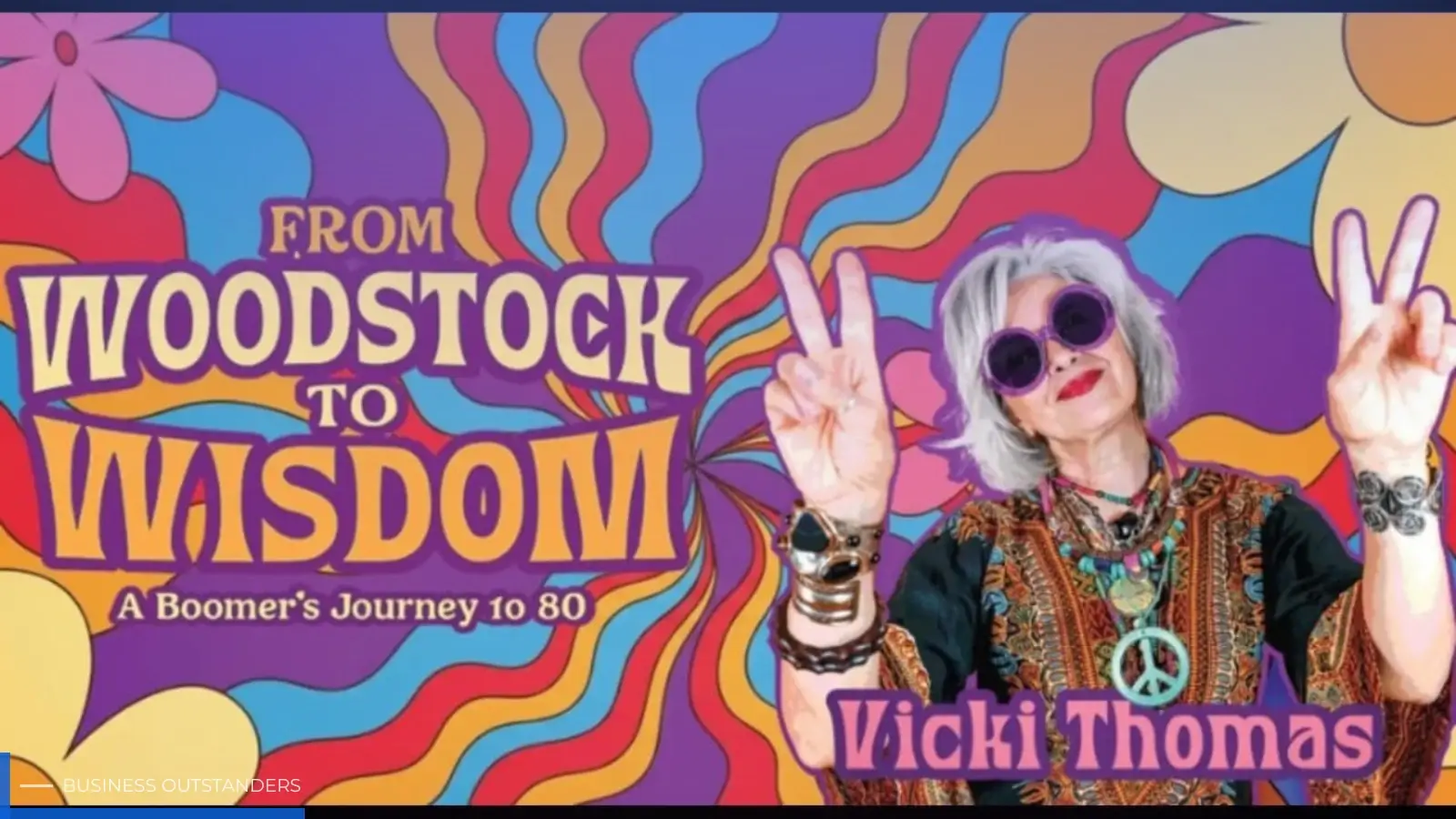
Vicki Thomas, author of From Woodstock to Wisdom and one of the first members of the Baby Boom generation to turn 80, is taking a moment to talk about something that does not usually come up in conversations about aging and purpose: music. Specifically, the music that Baby Boomers grew up with, and why it still matters, still plays, and still says something true about who this generation is and what it carries. That conversation is at the center of From Woodstock to Wisdom, available now at myfuturepurpose.com.
The Songs That Came First
There is a reason Boomers can still recite the lyrics to songs they heard at 16. Music from that era was not background noise. It was part of the air. The Beatles arrived in America in 1964 and changed what popular music was allowed to sound like. Bob Dylan put words to political frustration in ways that speeches and editorials could not. Aretha Franklin made it clear that respect was not optional. The Supremes proved that soul and grace were a language everyone could understand. The Rolling Stones brought a kind of urgency that said the world was moving fast and you needed to pay attention.
These were not just songs. They were the background rhythm of a generation that was in the middle of renegotiating what American life was going to look like.
What a Transistor Radio Meant in 1965
It is worth remembering what it took to hear music in those years. You carried a transistor radio the size of a paperback book. You pressed it to your ear and caught whatever the signal would give you. You gathered around a record player at someone's house because that was the only way to hear an album the way it was meant to be heard. You saved up to buy a 45 or an LP, and when you brought it home, you listened to it all the way through, not because you had to, but because every track was worth hearing.
That relationship with music was intentional. You had to work a little to get to it, and because of that, it meant something when it arrived. That same sense of care and attention still shapes how artists approach their craft today, including premium instruments.
The Music Moved Because the Times Did
The connection between the music and the moment was not accidental. The 1960s and early 1970s were years of real disruption, civil rights marches, Vietnam protests, the women's movement, the push for environmental protections. Music was one of the ways that people made sense of all of it. A song like "A Change Is Gonna Come" by Sam Cooke was not just a piece of art. It was a statement of fact and a source of strength for people who needed both.
Boomers grew up knowing that music and meaning were connected. A song could hold grief and hope at the same time. It could say out loud the things that were hard to say in conversation. It could bring strangers together in a field in upstate New York and make them feel, for a few days at least, like they were part of something larger than themselves.
That feeling did not go away when the festival ended.
Woodstock Was a Moment, Not a Museum Piece
Woodstock has become a cultural shorthand for the Boomer generation in ways that are sometimes more caricature than truth. The mud, the crowds, the famous performances, these are the images that survived. What is harder to convey is what it felt like to be part of a generation that believed, at least for a stretch of time, that music and community and shared conviction could change things.
Some of it did change. Some of it did not. But the spirit behind it, the idea that people coming together around something they cared about could matter, that part has stayed with Boomers in ways that continue to show up in how they live and what they build.
The Playlist Changed Platforms, Not Purpose
Today, the same songs that played on transistor radios and turntables are available on Spotify, Apple Music, and YouTube. Boomers who once waited for a song to come on the radio can now pull it up in three seconds on a phone that fits in a shirt pocket. The platform changed. The connection to the music did not.
This says something about the generation. Boomers are sometimes characterized as resistant to change, stuck in the past, more comfortable with what was than what is. But the reality is that Boomers have lived through more technological change than almost any generation in history, and most of them kept up. They just brought what mattered with them.
What the Music Still Carries
When a Boomer puts on a playlist today, whether it is Motown, folk, rock, or soul, what they are doing is more than nostalgia. They are reconnecting with a version of themselves that had strong convictions, a lot of energy, and a belief that the world could be pushed in a better direction. That version of themselves did not disappear. It just moved into a different stage of life.
That instinct is what Thomas wrote about in From Woodstock to Wisdom, and it is what she and co-founder Joyce Cohen built My Future Purpose around. The twice-monthly Pause for Purpose discussion groups, the workshops, the retreats, and the one-on-one coaching the organization offers are all built around the same idea: the things that moved you at 20 can still move you at 75, and that movement is worth paying attention to.
What Comes After the Playlist
Music has always been one of the ways that people figure out what they feel before they have the words for it. For Boomers, the music of the 1960s and 1970s was a first language for things like justice, love, loss, resistance, and hope. Those themes did not age out. They just found new forms.
The same generation that marched and protested and built careers and raised families is now in a position to mentor, advocate, create, and contribute in ways that carry all of that experience forward. From Woodstock to Wisdom is where that story lives. myfuturepurpose.com is where readers can find the book and everything that comes with it.
The playlist is still going. The spirit behind it is still there. And there is still plenty of room to dance.
About From Woodstock to Wisdom
From Woodstock to Wisdom by Vicki Thomas is available at myfuturepurpose.com. Part memoir, part generational portrait, the book reframes aging as a powerful and purposeful stage of life with real impact and real contribution still ahead.
About My Future Purpose
My Future Purpose is a Connecticut-based membership organization founded by Joyce Cohen and Vicki Thomas. The organization supports adults in later life through community, coaching, workshops, and tools designed to help people discover and act on purpose. Annual membership is $99. Learn more at myfuturepurpose.com.
Contact:
Joyce Cohen
joyce@myfuturepurpose.com
203-339-2000
Vicki Thomas
vicki@myfuturepurpose.com
203-984-2138
Business Outstanders brings you sharp insights on tech, business, entrepreneurship, law, crypto, and more. We uncover what’s next. Stay updated, sign up for our newsletter and be part of the future!