Picture a typical morning in an ICU. A nurse is managing critically ill patients. Her screen flashes an alert. Then another. Then a third within sixty seconds. She silences them the way she silences all the others she has learned do not matter. Meanwhile, a doctor across the hall is clicking through multiple screens just to pull up a patient's latest results. He mutters something under his breath and does what he always does. He works around the system.
This is not a technology failure in the traditional sense. This is what happens when technology is built without ever truly understanding the people it is supposed to serve.
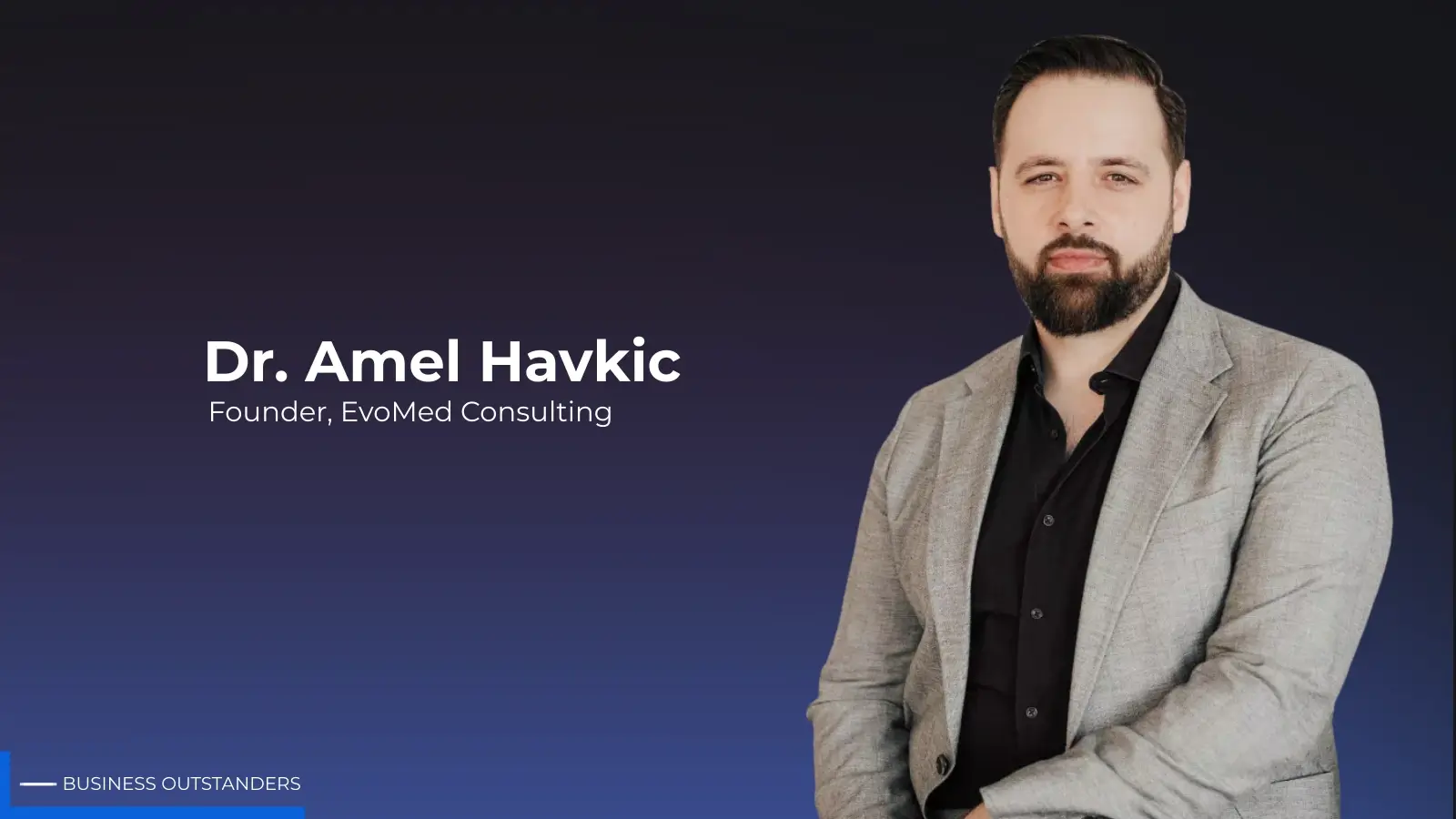
Dr. Amel Havkic spent years living inside that tension. Not as an observer, but as the physician in the hallway, the clinician in the ICU who went home exhausted not from the weight of his patients, but from the weight of the tools he was handed to care for them. What he did next became the foundation of EvoMed Consulting, and the reason this story is worth telling.
The Problem Nobody in MedTech Wants to Admit
Healthcare technology has never suffered from a shortage of ideas. The products look impressive on a feature list. They check every technical box. And then they reach the bedside and fail quietly. Not with a loud crash. They fail slowly, through non-adoption, through clinician workarounds, through healthcare platforms that get installed and never actually used.
Dr. Amel watched this cycle repeat so many times it stopped feeling like bad luck. It started feeling like a systemic problem. Brilliant MedTech founders were failing not because their ideas were wrong, but because their solutions were never adopted by the clinicians who were supposed to use them. The technology was technically impressive, but it was not trusted, not intuitive, and not aligned with the realities of clinical workflows.
That insight, simple as it sounds, is rarer than it should be in an industry worth trillions of dollars.
The Doctor Who Decided to Build a Bridge
Dr. Amel Havkic did not set out to become a healthcare innovation consultant. He set out to be a good doctor. He practiced across intensive care, respiratory medicine, and private practice, environments where perfection is impossible and yet mistakes are not an option. These were the conditions that shaped how he thinks about everything, including technology.
He watched colleagues pushed toward exhaustion and burnout, not by the patients they cared for, but by the very technologies meant to help them. Electronic Health Records, PACS systems, and digital tools promised efficiency but in reality often added friction, confusion, and cognitive overload to already strained clinical environments.
At the same time, he found himself crossing paths with MedTech founders who had genuine solutions to real problems but could not get clinicians to adopt what they built. The gap between those two worlds, the clinician's daily reality and the founder's vision, became the thing he could not stop thinking about.
So he founded EvoMed Consulting with a premise that sounds almost too obvious once you hear it:
“Medical technology must serve the clinician before it can ever serve the patient.”
Not as a slogan, but as the operating principle behind every decision.
What the ICU Teaches You About Innovation
There is a test that every piece of healthcare technology must pass, and it has nothing to do with clinical trials or regulatory filings. It happens in the first moments a clinician interacts with the tool. Does it help them do what they were already trying to do, just faster and with less friction? Or does it add a new step, require a new behavior, demand something extra from someone who has nothing extra to give?
Dr. Amel is direct about this reality. No clinician starts the day wishing for more innovation. What clinicians want is to survive a workload that is often overwhelming. A typical day might involve caring for many critically ill patients, managing hundreds of tasks, and making decisions where errors can cost lives.
In that environment, a tool earns trust only if it removes friction from what clinicians already do, saving time, reducing cognitive load, and eliminating unnecessary steps, or if it enables better decisions without interrupting natural workflow. If a product adds work, introduces uncertainty, or demands behavior change without delivering obvious and immediate benefit, clinicians will simply stay with what they already know. Not because they resist change, but because they are protecting their patients from one more variable in an already complex system.
The Blind Spot That Kills Good Companies
One of the most valuable things Dr. Amel brings to the founders he works with is a mirror. He has identified a recurring pattern across the MedTech industry. Founders almost always come from one of three worlds: medicine, technology, or business. Each brings essential strengths. Each also carries a blind spot that can quietly sink the whole company.
Medical founders believe that solving the clinical problem well enough guarantees success. Technical founders get absorbed by features, performance, and engineering quality. Business founders focus on marketing, finance, and distribution. Each assumes their angle is the most important one.
But healthcare does not work that way. Clinical relevance, technical execution, regulatory compliance, usability, workflow integration, and economic sustainability must all work together at the same time. Pull out any single piece and the whole structure collapses. The MedTech graveyard is full of companies that solved a real problem brilliantly in one dimension and neglected everything else.
Safety Is Not a Feature. It Is the Foundation.
For Dr. Amel, patient safety is not something that can be added later. It has to be part of the product's DNA from the very first day of development. Safety cannot be patched into version 2.0. If it is ignored early on, the cost of revisions, regulatory setbacks, and potential consequences grows exponentially. And the human cost of unsafe design in healthcare dwarfs any financial penalty.
This perspective shapes how Dr. Amel also thinks about regulation. Europe's fragmented regulatory landscape, for instance, reflects the genuine complexity of healthcare itself. But he advises the founders he works with to stop seeing regulation as an obstacle. When safety principles are embedded into a product from the beginning, regulatory compliance becomes a natural extension of good design rather than a burden imposed from outside.
Building with safety from the beginning is not just the ethical path. For anyone serious about long-term success in healthcare, it is the most economically rational approach as well.
Scaling the Wrong Thing Is How Promising Companies Die
Here is a pattern Dr. Amel has observed more times than he can count. A company gets early traction, secures funding, and immediately starts adding features, expanding marketing, and pushing sales. And then something strange happens. Every new sale feels like a fight. Adoption is slow. The team starts saying things like, they just need to understand the product.
Dr. Amel hears that phrase and knows exactly what it signals. When a product truly fits into clinical workflows, adoption feels natural, almost like a warm embrace. When it does not, every sale is an uphill struggle. No amount of marketing spend fixes a product that has not yet earned its place in the way care is actually delivered.
Scaling before workflow fit is genuinely proven burns funding, destroys trust with early clinical partners, and accelerates the timeline toward failure. In healthcare, premature growth is not just inefficient. It is fatal to long-term success. The question is never can we sell more of this. The question is whether this belongs in the way care is actually delivered.
The Framework Built From Real Failure
To make multi-dimensional alignment visible and measurable, Dr. Amel developed the EMC StarMap. It came directly from watching the same failure pattern repeat across the industry. The complexity of healthcare makes it nearly impossible for any single founder to hold all the moving pieces in mind at the same time. Most teams naturally prioritize whatever their background tells them matters most. They miss the rest until it is too late.
The StarMap changes that by making success measurable across all dimensions of healthcare delivery simultaneously. It shows how different factors relate to one another and, critically, where misalignment is developing before it becomes irreversible. It is not theoretical. It is built on research and pressure-tested in real clinical and commercial environments.
What AI Should Actually Do in a Clinical Setting
With experience spanning intensive care, imaging, and artificial intelligence, Dr. Amel holds a view on AI in healthcare that is more grounded than most of what gets published on the subject. He is not skeptical of AI itself. He is skeptical of how it is being deployed.
AI at its best in clinical settings is an extension of the clinician, not a replacement. It should provide information, support interpretation, and help monitor implementation. A decision support system that reduces workload without creating new risk. If an AI system increases complexity, it should not be used. Healthcare does not need smarter tools. It needs tools that help clinicians under pressure.
Why Dr. Amel Avoids the Word Disruptive
Dr. Amel is deeply skeptical of the idea of disruptive healthcare technology. Disruption means breaking things. In most industries, that is acceptable collateral damage on the path to progress. In healthcare, breaking things can kill people.
He holds a different standard for what innovation in this space should look like: continuous, but careful. He insists that healthcare is not simply an industry to be disrupted. It is a system that exists to serve patients. When that remains the guiding star, innovation, commercialization, and ethics stop competing with one another and start moving in the same direction.
The Vision Behind Everything
Strip away the frameworks, the consulting practice, and the industry language, and you find something simple at the core of everything Dr. Amel Havkic has built.
He wants to live in a world where every patient receives the best possible care, regardless of geography or income. Not just better care for people who live near world-class hospitals. Not just better outcomes for patients whose circumstances afford them access to the latest technology. Every patient. Everywhere.
He wants EvoMed Consulting to be the company that helped make that future possible, not by building technology itself, but by helping the people who build technology do it in a way that is trusted by clinicians, safe by design, and genuinely useful at the bedside.
In that future, healthcare is not just more digital. It is more humane, more intelligent, and more accessible, because it was built with trust at its core.
Business Outstanders brings you sharp insights on tech, business, entrepreneurship, law, crypto, and more. We uncover what’s next. Stay updated, sign up for our newsletter and be part of the future!