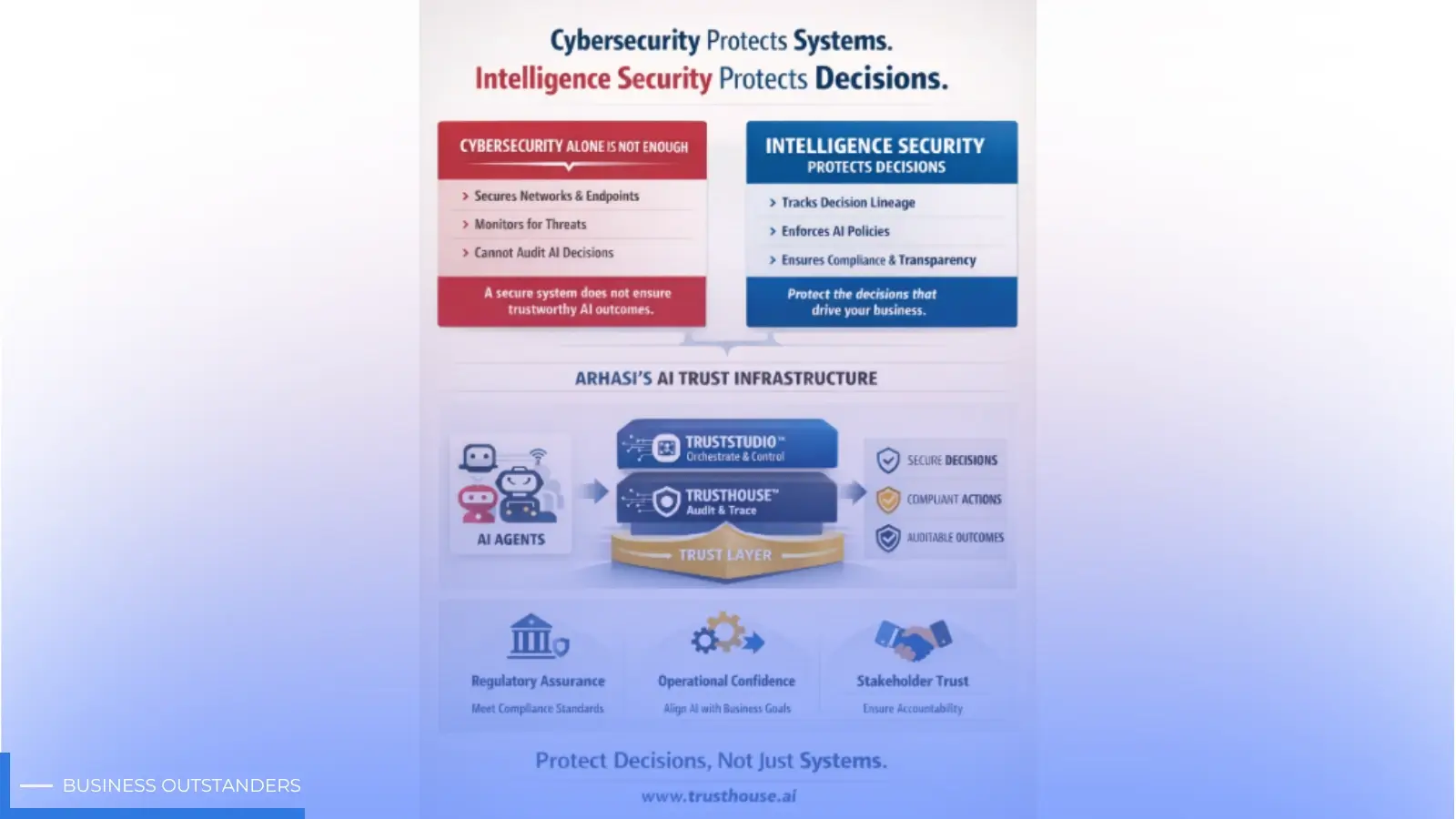
“Traditional cybersecurity protects your systems. Intelligence security protects your decisions and in the age of AI, that’s the new frontier.”, Chiru Bhavansikar, Chief AI Officer of Arhasi
As enterprises deploy AI agents at scale, protecting the infrastructure is no longer sufficient. While cybersecurity tools safeguard networks, servers, and endpoints, they cannot ensure that AI-driven decisions are accurate, compliant, or aligned with business objectives. Arhasi introduces intelligence security, a paradigm designed to fill this critical gap.
The Limits of Cybersecurity
Cybersecurity has historically focused on keeping threats out. Firewalls, intrusion detection systems, endpoint protection, and network monitoring defend against external attacks. These are essential smart security strategies — but they only go so far.
But in an AI-driven enterprise:
- A system can be secure yet produce flawed decisions.
- Biases in AI models may go undetected.
- Regulatory compliance requires decision traceability, which traditional tools cannot provide.
“Cybersecurity protects systems but without governance and oversight, AI decisions remain invisible and untrustworthy.” — Arhasi
Simply put, cybersecurity protects infrastructure; intelligence security protects outcomes.
Intelligence Security: Protecting Decisions
Intelligence security ensures AI-driven actions are trustworthy, auditable, and aligned with policy. Its core capabilities include:
- Decision Lineage: Trace every AI decision from data inputs to model outputs and human approvals.
- Policy Enforcement: Ensure AI actions comply with internal rules and regulatory requirements.
- Auditability: Provide regulators and boards with complete visibility into AI operations.
- Operational Alignment: Guarantee AI decisions meet business objectives and risk thresholds.
“In a world where AI makes critical business decisions, protecting the decision itself is as important as protecting the system it runs on.” — Arhasi
Why Cybersecurity Alone is Inadequate
Organizations often assume that securing systems is enough. But AI introduces a new class of risk that traditional cybersecurity cannot address.
- Automated lending: A secure system may approve discriminatory loans, violating regulations.
- Insurance claims: AI can produce inconsistent or noncompliant recommendations even in a secure environment.
- Healthcare: Clinical AI decisions may be operationally correct but not auditable or explainable.
“A secure system does not equal a trusted decision. Enterprises need visibility, lineage, and policy enforcement to truly trust AI outcomes.” — Arhasi
Arhasi’s AI Trust Infrastructure
Arhasi addresses these challenges with AI Trust Infrastructure, combining governance, orchestration, and decision provenance.
TrustStudio:
- Orchestrates AI agents across workflows.
- Ensures policy enforcement automatically.
- Acts as a control plane for enterprise AI operations.
TrustHouse:
- Captures decision lineage and approvals.
- Provides auditability and transparency across AI actions.
- Ensures every AI decision is traceable and defensible.
“Together, TrustStudio and TrustHouse ensure AI is not just operational but trustworthy, auditable, and aligned with enterprise objectives.” — Arhasi
The Business Case
Enterprises face significant risks when scaling AI without intelligence security:
- Regulatory penalties for noncompliant AI decisions.
- Reputational damage from errors or biased recommendations.
- Operational inefficiency from inconsistent agent behavior.
Adopting intelligence security delivers tangible benefits:
- Faster adoption of AI agents with confidence.
- Reduced risk exposure through policy enforcement and oversight.
- Stakeholder trust, as boards, regulators, and customers can rely on AI outcomes.
“Enterprises that secure decisions, not just systems, gain a strategic advantage in AI deployment.” — Arhasi
Timing is Everything
As AI adoption accelerates, enterprises are realizing that system security alone is insufficient. Protecting decisions is now a top priority, particularly in regulated industries like finance, insurance, and healthcare.
By defining the category of AI Trust Infrastructure, Arhasi positions itself as the foundational layer for responsible AI adoption, providing governance, oversight, and auditability at scale.
Conclusion
The future of enterprise AI depends on trustworthy decision-making, not just secure systems. Cybersecurity protects the infrastructure, while intelligence security ensures every AI-driven decision is accurate, compliant, and auditable.
With Arhasi’s AI Trust Infrastructure, TrustHouse.AI, enterprises can scale AI responsibly, confidently, and safely.
About Arhasi
Arhasi is the pioneer of Integrity First AI, an architectural and operational discipline for high-trust and autonomous enterprise solutions. In a landscape where AI “build” costs are plummeting, Arhasi provides the essential Trust infrastructure that ensures custom intelligence remains ethical, verifiable, and secure.
Unlike traditional SaaS providers, Arhasi delivers AI Decision & Trust Infrastructure, integrating trusted insights, trusted workflows and trust infrastructure. Based in Frisco, TX, Arhasi serves global enterprises that want to move fast with integrity. At Arhasi, we believe that for AI to be truly powerful, it must first be principled.
Business Outstanders brings you sharp insights on tech, business, entrepreneurship, law, crypto, and more. We uncover what’s next. Stay updated, sign up for our newsletter and be part of the future!