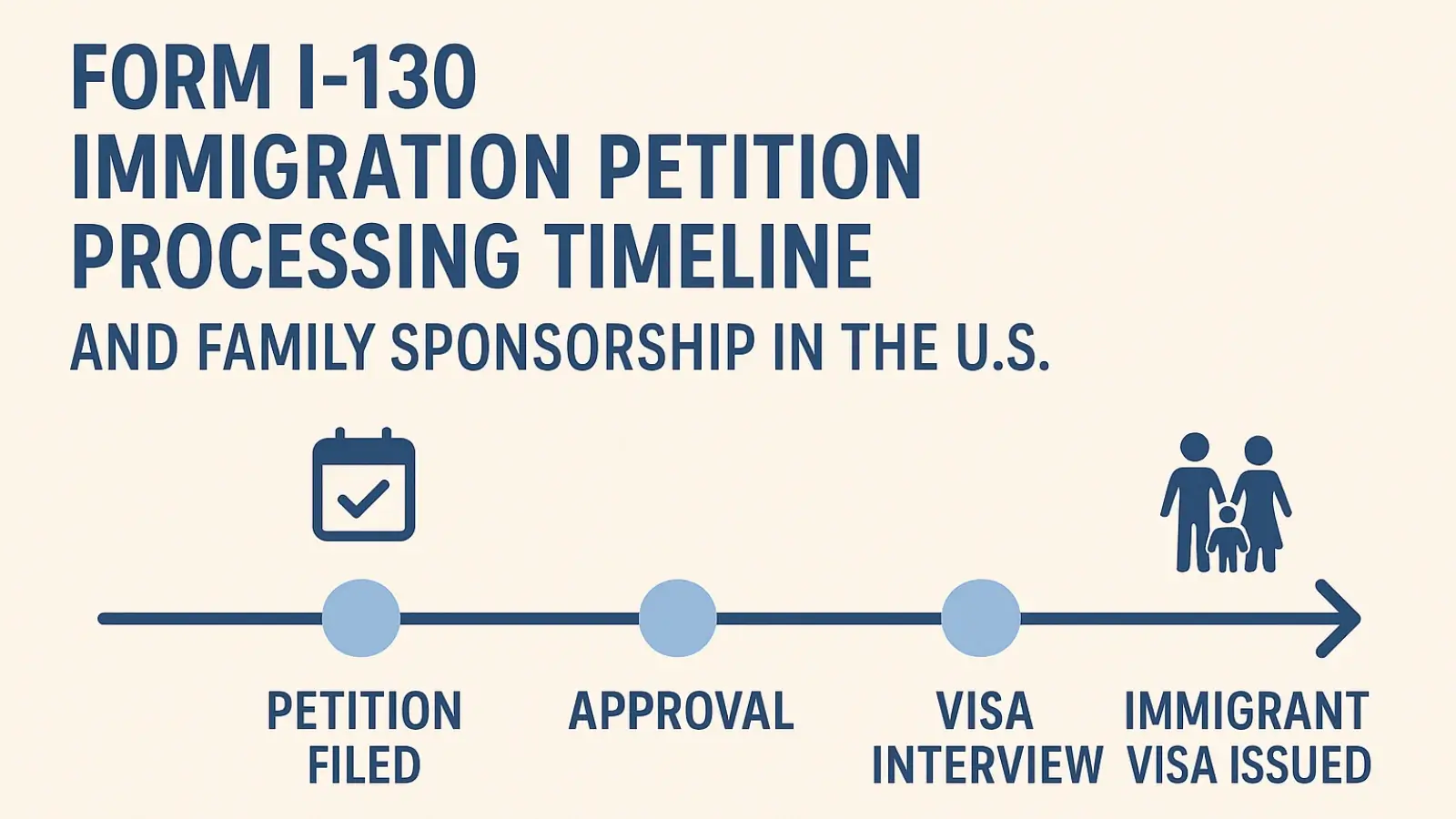
For anyone seeking to sponsor a family member for permanent residency in the United States, the process begins with one foundational form: Form I-130, Petition for Alien Relative. This petition, filed by the U.S. citizen or Legal Permanent Resident (LPR) relative (the petitioner), is merely the gatekeeper. Its approval does not grant a Green Card; it simply establishes the legally required family relationship between the petitioner and the beneficiary.
While the requirements to prove a valid relationship are generally straightforward, the I-130 processing time is notoriously long, unpredictable, and often the first source of major anxiety for families. The timeline is dictated by two primary factors: the Service Center's internal workload and, critically, the category of the family relationship.
Understanding the true nature of the wait—and taking proactive steps to avoid common pitfalls—is the only way to retain control during this anxious period.
The Two Timelines: Immediate Relatives vs. Preference Categories
The most significant factor influencing the I-130 processing time is the relationship between the petitioner and the beneficiary. The U.S. immigration system places family relationships into two starkly different groups:
1. Immediate Relatives (The Fastest Path)
This group is defined as the spouse, unmarried minor child (under age 21), and parent of a U.S. Citizen.
-
Timeline: While the actual I-130 processing time can still be substantial (often 10 to 18 months, depending on the Service Center), this category is not subject to annual visa quotas.
-
The Advantage: Once the I-130 is approved, a visa number is immediately available. This means the beneficiary can immediately file the next step—either the I-485 Adjustment of Status (if in the U.S.) or start Consular Processing (if abroad). This eliminates the longest wait period inherent in the system.
2. Family Preference Categories (The Decade-Long Wait)
All other family relationships—such as the adult child of a U.S. citizen, or the spouse and children of a Legal Permanent Resident (LPR)—fall under the numerically limited Family Preference Categories.
-
Timeline: The I-130 processing time here is split into two phases.
-
I-130 Adjudication: The initial processing time to approve the family relationship (typically 12 to 24 months).
-
The Visa Backlog: After I-130 approval, the beneficiary must then wait for a visa number to become available based on the monthly Visa Bulletin. For certain categories and nationalities (e.g., India, Mexico, Philippines), this backlog can extend the total wait to many years, sometimes exceeding a decade.
The USCIS Service Center Factor
The second major determinant of the I-130 processing time is the specific Service Center (or Lockbox) that handles your case. USCIS processing times fluctuate constantly, sometimes varying by more than 10 months between centers like the California Service Center and the Nebraska Service Center.
Strategic Considerations for the Petitioner:
-
Filing Location: The physical address where you mail your petition (the Lockbox) dictates which Service Center will adjudicate your case. This is generally based on the beneficiary’s eligibility category, the petitioner's state of residence, and whether the I-130 is filed concurrently with the I-485.
-
Fluctuating Efficiency: USCIS regularly publishes case processing data, but relying on this data for long-term prediction is unwise. The best strategy is to prepare a flawless petition from the start, as an incomplete filing that results in a Request for Evidence (RFE) is the single biggest contributor to administrative delays. You can track the official USCIS Case Processing Data online.
The Critical Role of the Priority Date
For those in the Preference Categories, the I-130 processing time for the initial approval is secondary to the date you establish your Priority Date.
-
Priority Date Definition: The Priority Date is the day USCIS receives the properly filed Form I-130. This date determines your place in the global queue for a visa number.
-
The Wait: Once the I-130 is approved, the petitioner must track the monthly Visa Bulletin published by the Department of State. When the date listed in the Visa Bulletin advances to meet or pass your Priority Date, your visa number is considered "current," and you can proceed to the final step (Adjustment of Status or Consular Processing).
This means the best way to regain control over the timeline is to file the I-130 as early as possible—even if the backlog is long—to secure the most advantageous spot in the queue. Delaying the initial filing only delays the eventual Green Card.
Taking Control: What You Can Do
While much of the I-130 processing time is outside your direct control, the proactive applicant can avoid the preventable delays that extend the wait unnecessarily:
-
Meticulous Preparation: Ensure the petition is fully complete, all necessary translations are certified, and all required forms of evidence (marriage certificates, birth certificates, divorce decrees) are included and legally valid. An RFE for missing evidence can easily add 3 to 6 months to your timeline.
-
Proactive Follow-Up: Use the USCIS Case Status Online tool to track your case using the receipt number provided by the initial I-797C notice. Do not wait for paper mail for status updates.
-
Avoid Petitioning for Ineligible Relatives: Attorneys must use the "clear-eyed" approach to advise clients on which categories are feasible. For instance, an LPR cannot petition for a married child; that requires the LPR to become a U.S. citizen first. Filing an incorrect petition adds years of wasted time and expense.
The wait for the I-130 processing time may be long, but a clear understanding of the process and a commitment to meticulous preparation ensures that you are maximizing efficiency and minimizing the time spent in bureaucratic limbo.
Business Outstanders brings you sharp insights on tech, business, entrepreneurship, law, crypto, and more. We uncover what’s next. Stay updated, sign up for our newsletter and be part of the future!