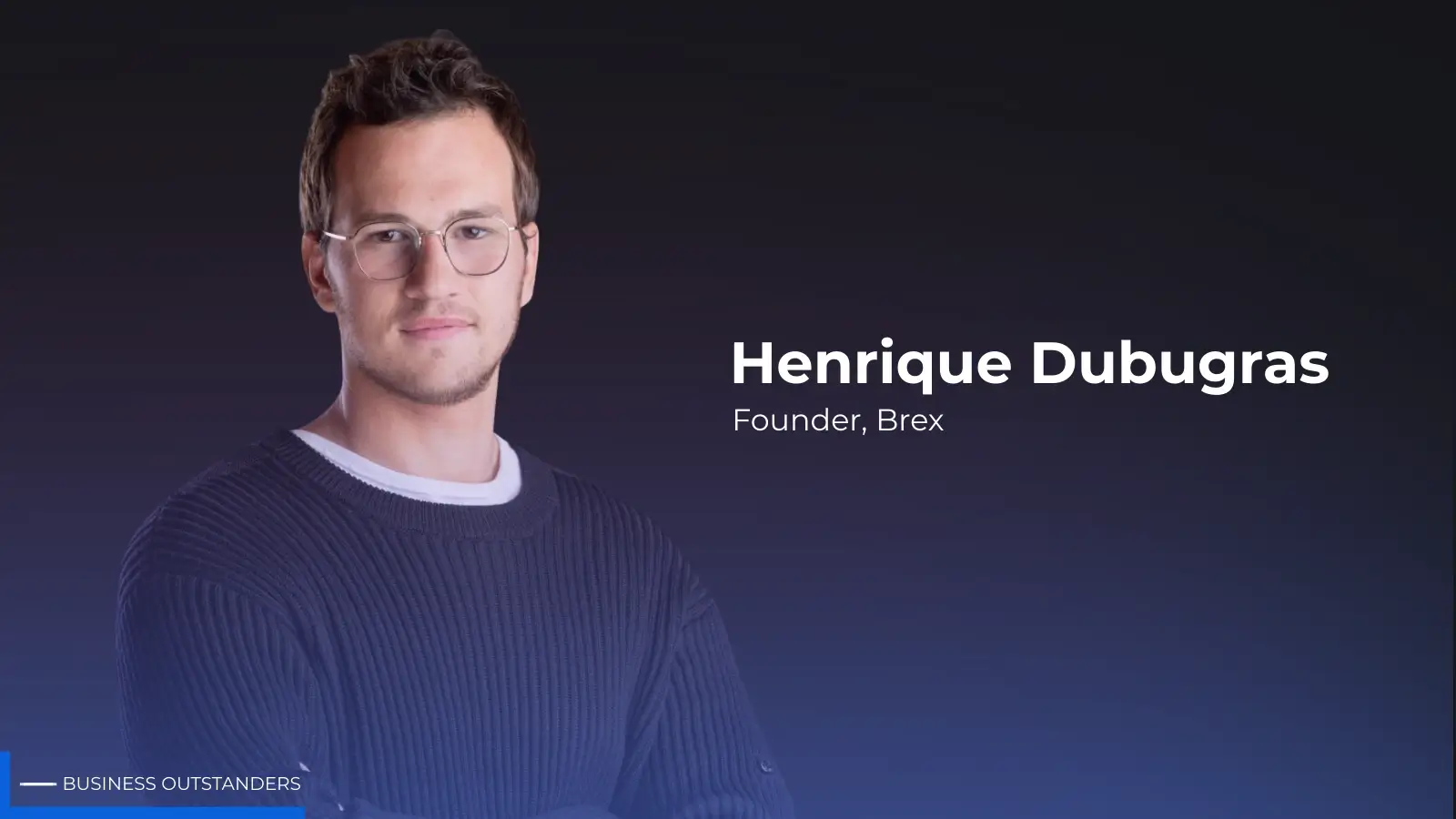
When Henrique Dubugras was 12 years old, he wanted to play a video game his parents refused to buy. So he did what most kids would never think to do, he learned to code and built it himself. That same stubborn resourcefulness, the kind that turns “no” into a technical workaround, is what eventually gave birth to Brex, a fintech company now valued at $12 billion.
Today, Henrique Dubugras is recognized as one of the most consequential young entrepreneurs in Silicon Valley. He is the co-founder and Chairman of Brex, a company that fundamentally changed how startups access corporate credit. But to understand why Brex exists, you first have to understand where Henrique came from.
From São Paulo to Silicon Valley: A Founder's Origin Story
Henrique Dubugras was born in 1995 in São Paulo, Brazil. Growing up in one of Latin America's most competitive cities, he was surrounded by ambition, but his earliest ambitions had nothing to do with finance or startups. They had to do with games.
"I started coding when I was 12 because there was this game I wanted to play. It was like a paid game and my parents didn't want to pay for me; I figured out, if I learned how to code, I could play it for free."
That spark became a fire. By 14, he was building small apps and websites. By 16, he was running a payments company.
Building Pagar.me at 16: The Startup That Taught Him Everything
In 2013, at just 16 years old, Henrique co-founded Pagar.me alongside Pedro Franceschi, a fellow coder he had met the year prior in an unlikely way, a Twitter argument. What started as a heated online disagreement quickly turned into a Skype call, then a friendship, and eventually a decade-long business partnership.
Pagar.me was Brazil's answer to Stripe, a payment processing platform built for a market that desperately needed modern infrastructure. Within three years, the company processed over $1.5 billion in transaction volume, won Microsoft's Startup of the Year prize at the 2014 Spark Awards, and grew to a team of over 100 people. In September 2016, they sold it.
Henrique was 21. He had already sold a $1.5 billion volume business, managed a company with more than a hundred employees, and navigated the labyrinth of Brazilian fintech regulation. That kind of experience, earned the hard way, is not something you get in a classroom.
Stanford, a Dropout Decision, and the Birth of Brex
After selling Pagar.me, Henrique and Pedro enrolled at Stanford University to study computer science. They lasted less than a year.
During their time in Y Combinator's 2017 batch, they spotted a problem hiding in plain sight. Every startup founder around them, people who had raised millions of dollars in venture funding, could not get a corporate credit card without putting their personal assets on the line. Banks evaluated personal credit scores instead of company cash flow, exposing a major flaw in the traditional founder credit strategy most financial institutions relied on. Their systems were built for established businesses, not venture-backed startups with millions in funding but no operating history.
"By seeing that problem of our batchmates and ourselves not being able to get a corporate credit card or having to personally guarantee it, we had the idea of building something better."
That insight became Brex.
What Made Brex Different From Day One
Brex launched in 2017 with a product that sounded almost too simple: a corporate credit card for startups that required no personal guarantee. But the execution behind it was anything but simple.
Instead of relying on personal credit history, Brex built its own underwriting models using real-time data, bank balances, funding rounds, spending patterns. This let them offer credit limits 10 to 20 times higher than traditional cards, approve companies instantly, and extend access to founders who had previously been turned away by every major bank.
"When we're redefining the experience, there's no way you can just build an app on top of an existing thing."
That philosophy meant building from scratch, proprietary technology, original underwriting logic, and a financial infrastructure designed entirely around how modern startups actually operate.
Within 22 months of launching, Brex had raised $215 million across three funding rounds. It became the fastest U.S. B2B company ever to reach a $1 billion valuation. Henrique and Pedro were featured on Forbes' 2019 '30 Under 30: Finance' list, and by 2022, both appeared on the Forbes Billionaires list as the youngest self-made billionaires added that year.
The Strategic Pivot That Defined Brex's Next Chapter
Not every chapter of the Brex story was a straight line upward. In 2022, the company made a decision that caught the startup world off guard, it stopped serving small, unregistered businesses to focus entirely on venture-backed startups and mid-market companies.
For many observers, it looked like Brex was turning its back on the very customers who helped build its reputation. But Henrique saw it differently. The decision was about focus, about choosing to serve one segment exceptionally rather than serving everyone adequately. It was an unpopular call. It was also, by most measures, the right one.
Brex has since expanded well beyond corporate cards into a full spend management platform, offering global cards, travel management, and AI-powered financial tools for CFOs and finance leaders worldwide. Companies like Airbnb, DoorDash, and Carta now count Brex among their financial infrastructure.
"We're not just building a product; we're reimagining the entire financial stack for businesses."
The Co-Founder Relationship: More Than a Business Partnership
One of the more unusual aspects of the Brex story is the depth of the partnership between Henrique and Pedro. They didn't just build companies together, they moved countries together, lived together, navigated the stress of hypergrowth together, and built a social circle together. Pedro even officiated Henrique's wedding.
In June 2024, Henrique announced a shift in their co-CEO structure. After nearly a decade of running Brex together as equals, they decided the company's next phase required a single decision-maker at the helm. Pedro became the sole CEO. Henrique stepped into the role of Chairman of the Board.
"Pedro and I started working together as co-founders when we were 16 years old, almost 12 years ago. Role definition is always a complicated topic for co-founders, but it was never complicated for us, given our complementary skillsets and the fact that we are also best friends."
The transition, as Henrique framed it, wasn't about stepping back. It was about the business needing to evolve, and both founders being mature enough to let it.
Beyond Brex: Boards, Investments, and Giving Back
Henrique Dubugras doesn't limit his work to Brex. He sits on the boards of Expedia Group and MercadoLibre, two of the most recognized companies in their respective industries. He is also an advisor to Hash and remains involved in Instituto Alpha Lumen, where he supports education and fundraising near his hometown in Brazil.
In the early days of Estudar nos EUA (Study in the USA), a platform he founded in March 2012, he worked to help Brazilian students access information about studying abroad. That early instinct to create access, to level the playing field for people who didn't fit the traditional mold, runs through everything he has built since.
What Henrique Dubugras Thinks About Building a Company
Over the years, Henrique has been direct about what he believes drives company-building at the highest level. He talks often about the difference between short-term and long-term thinking, and the need for both.
"I would say there are two ways of thinking about the world. One is: let's see what's short-term working and keep doing it. The other way is being willing to be more long-term oriented. And none of them are actually worse than the other. You need a mix of both."
On the topic of fundraising, he emphasizes clarity over charisma.
"I think that fundraising is about clarity. Being really good at fundraising means being really good at sharing the story of where we are, where we're going to go and why it's good work."
And when asked about the biggest danger for co-founders, his answer is blunt.
"The key pitfall is a zero-sum mentality. The best way to generate wealth is not to get more of the pie, it's just to make the pie bigger."
Henrique Dubugras Valuation, and What the Numbers Actually Mean
As of the most recent reporting, Brex carries a valuation of $12.3 billion. Henrique Dubugras's personal net worth, as reported by Forbes, places him firmly in billionaire territory, a status he reached before his 27th birthday.
But in most of his interviews and public appearances, Henrique doesn't speak much about wealth. He speaks about problems worth solving, systems worth building, and teams worth leading. For someone who started coding to dodge a $5 video game purchase, the obsession was never about money. It was about what happens when you care more about figuring something out than you care about being told it's impossible.
The Bigger Picture: Why Henrique Dubugras Matters to Founders
The Henrique Dubugras story sits at the intersection of immigrant ambition, technical depth, and institutional disruption. He and Pedro didn't walk into a broken system and ask for permission to fix it. They built an alternative and let the results speak.
For founders watching from the outside, especially those in Latin America, those who have been turned down for funding, those who were told the system wasn't built for people like them, Brex is proof that the system itself can be redesigned.
His path from a São Paulo kid who learned to code for a free video game to the Chairman of a $12 billion company isn't a lucky accident. It is the product of two decades of relentless curiosity, sharp execution, and an unshakeable belief that the next version of something can always be built better than the last.
Explore More Success Stories: Discover more inspiring entrepreneurial journeys, leadership lessons, and business success stories in the BusinessOutstanders.com Success Stories category.
Business Outstanders brings you sharp insights on tech, business, entrepreneurship, law, crypto, and more. We uncover what’s next. Stay updated, sign up for our newsletter and be part of the future!