Abstract
This article examines the evolution of a quality management system within a small manufacturing enterprise specializing in the production of auto accessories. The objective of the study is to analyze the transition from an informal quality management approach based on the founder’s personal supervision to a systematic, multi-level quality control model encompassing incoming material inspection, in-process control, finished goods inspection, and customer feedback.
Using the example of an enterprise operating since 2010, the study traces the development of a quality culture under conditions of limited resources, product assortment expansion, and workforce growth. It is demonstrated that the consistent implementation of control points throughout all stages of the production cycle made it possible to reduce the defect rate from 8.4% in 2013 to 1.8% in 2019, while revenue simultaneously increased by 138%.
Practical principles for building an effective quality management system in small consumer goods manufacturing businesses are formulated.
Introduction
Product quality is a fundamental prerequisite for the long-term competitiveness of any manufacturing enterprise; however, the issue of quality is particularly acute for small businesses. Unlike large corporations that possess dedicated quality assurance departments, ISO 9001-certified processes, and specialized measurement equipment, small enterprises are compelled to build quality management systems under conditions of limited resources, multifunctional personnel, and constant pressure from day-to-day operational demands [1].
At the same time, product quality becomes the primary instrument of competitive differentiation for small manufacturers. A customer who receives a high-quality product develops loyalty and generates repeat purchases and in small manufacturing, especially industrial manufacturing, quality and precision are what set businesses apart; conversely, in the era of digital communications, a dissatisfied customer can inflict reputational damage disproportionate to the size of the enterprise itself [3].
This article analyzes a six-year experience of developing a quality management system within a specific small manufacturing business.
Theoretical Foundations: Quality Management in the Context of SMEs
Classical quality management concepts—TQM (Total Quality Management), Deming’s PDCA cycles, and Six Sigma systems—were developed primarily for large industrial enterprises [2]. For small businesses, their direct implementation is associated with significant difficulties, including high implementation costs, the need for dedicated specialist personnel, and process bureaucratization that is incompatible with the flexibility that constitutes a key competitive advantage of SMEs [4].
An alternative approach, widely recognized in small manufacturing practice, is the gradual and iterative establishment of control points within the production cycle without the formal implementation of comprehensive standards. This model assumes that, in the early stages, the founder’s personal supervision effectively serves as the quality system, gradually evolving into formalized procedures as production expands [5].
Evolution of the Quality System: Chronology of Changes (2013–2019)
2013–2014
Informal personal control. The founder personally inspects each finished product. Defect rate: 7–8%. Main causes of defects: mismatches in pattern dimensions and deviations in the quality of incoming materials.
2015–2016
Introduction of incoming material inspection. Development of simple checklists for the acceptance of fabric, fittings, and filling materials. Defect rate decreased to 4–5%. The need for in-process (operational) control was identified.
2017
Implementation of in-process control points. Quality control at cutting, assembly, and finishing stages. Initial attempts to systematize data on defect types. Defect rate: 3.2%.
2018
Formalization of procedures. Standardization of dimensions and tolerances for key product lines. Introduction of a returns and complaints tracking system as a data source for process improvement.
2019
Mature quality control system. Four levels of control: incoming inspection, in-process control, finished goods inspection, and customer feedback analysis. Defect rate: 1.8%. Revenue growth of 138% compared to 2013.
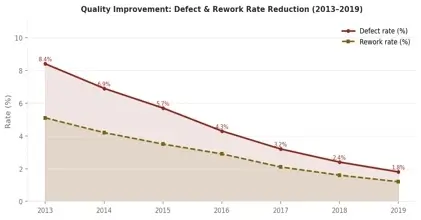
Figure 1. Quality Improvement: Defect & Rework Rate Reduction (2013–2019) — dynamics of the reduction in defect and rework rates.
Transformation of the Control Structure: From a Reactive to a Preventive Approach
A fundamental shift in the quality management system during the period 2015–2019 was the transition from reactive quality control—the identification and correction of defects in finished products—to a preventive approach aimed at preventing defects from occurring during the early stages of the production cycle. This transition represents a practical implementation of the principle that “quality is built into the process rather than inspected into the product,” a concept originally articulated in the works of W. Edwards Deming [2].
During the early stage (2013–2015), the majority of quality-control efforts were concentrated on the final inspection of finished products. This resulted in high rework costs and material losses due to the late detection of defects. As incoming inspection and in-process quality control were introduced, the focus gradually shifted: preventive control stages began to intercept problems at earlier and less costly points in the production process.
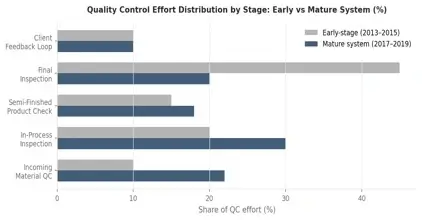
Figure 2. Quality Control Effort Distribution by Stage — distribution of quality-control efforts at the early and mature stages.
Quality as an Investment: The Economic Impact of a Systematic Approach
A common misconception among small manufacturing business owners is the belief that the costs associated with building a quality management system reduce profitability. The data from the analyzed case suggest the opposite: the gradual reduction of the defect rate from 8.4% to 1.8% was accompanied by sustained revenue growth and a simultaneous decrease in the share of quality-control costs relative to turnover, as preventive measures reduced the volume of rework and material losses [6].
The key mechanism behind this effect is the dual nature of quality as a competitive asset. On the one hand, quality reduces internal costs, including rework, returns, and customer complaints. On the other hand, it builds reputation and customer loyalty, thereby generating a stable flow of repeat orders without requiring additional marketing expenditures [3].
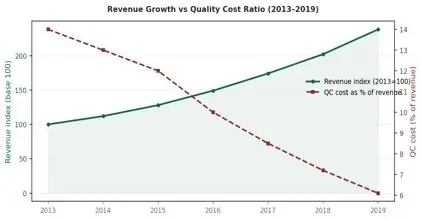
Figure 3. Revenue Growth vs Quality Cost Ratio (2013–2019) — revenue growth and the reduction in the proportion of quality-related costs.
Practical Principles for Building a Quality Management System in Small Manufacturing Enterprises
Based on the analysis of the case under consideration, the following practical principles can be formulated. These principles are applicable to a wide range of small manufacturing enterprises producing consumer goods.
|
Principle |
Practical Content |
|
Start with incoming inspection |
The greatest effect at the initial stage comes from controlling the quality of incoming materials; this prevents the propagation of defects throughout the entire production chain. |
|
Data over intuition |
Recording types and frequency of defects makes it possible to identify systemic causes and eliminate them, rather than addressing symptoms. |
|
The customer as a data source |
A system for tracking returns and complaints serves as a cost-free tool for identifying hidden defects and mismatches with customer expectations. |
|
Standardization before scaling |
Standardization of key product parameters should precede product line expansion and hiring of new employees. |
|
Quality = investment |
Costs of defect prevention are offset by reduced rework losses and increased customer loyalty. |
Conclusion
The analysis of a six-year evolution of the quality management system in a small manufacturing enterprise confirms that the consistent implementation of control points—from incoming material inspection to customer feedback analysis—is a key factor in achieving sustainable growth in competitive consumer markets. The reduction of the defect rate from 8.4% to 1.8% alongside a 138% increase in revenue clearly demonstrates that, in small-scale manufacturing, quality is not a cost but an investment with measurable returns. The proposed principles and tools are applicable to small consumer goods manufacturers regardless of specific product category.
References
- Storey D. J. Understanding the Small Business Sector. London: Routledge, 1994. 384 p.
- Deming W. E. Out of the Crisis. Cambridge: MIT Press, 1986. 507 p.
- Garvin D. A. Managing Quality: The Strategic and Competitive Edge. New York: Free Press, 1988. 319 p.
- Terziovski M. Quality Management Practices and Their Relationship with Customer Satisfaction and Productivity Improvement. Management Research Review, 2010, Vol. 33, No. 7, pp. 693–709.
- Hudson M., Smart A., Bourne M. Theory and Practice in SME Performance Measurement Systems. International Journal of Operations & Production Management, 2001, Vol. 21, No. 8, pp. 1096–1115.
- Feigenbaum A. V. Total Quality Control. 4th ed. New York: McGraw-Hill, 1991. 863 p.
Author:
Arkadi Khachaturian
Founder of a Family-Owned Auto Accessories Manufacturing Business
Business Outstanders brings you sharp insights on tech, business, entrepreneurship, law, crypto, and more. We uncover what’s next. Stay updated, sign up for our newsletter and be part of the future!