The IEEE SouthEast Conference 2026, held earlier in March, brought together engineers and researchers from across the region to present and discuss advances in emerging technologies. Among the many sessions was Akhil Koduri's presentation on "Hybrid LLM Architectures for On-Device and Cloud-Based Intelligence in Regulated Industries." The talk explored the architectural balance between edge computing and centralized AI systems in regulated industries—a topic that resonated deeply with engineers and healthcare IT professionals attending the session.
After the presentation, I spoke with Koduri about various challenges his work touched upon: the stubborn gap between AI's breathtaking advancement and its glacial adoption in high-stakes sectors. What began as a brief exchange evolved into a deeper exploration of why artificial intelligence remains largely theoretical in the places it could matter most.
This interview examines the "N×M integration problem," the rise of Agentic AI, and Koduri's proposed framework—the Regulated Enterprise MCP Suite (REMS)—for deploying trustworthy AI where patient safety and regulatory compliance are non-negotiable.
1. The Core Challenge: The N×M Integration Problem
Emily Wilson: After your presentation, we discussed why AI adoption lags in regulated sectors despite rapid model advancement. What's the fundamental bottleneck?
Akhil Koduri: The challenge has shifted. Two years ago, we asked, "Is the model smart enough?" Today, models are sufficient, but integration is the barrier. In healthcare and pharma, integration isn't just technical—it's governed by rigid data privacy requirements (HIPAA, GDPR) and clinical safety standards (GxP).
Historically, connecting an AI agent to core systems—FHIR databases, Laboratory Information Management Systems—required bespoke, point-to-point integrations. These custom connections were fragile, difficult to validate, and insecure, often relying on static API keys that sat in codebases for years. When every connection is a custom project fraught with security risks, you cannot scale.
Emily Wilson: You've described this as the "N×M integration problem." What does that mean?
Koduri: It describes exponential complexity when connecting N AI applications to M data sources. In a large hospital, you might have dozens of AI agents for clinical documentation, scheduling, and diagnostics, each needing to connect to hundreds of systems: EHRs, imaging archives, billing systems, drug databases.
Without a standard protocol, every connection is unique custom code. This creates an N×M matrix of bespoke integrations—a brittle, ungovernable web. It's why AI remains stuck in pilots. We need to turn N×M into N+1. That's what foundational standards now solve.
2. The Model Context Protocol: A Universal Standard
Emily Wilson: The industry is coalescing around the Model Context Protocol (MCP). You called it the "USB-C for AI." What does that mean?
Koduri: MCP, introduced by Anthropic in late 2024, is an open standard creating a universal interface for AI agents to interact with external tools and data. Before USB-C, we had different cables for everything. USB-C standardized the connector. MCP does the same digitally—it standardizes how an AI agent "plugs into" databases or APIs using JSON-RPC 2.0, eliminating custom code for every connection.
Emily Wilson: Is MCP alone sufficient for GxP-validated pharmaceutical companies?
Koduri: No. MCP is necessary but not sufficient. A protocol is just a language—it defines grammar but doesn't dictate what you should say or verify who's speaking. Raw MCP lacks governance, real-time safety checks, identity management, and immutable audit trails required in GxP environments. Regulated industries need a comprehensive framework that dictates how that language is used safely. That's the gap REMS fills.
3. The REMS Framework: Defense-in-Depth Architecture
Emily Wilson: What is REMS, and how does it make MCP production-ready?
Koduri: The Regulated Enterprise MCP Suite (REMS) encapsulates MCP within a rigorous governance shell. Unlike AI Gateways that manage LLM traffic and optimize costs, REMS provides an MCP Gateway—the "hands-and-tools manager" governing what the agent can actually do.
Emily Wilson: Walk us through the architecture.
Koduri: We use defense-in-depth with four layers:
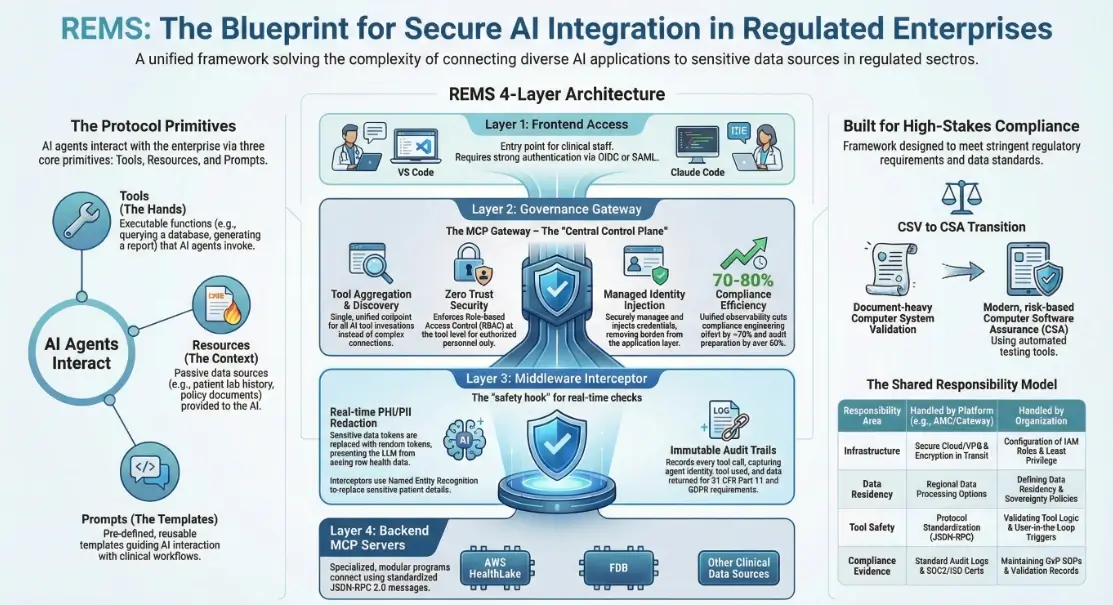
- Frontend Access Layer: Strong authentication (OIDC, SAML) ensures we know which human-in-the-loop initiates actions before any agentic process begins.
- Governance Gateway Layer: The system's heart. It enforces Zero Trust principles, replacing dangerous static API keys with short-lived, rotated tokens. Even if a connector is compromised, damage is contained.
- Middleware Interceptor Layer: Real-time traffic inspection. Before prompts reach the LLM, interceptors redact Protected Health Information. Before tools execute commands, interceptors validate payloads against safety schemas.
- Backend MCP Server Layer: Purpose-built, validated programs—AWS HealthLake for FHIR operations, First Databank for medication management—acting as authoritative sources of truth.
4. Safety by Design: Deterministic Guardrails
Emily Wilson: You distinguish between "safety" and "security." Explain that.
Koduri: Security protects the system from bad actors. Safety ensures the AI protects patients from the model's probabilistic nature. REMS integrates safety tools to create deterministic guardrails. For example, when an AI agent understands a physician's intent—"Calculate pediatric dosage"—we never let the LLM do math. LLMs are text predictors, not calculators. The agent extracts parameters, but a GxP-validated Python script executes the calculation.
Emily Wilson: How do you prevent hallucination?
Koduri: We mandate Retrieval-Augmented Generation (RAG) within the tool execution path. When a clinician asks for treatment recommendations, REMS prevents the LLM from relying solely on training data. The workflow triggers a tool querying vetted clinical databases—PubMed, hospital guidelines. We ground the model in verified facts, cutting off its ability to invent advice.
Emily Wilson: What about data privacy and HIPAA compliance?
Koduri: We use a PHI Redaction Microservice in the Middleware Layer employing tokenization. Using Named Entity Recognition, it scans prompts in real-time. If it detects patient names or medical record numbers, it swaps them for random tokens (e.g., PATIENT_ID_7f8a9). The LLM processes logic using tokens and never sees actual private data. PHI never leaves the secure enterprise boundary, dramatically reducing the blast radius of potential leaks.
5. Validation and Compliance: Audit-Ready Infrastructure
Emily Wilson: How does REMS address FDA Software as a Medical Device (SaMD) guidelines and the EU AI Act?
Koduri: REMS provides "infrastructure for evidence." For the EU AI Act, which classifies most healthcare AI as high-risk, we implement Agentic Observability. We don't just log errors—we trace the entire thought hierarchy: user prompt, gateway decision, tool call, database query. It's a black box recorder for every clinical session.
For FDA's SaMD framework, REMS enables Pre-determined Change Control Plans (PCCP). We programmatically lock AI agents to specific versions of clinical tools. The AI cannot accidentally use unvalidated drug database versions until updates are formally approved in the gateway.
Emily Wilson: How does this fit the shift from Computer System Validation (CSV) to Computer Software Assurance (CSA)?
Koduri: Traditional CSV was a paperwork nightmare focused on documentation volume rather than risk. CSA emphasizes critical thinking. REMS enables CSA by allowing organizations to validate the platform once. Once the Gateway and Protocol are validated, new tools inherit that trust. Teams focus intense testing on high-risk functions—altering prescriptions—while using automated testing for low-risk tools like policy queries. It breaks the validation bottleneck that kills innovation.
6. The Strategic Advantage
Emily Wilson: Beyond compliance, what's the strategic value for a CIO investing in REMS?
Koduri: The transition from fragmented experimentation to unified infrastructure. Instead of managing dozens of isolated AI pilots, a CIO gains a single, governed control plane. They can scale AI deployments without exponentially increasing compliance costs, future-proofing their architecture for the Agentic Healthcare Revolution.
Emily Wilson: Final advice for organizations beginning their agentic AI journey in regulated spaces?
Koduri: Prioritize trust, transparency, and traceability from day one. Don't treat compliance as a bolt-on feature—it must be architected from the foundation. The organizations that will lead won't be those moving fastest recklessly, but those building the most trustworthy systems. The question isn't if you need these governance layers, but how quickly you can implement them to unlock AI's potential safely.
Conclusion
The path to transformative AI in life sciences is paved with trust. As Koduri articulated, this trust cannot be an afterthought—it must be engineered. Frameworks like REMS represent critical evolution, moving beyond basic protocols to create comprehensive governance ecosystems. By building in security, deterministic safety, and deep auditability from the ground up, such architectures provide the essential blueprint for harnessing AI while upholding the highest standards of patient safety. The conversation that began after that March conference in Alabama has illuminated not just the problem, but a credible path forward.
Business Outstanders brings you sharp insights on tech, business, entrepreneurship, law, crypto, and more. We uncover what’s next. Stay updated, sign up for our newsletter and be part of the future!