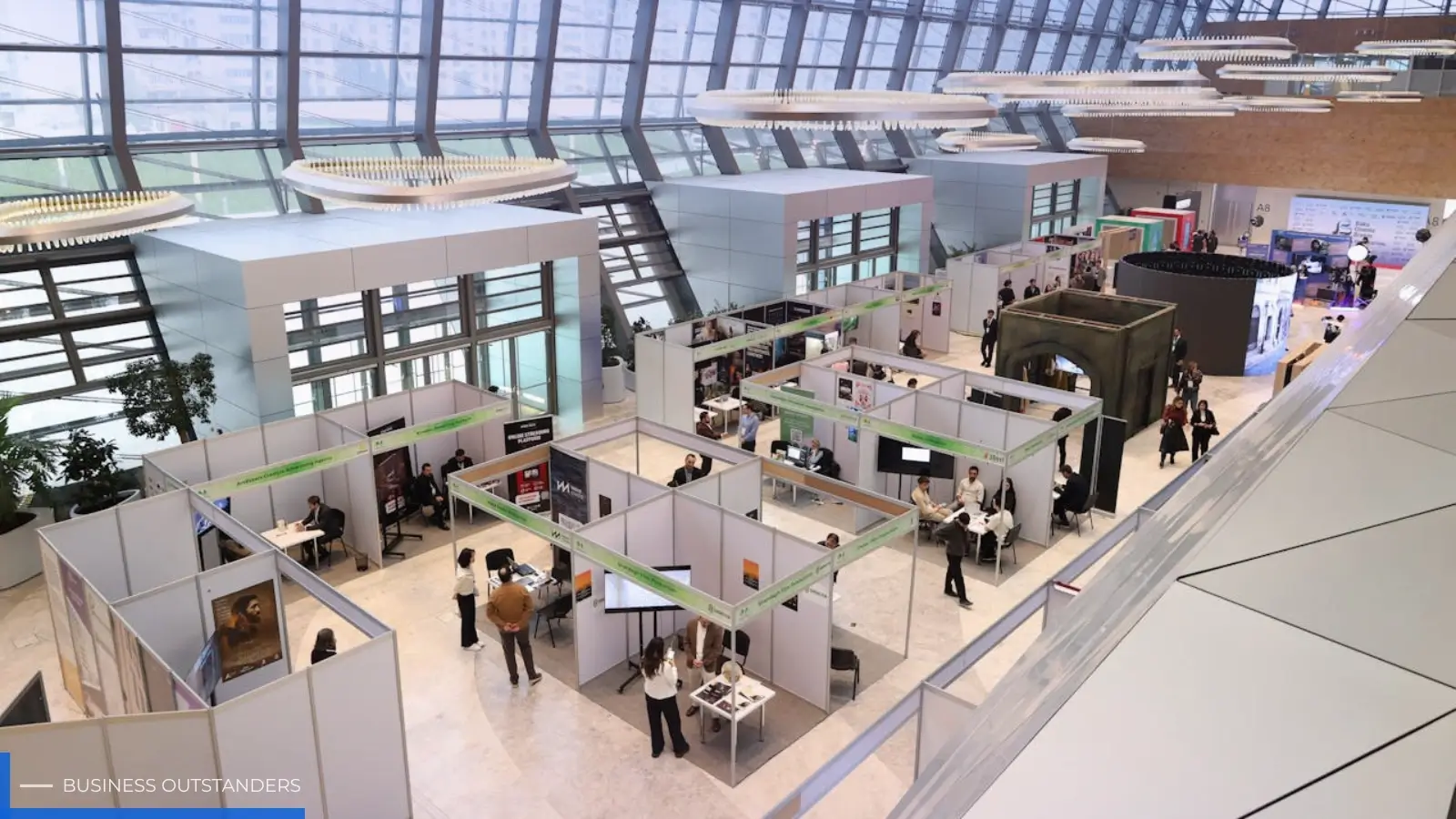
Trade show ROI is notoriously hard to measure, which is precisely why so many exhibitors tolerate displays that quietly lose them money year after year. The leads come in, someone closes a few, and the post-show report looks fine enough to justify another year's booking. Meanwhile, the display itself is leaking attention — letting qualified prospects wander over to the competitor across the aisle who got the fundamentals right.
These are the seven most common display mistakes on show floors today — and all of them are fixable with effective trade show booth design before your next event.
1. Leading with the logo
Your company name is the least interesting thing about you to someone who's never heard of you. Yet the single largest, boldest element on most displays is still the logo.
Think about it from the attendee's perspective: they're walking past 400 booths in a three-hour window. "ACME Industries" in 36-inch letters tells them nothing about whether you're worth stopping for. A headline that describes a result, a benefit, or a problem you solve — in seven words or fewer — does the work that a logo can't. Keep the logo. Shrink it. Give the prime real estate to a message that earns the stop.
2. Writing for readers, not skimmers
Second place in the mistake rankings: paragraph-length copy on the back wall. Nobody reads it. Not one person. It's a rookie display habit carried over from website design, where users sit still and scroll.
On a show floor, you have 2 to 5 seconds of aisle-view attention. Copy needs to be headline plus three bullet points maximum, each under eight words, with the bullets reading as benefits rather than features. "Cut inspection time 70%" beats "AI-powered automated inspection platform" every time.
3. Choosing graphics that don't photograph
Exhibitors still pick display graphics the way they'd pick a business card — neat, corporate, tasteful, slightly muted. Then they stand in front of them on day one and wonder why the team photos look dull.
Displays need to pop under overhead convention lighting, which is flat, high-kelvin, and unforgiving. That means higher contrast, bolder color blocks, and one or two saturated accent colors. If your brand guide is gentle pastels, work with your designer on a show-floor variant. Your social content from the event will look dramatically better, too.
4. Hiding what you sell
It sounds obvious, but walk any floor and count how many booths you can't identify the product or service of within five seconds. A quarter? More? These are companies that spent thousands on presence and forgot to tell anyone what they do.
Show the thing. A product photo, a screenshot of your software, a before/after comparison, a physical sample. Abstract imagery and stock photos of smiling handshakes don't clarify anything. Literal beats clever on the show floor.
5. Fronting the booth with a table
Every square foot of your front 36 inches is the most valuable real estate you'll rent all year. Putting a table across it is the exhibitor equivalent of building a fence in your storefront.
Move the table back. Or replace it with a single standing counter to one side. Leave the front open. Open booths get entered; closed booths get walked past. Your dwell time metrics will move the same week you make this change.
6. Underestimating setup and breakdown
This one bleeds ROI in a way that never shows up on the show report: displays that are a nightmare to assemble, travel heavy, and require freight rather than checked baggage. By the time your team has lost two hours to setup and another $600 to drayage, the display has already cost more than it needed to — and that's before anyone's scanned a single badge.
Exhibitors using well-designed trade show displays often reduce setup time, lower shipping costs, and improve overall event ROI.
If you're exhibiting more than three times a year, the lifetime labor and shipping cost of your display matters more than the upfront price. Modern modular systems are worth evaluating even if your current setup technically "works."
7. Not refreshing graphics often enough
The display hardware — the frame, the stand, the lighting — can reasonably last five to seven years. The graphics on it cannot. Messaging, pricing, product lineup, branding direction, and the market itself all move faster than that.
Budget for a graphics refresh every 18 to 24 months, or whenever a meaningful part of your pitch changes. A $600 graphics update on an existing frame is dramatically cheaper than a $6,000 new booth — and it's the part that actually talks to attendees.
The fix is usually simpler than a redesign
Here's the hopeful part: these aren't expensive problems to solve. Most of them are a reprint and a layout rethink, not a booth replacement. A clear headline, some bolder graphics, a moved table, and a fresh set of bullet points will materially change your floor performance at a show.
When you're ready to evaluate your setup end-to-end, investing in modern displays designed around attention economics — not just aesthetics — is the move that separates exhibitors who grow show-over-show from those quietly plateauing.
A quick self-audit
Before your next event, stand 20 feet in front of a photo of your current booth and time yourself. In five seconds, can a stranger tell: who you are, what you sell, and why they should care? If the answer to any of those is "not really," you've found your ROI leak — and you've found exactly where to invest your next marketing dollar.
Run the same test on three booths you photographed at your last show — two that pulled traffic and one that didn't. The ones drawing crowds almost always pass the five-second test cleanly, and the ones that didn't fail on at least one of the three questions. Once you've seen the pattern in someone else's booth, you'll never unsee it in your own.
Fix the mistakes above one at a time, starting with whichever costs the least to address — usually the headline and the table placement. Don't wait for a budget cycle or a booth redesign. The exhibitors who grow year over year are the ones who treat their display as a living piece of marketing infrastructure, not a fixed asset. Small changes compound, and the show floor rewards them fast.
Business Outstanders brings you sharp insights on tech, business, entrepreneurship, law, crypto, and more. We uncover what’s next. Stay updated, sign up for our newsletter and be part of the future!