**This post is sponsored by Semrush. When you purchase through links in this article, we may earn an affiliate commission from Semrush.**
For years, marketers have asked the same question.
"What's the best SEO tool?"
It sounds like a simple question, but it assumes there's a simple answer.
The truth is there probably isn't.
Search has become much more complicated than it was even a few years ago. Ranking well on Google still matters, but it is no longer the only place people discover brands. Someone might search on Google, ask ChatGPT for recommendations, compare answers in Perplexity, then visit your website only after seeing your brand mentioned several times.
That shift has caught many businesses off guard.
They haven't necessarily lost rankings, yet traffic continues to decline. According to a Semrush survey from September 2025, 59 percent of marketers reported experiencing traffic drops. At the same time, Google searches increasingly end without a click because AI-generated answers provide users with enough information before they ever visit a website.
SEO hasn't stopped working.
The way people search has simply expanded.
That is why experienced marketers are moving away from the idea of finding one perfect platform. Instead, they are building an SEO stack where each tool contributes something valuable. Some platforms excel at backlink analysis. Others are great for technical audits or content optimization. Increasingly, businesses also need a way to understand how they appear in AI-generated search results.
The goal is no longer to own every tool. It is to choose the right combination.
What Should Be in an SEO Stack Today?
If you look at the workflows of many successful marketing teams, you'll notice they rarely depend on one platform for everything.
A technical SEO crawler might help identify indexing issues. A specialized writing assistant may speed up content production. Some agencies even use dedicated reporting software because it fits their clients' needs better.
The foundation, however, is usually the platform that provides the broadest view of search performance.
That foundation should answer a few important questions.
Can you discover new keyword opportunities?
Can you understand why competitors outperform you?
Can you monitor backlinks and technical health?
Most importantly, can you see how your brand appears in AI-powered search experiences instead of relying only on traditional rankings?
Not every platform checks all of those boxes.
Comparing the Building Blocks
Semrush
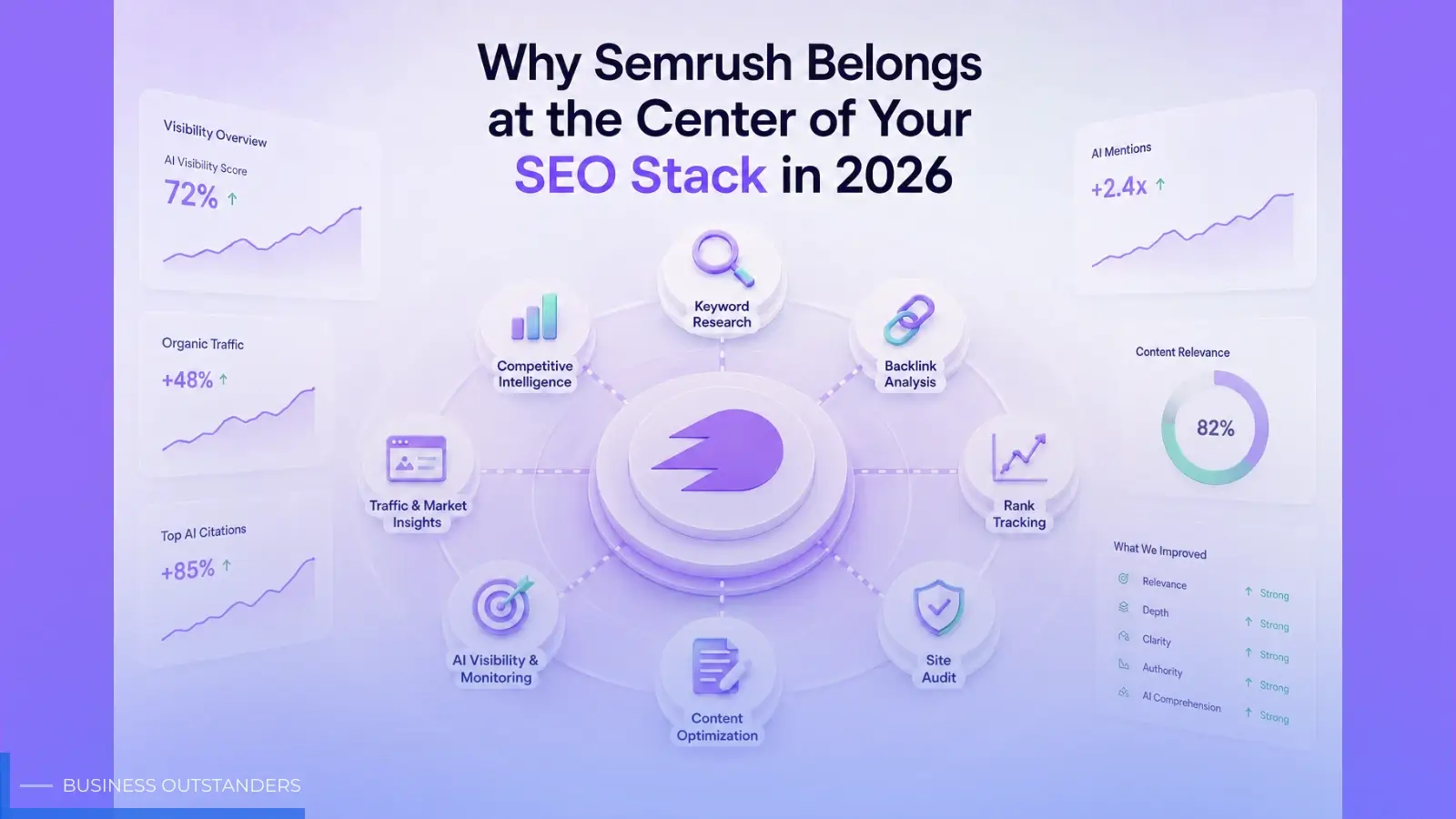
If you're choosing one platform to build around, Semrush is one of the strongest starting points because it covers more areas than most competitors without trying to replace every specialized tool you may already use.
Its traditional SEO capabilities are well established. You can research keywords, monitor rankings, analyze competitors, audit websites, build content strategies, and evaluate backlinks using one interface backed by extensive data. The platform includes access to 27.5 billion keywords across 142 databases, a backlink index containing 43 trillion links, and historical data dating back to 2012.
Where it stands apart is its focus on AI visibility.
As AI search continues to grow, marketers increasingly want answers to questions they couldn't even ask a year ago. Is ChatGPT mentioning my brand? Which competitors appear more often in AI-generated recommendations? Are AI answers accurately describing my products?
Semrush's AI Visibility Toolkit was built for exactly that purpose.
It tracks visibility across Google AI Mode, AI Overviews, ChatGPT, Gemini, and Perplexity while monitoring citations, sentiment, competitor performance, and prompt visibility. Semrush has also shared that it increased its own share of voice from 13 percent to 32 percent in one month by using these insights internally.
The biggest limitation is cost. With pricing starting at $199 per month for the Starter plan, it is designed for businesses that intend to invest seriously in search. There is also a learning curve simply because the platform offers so much.
Still, if you want one platform to anchor your SEO stack while adapting to the future of search, Semrush makes a compelling case.
Ahrefs
Ahrefs continues to earn its reputation for backlink research.
Its Site Explorer remains one of the fastest ways to investigate competitors, understand link profiles, and uncover opportunities that might otherwise be missed. Many SEO professionals also appreciate its keyword research tools and clean interface.
Where it becomes less comprehensive is AI visibility.
Although AI-related features have started to appear, businesses looking for continuous monitoring across multiple AI search platforms may need an additional solution. Ahrefs works exceptionally well for backlink-focused workflows, but many teams now pair it with other platforms as search evolves.
Moz Pro
Moz has always focused on making SEO approachable.
For freelancers, local businesses, and marketing teams learning SEO, it remains one of the easiest platforms to navigate. Its reports are straightforward, and the learning curve is much lower than many enterprise-level tools.
Its limitations become more noticeable as businesses grow.
Compared with larger competitors, its keyword and backlink datasets are smaller, and it currently lacks the AI visibility capabilities that many brands are beginning to prioritize. It remains a dependable option for foundational SEO, but growing teams often supplement it with additional tools over time.
Build Around Your Needs, Not Someone Else's
One mistake many businesses make is trying to copy another company's software stack.
What works for a global agency managing hundreds of websites may be unnecessary for a local business. Likewise, a solo consultant may not need the same reporting features that an in-house marketing department depends on every day.
The better approach is to think about the work you actually do.
If technical SEO is your biggest challenge, invest in a platform that excels there. If backlinks drive your strategy, prioritize tools with strong link intelligence. If you're noticing fewer clicks despite stable rankings, make sure AI visibility becomes part of your workflow.
That is exactly why Semrush deserves serious consideration. It does not claim to eliminate the need for every other tool, and it shouldn't. Instead, it provides one of the broadest views of modern search by combining trusted SEO capabilities with AI visibility in a single platform.
As search continues to change, the strongest marketing teams will not be the ones with the longest list of subscriptions. They will be the ones using the right combination of tools to answer the questions that matter.
If you're planning your SEO stack for 2026, start with a platform that helps you understand both traditional search and AI discovery. Explore what Semrush offers, compare it with your current workflow, and build a toolkit that prepares your business for where search is going next, not where it has already been.
Business Outstanders brings you sharp insights on tech, business, entrepreneurship, law, crypto, and more. We uncover what’s next. Stay updated, sign up for our newsletter and be part of the future!