The Foundations of Business Strategy and Marketing
The year 2026 continues to bring rapid shifts in market conditions and consumer behavior. For businesses aiming for sustainable growth and a lasting competitive edge, a unified approach to strategy and marketing is more crucial than ever. We understand that navigating these changes requires careful planning and continuous adaptation.
This guide explores how to build truly aligned brands by understanding the critical distinctions between business and marketing strategy, and why their seamless integration is vital for success. We will delve into how modern organizations are leveraging the power of artificial intelligence (AI) and the often-overlooked role of human intuition to create highly effective, adaptive, and anti-burnout systems.
We'll examine how innovative approaches, from data-driven AI solutions to more human-centric practices like Intuitive email marketing, are shaping the future of brand building. Join us as we uncover the frameworks, insights, and actionable steps needed to align your brand strategy for 2026 and beyond.
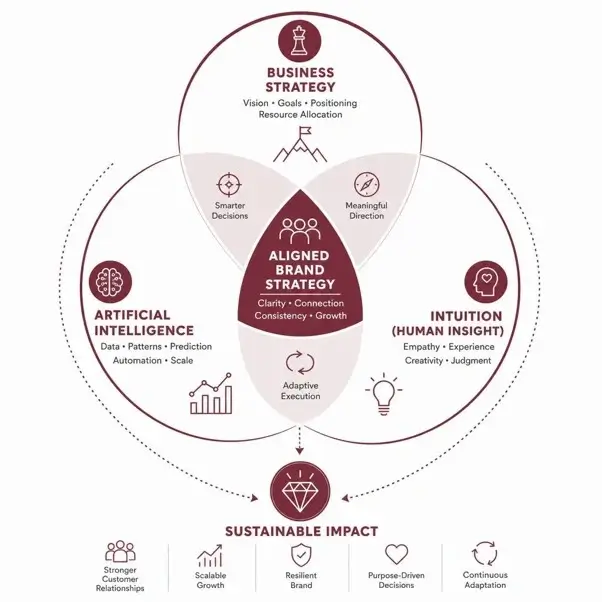
At the core of any successful enterprise lies a robust business strategy. This overarching plan defines a company's long-term vision, objectives, and the fundamental approaches it will take to achieve them. It's about making critical decisions on where to compete, how to allocate resources, and what unique value proposition the organization will offer to gain a competitive advantage. Think of it as the blueprint for the entire organization, guiding every major decision from product development to market entry.
Business strategy operates on distinct levels to ensure comprehensive organizational alignment:
- Corporate-Level Strategy: This defines the overall scope and direction of the entire organization, addressing questions like which industries or markets to operate in. It focuses on maximizing shareholder value across a portfolio of businesses.
- Business-Level Strategy: Here, the focus narrows to how a specific business unit will compete within its chosen market. This involves developing a competitive advantage, whether through cost leadership, differentiation, or niche focus.
- Functional-Level Strategy: This level outlines how each functional department (e.g., marketing, operations, finance, HR) will support the business-level strategy. For instance, a marketing department's strategy will directly contribute to the broader business goals.
Understanding these levels is crucial because they dictate how resources are deployed and how the company positions itself for long-term success. A well-defined business strategy provides clarity on the organization's long-term direction, ensures resources are allocated efficiently to strategic priorities, and forms the basis for sustainable competitive advantage. It's a living document, constantly reviewed and adapted to market dynamics, as detailed in comprehensive guides like "Strategic Market Management, 12th Edition," which offers updated frameworks for environmental analysis and target market selection. For those looking to deepen their understanding of how companies identify, select, implement, and adapt market-driven business strategies for profitable growth in competitive markets, exploring resources such as Strategic Market Management, 12th Edition | Wiley can be immensely beneficial.
It's important to distinguish a business strategy from a business plan. While often used interchangeably, they serve different purposes. A business strategy is the long-term, adaptable vision and direction, focusing on what the company aims to achieve and why. In contrast, a business plan is a detailed, structured document outlining how the strategy will be executed over a shorter period, covering operational details, financial projections, and specific tactics. The strategy sets the destination, while the plan maps out the journey.
Why Business Strategy and Marketing Must Align
The intrinsic link between business strategy and marketing strategy cannot be overstated. Marketing isn't merely a function; it's the voice and ears of the business, translating the core strategy into market-facing actions and bringing market insights back to inform strategic decisions. When these two are misaligned, efforts become fragmented, resources are wasted, and the path to achieving organizational goals becomes unclear.
The primary objective of this alignment is to drive revenue growth, enhance customer engagement, and solidify brand identity. A marketing strategy that is deeply integrated with the overall business strategy ensures that every campaign, every message, and every customer interaction contributes directly to the company's broader objectives. This means:
- Driving Revenue Growth: Marketing efforts are not just about awareness; they must directly support sales targets and revenue streams. If the business strategy aims for market penetration, marketing will focus on aggressive pricing and broad distribution. If the strategy is differentiation, marketing will highlight unique product features and premium branding.
- Enhancing Customer Engagement: A clear business strategy defines the ideal customer. Marketing then crafts tailored messages and experiences that resonate with this audience, fostering deeper connections and loyalty. This includes defining a compelling value proposition that speaks directly to customer needs and ensuring product-market fit.
- Solidifying Brand Identity: The brand is the promise a company makes to its customers. Marketing is responsible for consistently communicating and delivering on this promise, ensuring that the brand identity reflects the core values and strategic positioning of the business. As outlined in guides on creating a complete marketing strategy, a strong brand identity is crucial for standing out in a crowded marketplace. For a deeper dive into crafting effective marketing plans, resources like How to create a complete marketing strategy [data + expert tips] offer invaluable insights into aligning marketing efforts with overarching business goals.
Furthermore, alignment ensures that marketing efforts are guided by SMART (Specific, Measurable, Achievable, Relevant, Time-bound) goals that directly cascade from the business's strategic objectives. This creates a cohesive organizational effort where every department understands its role in achieving the collective vision. Without this synergy, marketing risks operating in a silo, potentially promoting products or services that don't align with the company's long-term direction or target the wrong customer segments.
Modern Frameworks for Business Strategy and Marketing
In 2026, the complexity of the market demands structured approaches to strategy development. Two frameworks stand out for their effectiveness in guiding the creation of comprehensive marketing strategies: SOSTAC and STP. These models provide a systematic way to analyze the market, set objectives, define strategies, implement tactics, and control performance, ensuring marketing efforts are robust and aligned.
The SOSTAC framework, developed by PR Smith, offers a logical planning process that covers six key areas:
- Situation Analysis (Where are we now?): This involves a thorough review of the current market landscape, including internal capabilities, customer behavior, competitor analysis, and macro-environmental factors (PESTLE analysis). It helps businesses understand their starting point.
- Objectives (Where do we want to be?): This stage defines specific, measurable, achievable, relevant, and time-bound (SMART) goals for the marketing strategy. These objectives must directly support the broader business goals, such as increasing market share by 15% or improving customer retention by 10% within the next year.
- Strategy (How do we get there?): This is the core direction and approach to achieve the objectives. It involves identifying the target audience, crafting a unique value proposition, and outlining the overall themes that will guide marketing activities. This is where the STP model often comes into play.
- Tactics (How exactly do we get there?): This stage details the specific marketing channels and tools that will be used to implement the strategy. This could include digital marketing channels (SEO, social media, email, PPC), traditional advertising, content marketing, and public relations.
- Action (Who does what, when?): This is the implementation phase, breaking down tactics into concrete tasks, assigning responsibilities, setting timelines, and allocating budgets. It ensures that the strategy is put into motion effectively.
- Control (How do we monitor performance?): This final stage focuses on measuring progress against objectives, using key performance indicators (KPIs) and analytics. It involves regular reviews, reporting, and making necessary adjustments to optimize performance.
Complementing SOSTAC, the STP (Segmentation, Targeting, Positioning) model is fundamental for developing a focused marketing strategy:
- Segmentation: This involves dividing the total market into distinct groups of customers who share similar needs, characteristics, or behaviors. Segmentation can be based on demographics, psychographics, geographic location, or behavioral patterns.
- Targeting: After segmenting the market, businesses select one or more segments to focus their marketing efforts on. The choice of target segments depends on their attractiveness, size, growth potential, and alignment with the company's capabilities.
- Positioning: This is about creating a clear, distinctive, and desirable place for the product or brand in the minds of the target customers relative to competitors. It involves crafting a unique value proposition and communicating it effectively through the marketing mix.
By integrating SOSTAC with STP, businesses can develop a comprehensive marketing strategy that is both strategically sound and practically actionable. The STP model provides the "Strategy" component of SOSTAC, ensuring that marketing efforts are precisely aimed at the right audience with the right message. For a detailed guide on building a marketing strategy plan for the current year, including the integration of these frameworks, resources like Marketing Strategy Plan: Step-by-Step Guide to Growth (2026) offer invaluable templates and insights. Companies with documented marketing strategies are reportedly 313% more likely to report success, underscoring the importance of such structured planning.
Integrating AI, Intuition, and Anti-Burnout Systems
The marketing landscape of 2026 is increasingly shaped by technological advancements, particularly in artificial intelligence, while simultaneously demanding a more human-centric and sustainable approach to business. Integrating AI with intuition and designing anti-burnout systems is key to creating a resilient and high-performing marketing strategy.
AI has revolutionized how we approach marketing, offering unparalleled capabilities in data analysis, personalization, and automation. AI tools can predict customer behavior with remarkable accuracy, optimize ad placements for maximum impact, and even generate dynamic content tailored to individual preferences. This leads to highly effective customer segmentation, where AI can identify subtle patterns in vast datasets to create hyper-targeted campaigns. For instance, AI-powered predictive analytics can forecast which customers are most likely to churn, allowing for proactive retention strategies. Similarly, it can identify cross-selling and up-selling opportunities, driving significant revenue growth. Businesses looking to leverage these advanced capabilities for strategic advantage often turn to specialized platforms for AI-Powered Strategy & Marketing.
However, relying solely on algorithms risks losing the nuanced understanding that only human intuition can provide. Intuition-based decision-making, often dismissed in a data-driven world, plays a crucial role in creative strategy, understanding brand sentiment, and navigating unpredictable market shifts. It's about recognizing emerging trends before the data fully validates them, understanding unspoken customer needs, and infusing marketing with authentic, heart-led entrepreneurship. This human element ensures that marketing remains empathetic and resonant, building genuine connections rather than just optimizing for clicks.
Moreover, the relentless pace of modern marketing, fueled by technology, can lead to burnout among teams. Sustainable business practices must extend to the well-being of employees. Anti-burnout systems involve streamlining workflows, automating repetitive tasks (where AI shines), fostering a culture of balanced work, and prioritizing mental health. For instance, automating routine email campaigns through advanced platforms can free up marketing teams to focus on strategic thinking and creative development, preventing the exhaustion that comes from manual, repetitive tasks. This also allows for more thoughtful and effective approaches, such as building truly Intuitive email marketing campaigns that resonate deeply with recipients.
The evolution of content marketing also benefits from this integrated approach. While AI can assist in generating content ideas, optimizing for SEO, and even drafting initial versions, the unique voice, storytelling, and emotional appeal must come from human creativity. Similarly, omnichannel integration, which ensures a seamless customer experience across all touchpoints, requires both AI to manage complex data flows and human insight to design cohesive journeys. As we move through 2026, the most effective marketing strategies will be those that master this synergy. Resources like "7 Steps to Build a Marketing Strategy That Actually Works in 2026" emphasize the need for structure over mere tactics, highlighting how a well-structured approach, integrating AI and human oversight, can lead to sustainable growth and prevent team fatigue. To ensure your marketing strategy is robust and adaptable, especially with the rapid changes in technology and consumer behavior, consider the practical framework outlined in 7 Steps to Build a Marketing Strategy That Actually Works in 2026. This approach helps in optimizing resource allocation and ensures that both technological tools and human creativity are utilized to their full potential.
Market Intelligence and Performance Measurement
In the dynamic business environment of 2026, staying ahead requires more than just a good strategy; it demands continuous market intelligence and rigorous performance measurement. These elements are the feedback loops that allow businesses to adapt their strategies to changing market conditions, evolving consumer behaviors, and emerging trends.
Market research forms the bedrock of both business and marketing strategies. It involves systematically gathering, analyzing, and interpreting data about customers, competitors, and the broader market. This includes:
- Customer Analysis: Understanding who your customers are, their needs, preferences, pain points, and buying behaviors. This can involve surveys, focus groups, interviews, and analysis of customer data.
- Market Trends: Identifying shifts in consumer tastes, technological advancements, regulatory changes, and economic factors that could impact the business.
- Industry Landscape: Gaining insights into market size, growth rates, and key drivers.
Competitor analysis is equally vital. It involves identifying direct and indirect competitors, assessing their strengths and weaknesses, understanding their strategies, and anticipating their moves. Tools like SWOT analysis (Strengths, Weaknesses, Opportunities, Threats) are invaluable here, helping businesses to identify their unique competitive advantages and potential vulnerabilities. This intelligence allows companies to refine their value proposition, differentiate their offerings, and develop strategies to outperform rivals. For executives seeking to deepen their strategic market analysis capabilities, programs such as those focused on strategic marketing for driving growth offer advanced insights into competitor intelligence and market dynamics. Leaders looking to sharpen their analytical skills and develop an integrated marketing strategy that blends traditional and AI-driven approaches can find immense value in executive education programs like Strategic Marketing for Driving Growth | Executive Education.
Once strategies are in motion, measuring their success is paramount. This is where Key Performance Indicators (KPIs) and Return on Investment (ROI) tracking come into play. KPIs are specific, quantifiable metrics used to evaluate the effectiveness of a strategy in achieving its objectives. For marketing, KPIs might include website traffic, conversion rates, customer acquisition cost (CAC), customer lifetime value (CLTV), social media engagement, and brand sentiment. For overall business strategy, KPIs could involve revenue growth, profit margins, market share, and employee retention.
Effective measurement involves:
- Setting Clear Benchmarks: Establishing baseline data before implementing a new strategy to accurately assess its impact.
- Regular Monitoring: Continuously tracking KPIs through dashboards and analytics tools to identify trends and anomalies.
- Attribution Models: Understanding which marketing efforts contribute to conversions and sales, though in a multi-touchpoint world, perfect attribution can be challenging. Directional clarity is often sufficient to inform decisions.
- Feedback Loops: Using the insights gained from KPI tracking to inform strategic adjustments. This involves regular reviews (e.g., quarterly) to assess what's working, what's not, and why.
The ability to adapt strategies to changing conditions is a hallmark of successful businesses in 2026. Market research and performance data provide the necessary information to make informed decisions about pivoting, optimizing, or scaling initiatives. This continuous cycle of planning, execution, measurement, and adaptation ensures that both business and marketing strategies remain relevant and effective in a constantly evolving marketplace.
Frequently Asked Questions about Business Strategy and Marketing
Navigating the complexities of business and marketing in 2026 often brings up common questions. Here, we address some of the most pressing inquiries regarding strategic planning and marketing execution.
What is the main difference between business strategy and marketing strategy?
The core distinction lies in their scope and focus. Business strategy is the overarching, long-term plan that defines the entire organization's direction, competitive advantage, and resource allocation across all functions. It answers what the company wants to achieve and why. Its timeframe is typically long-term, guiding decisions across corporate, business, and functional levels.
Marketing strategy, conversely, is a component of the broader business strategy. It specifically focuses on how the company will promote its products or services to its target audience to achieve its marketing and sales objectives. It answers how the company will communicate its value proposition and reach customers. While it has its own long-term considerations, its timeframe is often more tactical and responsive to market changes, directly supporting the business's overall goals. For a more detailed breakdown, exploring resources like The difference between Business Strategy and Marketing Strategy can provide further clarity.
How does AI enhance modern marketing strategies without losing the human touch?
AI significantly enhances modern marketing strategies by providing powerful tools for automation, personalization, and data-driven insights, but it doesn't replace the human touch; rather, it augments it. AI excels at:
- Automation: Handling repetitive tasks like email scheduling, ad bidding, and basic content generation, freeing up human marketers for more strategic and creative work.
- Personalization: Analyzing vast amounts of customer data to deliver highly relevant content, product recommendations, and offers, creating more engaging experiences.
- Predictive Analytics: Forecasting customer behavior, identifying trends, and optimizing campaigns for better performance.
However, the human touch remains indispensable for:
- Brand Voice and Storytelling: Crafting compelling narratives and maintaining an authentic brand voice that resonates emotionally with audiences.
- Intuition and Creativity: Developing innovative campaigns, understanding nuanced customer emotions, and making strategic pivots that data alone might not suggest.
- Ethical Oversight: Ensuring AI usage is responsible, transparent, and aligns with brand values and customer trust.
The most effective strategies in 2026 integrate AI as a powerful assistant, allowing human marketers to focus on creativity, empathy, and strategic thinking, enhancing both efficiency and impact.
Why is a documented strategy critical for business success?
A documented strategy is not just a formality; it's a critical tool that significantly increases a business's chances of success. Several compelling reasons highlight its importance:
- Clarity and Direction: A written strategy provides a clear roadmap for everyone in the organization, ensuring alignment on goals, priorities, and methods. This minimizes confusion and ensures that all efforts are channeled towards common objectives.
- Increased Success Rates: Statistics consistently show that companies with documented strategies are significantly more successful. For instance, businesses with documented marketing strategies are reportedly 313% more likely to report success than those without one. This isn't just about having a plan, but the process of creating it, which forces critical thinking and foresight.
- Improved Goal Setting: Documenting a strategy necessitates setting clear, measurable goals. Marketers who set clear, measurable goals are approximately 377% more successful than those who do not. This structured approach to goal setting provides tangible targets to aim for and metrics to track progress.
- Efficient Resource Optimization: A documented strategy helps in allocating resources (time, money, personnel) effectively by prioritizing initiatives that directly contribute to strategic goals. It prevents wasted effort on activities that don't align with the overall direction.
- Adaptability and Accountability: A written strategy serves as a baseline for continuous monitoring and evaluation. It makes it easier to identify deviations, understand what needs adjustment, and hold teams accountable for their contributions. It also provides a framework for adapting to changing market conditions without losing sight of the core vision.
A documented strategy transforms abstract ideas into actionable plans, fostering accountability, efficiency, and a much higher probability of achieving desired business outcomes.
Conclusion
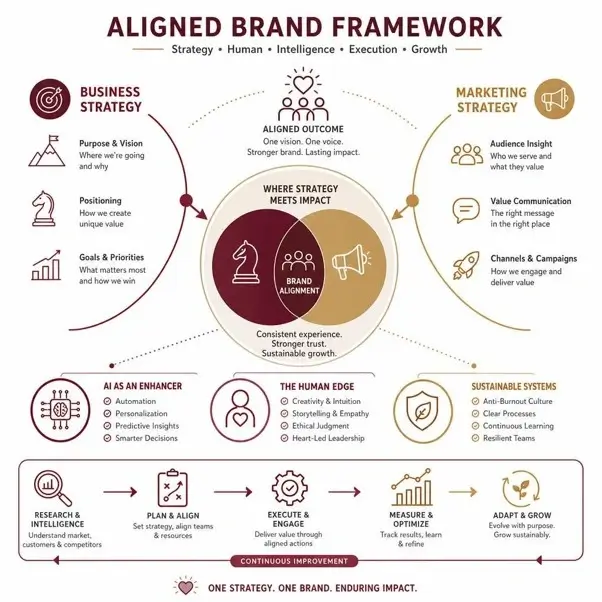
As we navigate the complexities of 2026, the imperative for businesses to build truly aligned brands has never been clearer. The journey begins with a robust understanding of the distinction and symbiotic relationship between business strategy and marketing strategy. By integrating these two pillars, organizations can ensure that every action, from corporate vision to a specific marketing campaign, contributes to a cohesive and powerful brand presence.
The modern landscape demands more than traditional approaches. It calls for the strategic integration of cutting-edge technologies like AI to enhance personalization, optimize campaigns, and automate routine tasks. Yet, this technological prowess must be balanced with the invaluable human elements of intuition, creativity, and heart-led leadership. Furthermore, building anti-burnout systems and fostering sustainable growth practices are not just ethical considerations but strategic advantages, ensuring that teams remain energized and innovative.
By embracing market intelligence through diligent research and competitor analysis, and by rigorously measuring performance against clear KPIs, businesses can remain agile and responsive to ever-changing conditions. This continuous cycle of planning, execution, measurement, and adaptation is the hallmark of enduring success. Building an aligned brand in 2026 means harmonizing strategic intent with market execution, leveraging technology intelligently, and nurturing the human spirit within the enterprise. It's about designing a business that is not only profitable but also purposeful and resilient.
Business Outstanders brings you sharp insights on tech, business, entrepreneurship, law, crypto, and more. We uncover what’s next. Stay updated, sign up for our newsletter and be part of the future!