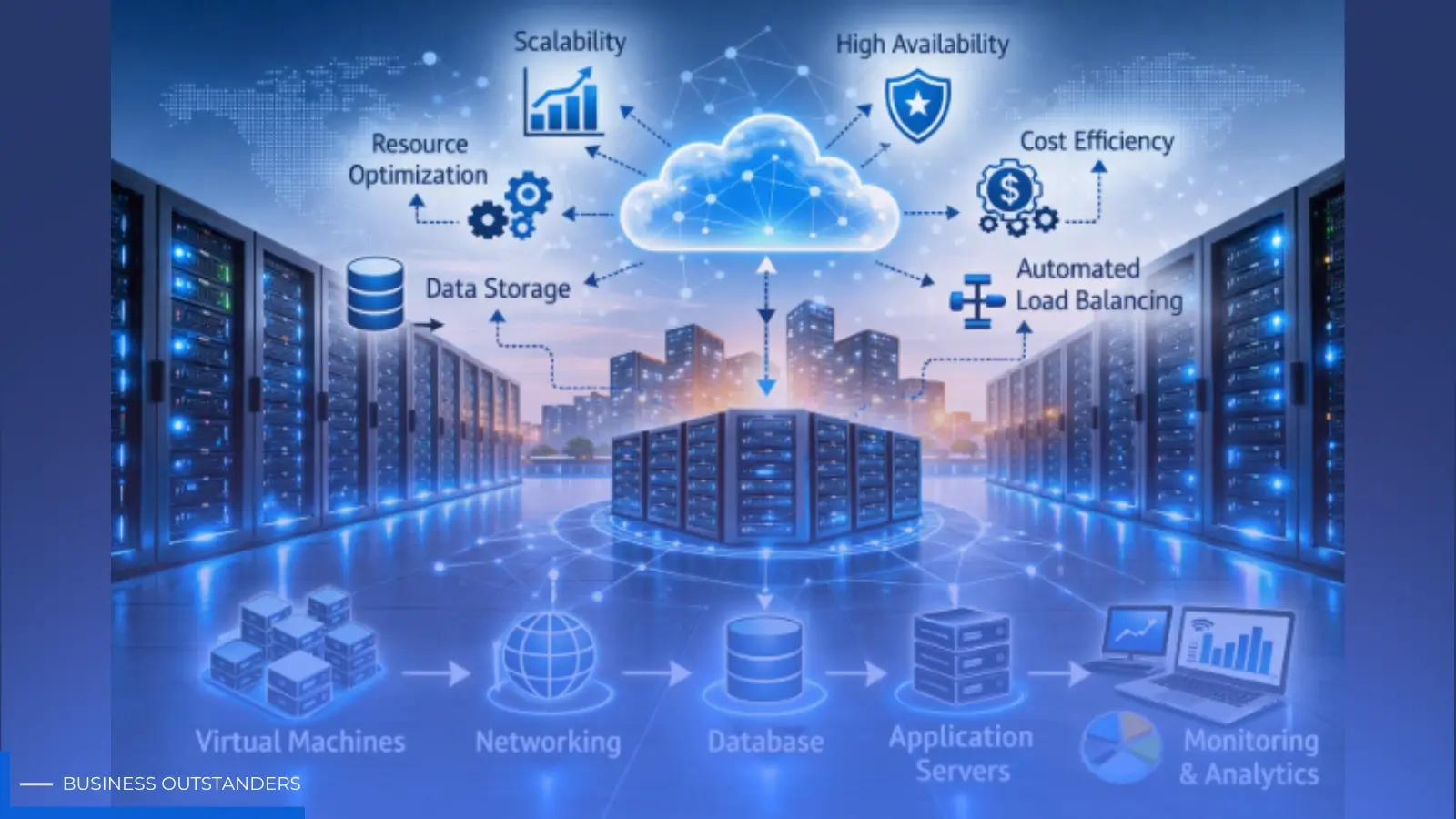
As global enterprises accelerate their migration to cloud-native infrastructure, one technical layer increasingly determines operational efficiency, system resilience, and cost optimization: intelligent load balancing. While cloud computing promises elasticity and distributed scalability, the way workloads are allocated across virtual machines ultimately defines performance stability and enterprise competitiveness. For example, major cloud providers and hardware partners are already scaling up AI-driven cloud infrastructure globally, such as Nvidia’s industrial AI cloud initiative in Germany that exemplifies enterprise-scale AI-optimized infrastructure.
Addressing this challenge is Prashant Awasthi, a Technical Architecture Manager and Artificial Intelligence researcher whose Springer publication, Evaluating the Need of Reinforcement Learning by Implementing Heuristic Algorithms with Its Load Balancing and Performance Testing in Cloud, examines whether traditional scheduling mechanisms remain sufficient for today’s dynamic cloud ecosystems—or whether reinforcement learning represents the next evolution in adaptive orchestration.
Historically, cloud scheduling has relied on heuristic algorithms such as First Come First Serve (FCFS), Shortest Job First (SJF), and Highest Response Ratio Next (HRRN). These models were built for predictability and simplicity, functioning effectively in structured environments. However, modern enterprise platforms operate in high-variability, multi-tenant ecosystems where demand fluctuates unpredictably. Static scheduling frameworks struggle to adapt to real-time workload spikes, priority changes, and uneven resource utilization.
To evaluate these limitations, Awasthi and his collaborators conducted controlled simulations across ten cloud scenarios, scaling infrastructure from five to fifty virtual machines using WorkflowSim. Each algorithm was tested under varying load conditions to measure deviation from ideal workload distribution. The results demonstrated that while HRRN outperformed FCFS and SJF in comparative load management, none of the heuristic approaches delivered consistent optimization across all environments. As workload intensity increased, imbalance widened, revealing structural rigidity in fixed-rule scheduling systems.
Empirical regression analysis further validated these findings. Awasthi’s statistical modeling confirmed that heuristic frameworks lack the adaptive intelligence necessary to sustain equilibrium in dynamic cloud ecosystems. This conclusion led to the central proposition of the research: integrating reinforcement learning into the load balancing layer.
Reinforcement learning fundamentally transforms how scheduling decisions are made. Unlike deterministic algorithms, RL systems learn from environmental feedback. Allocation decisions are evaluated through reward mechanisms, enabling continuous refinement of strategy. Over time, the system adapts to workload patterns, learning optimal responses without requiring predefined rules.
In Awasthi’s proposed architecture, a Q-table reward framework evaluates scheduling outcomes and adjusts task allocation dynamically. Rather than reacting passively to demand fluctuations, the load balancer evolves with the environment. This adaptive capability is particularly critical in enterprise environments processing millions of concurrent transactions, where even minor inefficiencies can lead to latency spikes, SLA violations, or inflated operational costs.
The implications extend beyond performance metrics. Intelligent load balancing improves virtual machine utilization, reduces task starvation, stabilizes Quality of Service (QoS), and enhances system resilience during traffic surges. Unlike conventional machine learning models that depend on labeled datasets, reinforcement learning operates through iterative optimization, making it highly suitable for real-time cloud orchestration.
What distinguishes Awasthi’s work is its integration of research with enterprise-scale implementation. With over two decades of experience in digital transformation and leadership of large modernization initiatives across North America, his research reflects operational realities rather than theoretical abstraction. In enterprise cloud environments supporting finance, logistics, insurance, and supply chain systems, load balancing efficiency directly influences infrastructure cost, energy consumption, and scalability.
Data centers represent significant operational expenditure for organizations. Improved workload distribution enhances resource utilization and reduces computational waste. In an era where sustainability and cost discipline are strategic priorities, adaptive reinforcement learning models provide measurable economic value.
The broader economic context further underscores the importance of this research. Cloud infrastructure forms the backbone of the U.S. digital economy, supporting banking networks, e-commerce platforms, healthcare systems, logistics operations, and enterprise SaaS ecosystems. Intelligent orchestration strengthens digital reliability and improves resilience against performance disruptions. As evaluated in Awasthi’s peer-reviewed research, RL-based load balancing can contribute to productivity gains and operational competitiveness by minimizing downtime and optimizing infrastructure usage.
The research ultimately positions reinforcement learning not as a theoretical enhancement, but as a structural evolution in cloud architecture. Traditional scheduling operates as a static control layer. Reinforcement learning introduces a self-improving intelligence engine capable of continuous adaptation. Hybrid models that combine heuristic efficiency with RL adaptability represent a pragmatic pathway toward resilient cloud ecosystems.
As computational demands intensify and enterprises pursue greater scalability, adaptive load balancing will become a defining component of performance engineering. The question is no longer whether cloud systems require intelligent orchestration—but how quickly they can transition from rule-based scheduling to learning-driven infrastructure.
Through empirical validation, architectural modeling, and enterprise alignment, Prashant Awasthi’s work advances the conversation from algorithm comparison to cloud intelligence reinvention. In doing so, it reflects a broader transformation underway in digital infrastructure—where intelligent systems do not merely execute tasks, but continuously optimize themselves.
About the Researcher
Prashant Awasthi is a Technical Architecture Manager and Artificial Intelligence researcher with over 20 years of experience in enterprise digital transformation, cloud-native architecture, and AI-driven optimization systems. He has authored multiple peer-reviewed publications in internationally recognized venues including Springer, IEEE, Elsevier, and Taylor & Francis. His research focuses on reinforcement learning for cloud load balancing, intelligent automation frameworks, and scalable enterprise performance engineering. Through both academic contributions and leadership of high-impact enterprise programs, he continues advancing adaptive and resilient computing systems that support modern digital economies.
Business Outstanders brings you sharp insights on tech, business, entrepreneurship, law, crypto, and more. We uncover what’s next. Stay updated, sign up for our newsletter and be part of the future!