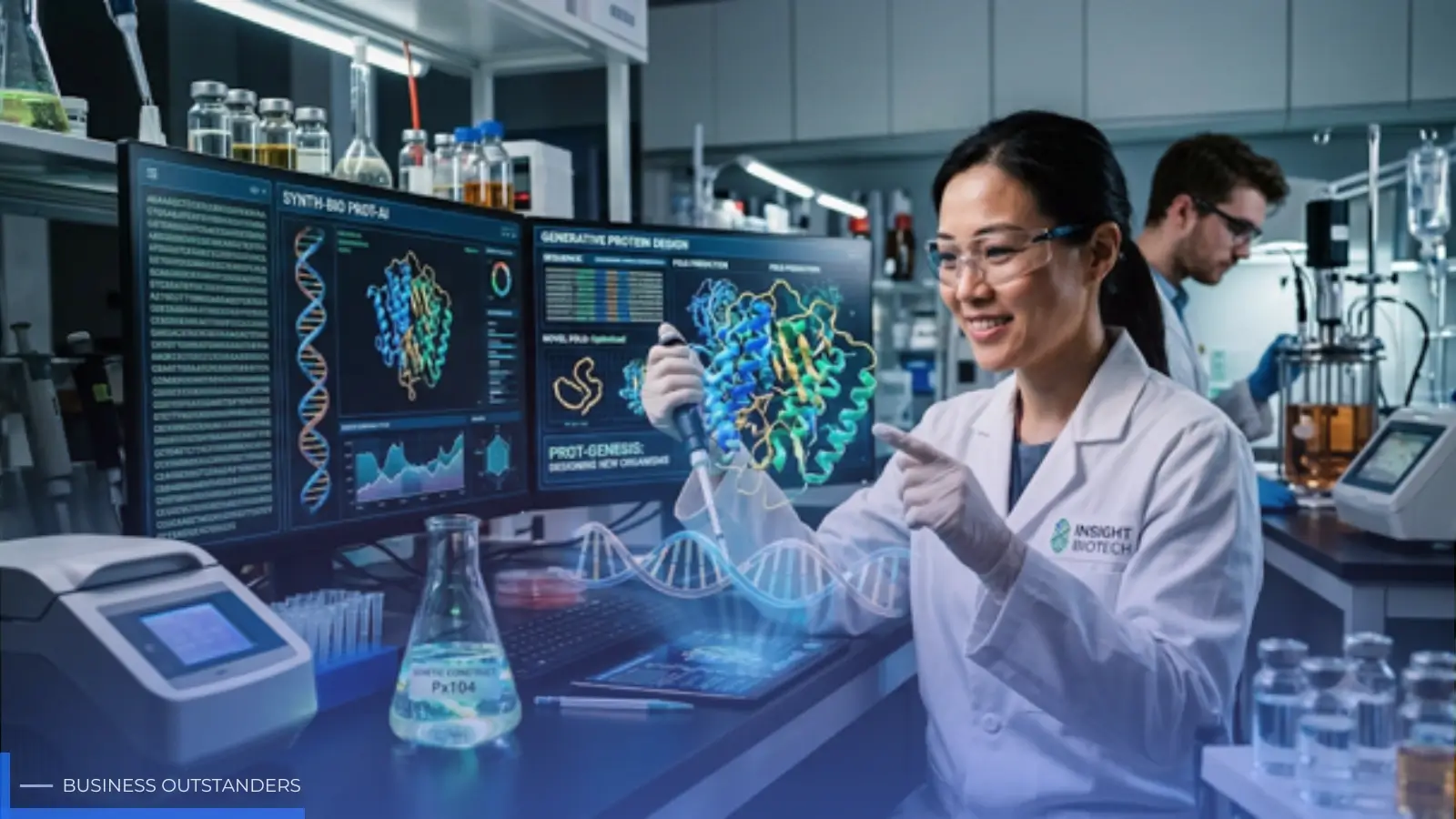
Biology used to run on trial and error. Researchers tested one mutation at a time, waited weeks for results, then started over. That era is closing fast. Generative AI now writes genetic code the way large language models write sentences, predicting which sequences will fold correctly and function as intended before a single molecule touches a lab bench.
This shift matters because protein engineering has always been a numbers game stacked against researchers. The pool of possible amino acid combinations for even a modest protein exceeds the number of atoms in the observable universe. Traditional methods like directed evolution and structure-guided design could only sample a tiny fraction of that space. Generative models change the math entirely.
From Guesswork to Directed Design
Deep learning tools built for protein design now generate sequences that fold into specific, predictable shapes. A 2026 review in Springer's computational biology series describes how these models tackle industrial enzyme optimization, therapeutic peptide development, and synthetic circuit engineering as a unified design problem rather than separate disciplines. The same underlying architecture that predicts a protein's shape can now propose entirely new shapes that never existed in nature.
Early results carry real weight. Research published on generative protein design reports roughly 15 percent success rates when lab-tested designs are validated experimentally, with some AI-generated proteins showing binding potency 100 to 1,000 times stronger than earlier attempts. That gap between raw computational output and lab-confirmed function still exists, but it keeps narrowing every quarter as training data grows and validation pipelines mature.
Beyond Static Structures
AlphaFold2 solved a huge piece of the puzzle by predicting fixed protein shapes from sequence alone. But proteins are not rigid objects. They flex, shift, and adopt multiple working states depending on their environment. Structural biology researchers now push generative models to approximate these shifting conformations directly, using approaches inspired by statistical physics to estimate energy differences between states. This lets scientists model how a protein actually behaves in a cell instead of freezing it in a single snapshot.
Pair that with AI-guided platforms built specifically for designing high-affinity protein binders, and drug discovery starts to look like an engineering discipline instead of a hunt. Teams can now specify a target and generate candidate binders computationally, cutting months off the discovery timeline for therapeutics and diagnostic tools.
Designing Whole Organisms, Not Just Molecules
The ambition extends past individual proteins. Genome-scale language models trained on massive sequence databases can now generate entire functional systems, including novel bacteriophages built from scratch. Researchers feed these models genetic "grammar" the same way a text model learns sentence structure, and the output is a working genome rather than a paragraph.
This capability opens doors across biomanufacturing. Companies use engineered organisms to produce everything from industrial enzymes to specialty chemicals and even manufactured reference standards used in laboratory quality control, including synthetic urine reference materials that calibration labs and diagnostic manufacturers rely on for consistent testing accuracy. Wherever a biological process needs to be repeatable and precise, generative design offers a shortcut that used to take years of selective breeding or chemical synthesis.
Cell-free protein synthesis adds another layer of speed. Instead of growing organisms in bioreactors, researchers can now produce and screen protein variants outside living cells entirely, running high-throughput experiments that would have been impossible with traditional fermentation timelines.
The Security Question Nobody Can Ignore
Every powerful tool creates new risks, and generative protein design is no exception. A March 2026 paper in Frontiers in Microbiology raises a specific concern: AI-generated proteins can perform the same function as known toxins while sharing almost no sequence similarity with them. Screening tools built on homology detection, which compare new sequences against databases of known threats, simply miss these designs because there is nothing to match against.
This is not a reason to slow the field down, but it does demand new screening infrastructure built for function-based detection rather than sequence lookup alone. Biosecurity researchers and synthetic biology labs are now working jointly on this problem, since the same generative techniques that create therapeutic breakthroughs could theoretically produce something dangerous if left unchecked.
What This Means for the Next Five Years
Conferences like SynBioBeta and the AIChE-backed SEED summit now center entire tracks on this convergence, pulling together computational biologists, drug developers, and industrial bioengineers under one roof. The consensus among presenters is consistent: AI-driven biological engineering is not a future trend. It is already reshaping how gene therapies get delivered, how enzymes get optimized for biocatalysis, and how research teams prioritize which molecules deserve lab time.
Gene therapy delivery stands out as a near-term win. AI-enabled design now targets tissues that naturally occurring viral vectors struggle to reach, including the eye, muscle, and brain, which could meaningfully expand which diseases gene therapy can treat.
For researchers and biotech teams watching this space, the practical takeaway is straightforward. Generative AI does not replace lab validation, and it never will. What it does is compress the search space from millions of failed guesses down to a shortlist worth actually testing. That shift alone is turning synthetic biology from a slow craft into a faster, more predictable engineering practice, one sequence at a time.
Author Bio:
John Llanasas is an SEO content writer with over five years of experience creating research-backed articles across biotech, healthcare, SaaS, and e-commerce niches. He specializes in translating complex technical topics into clear, accurate content that meets search intent while holding up to expert scrutiny. His work spans off-page SEO strategy and link building alongside long-form content development, giving him a practical understanding of what makes an article both rank well and genuinely inform its readers.
Business Outstanders brings you sharp insights on tech, business, entrepreneurship, law, crypto, and more. We uncover what’s next. Stay updated, sign up for our newsletter and be part of the future!