There is a moment in most leadership careers when the strategy is sound, the data is clean, the commercial logic is airtight, and the deal still falls apart. The team still disengages. The transformation still stalls.
Corina Taban has lived that moment. And she has spent years figuring out exactly why it happens.
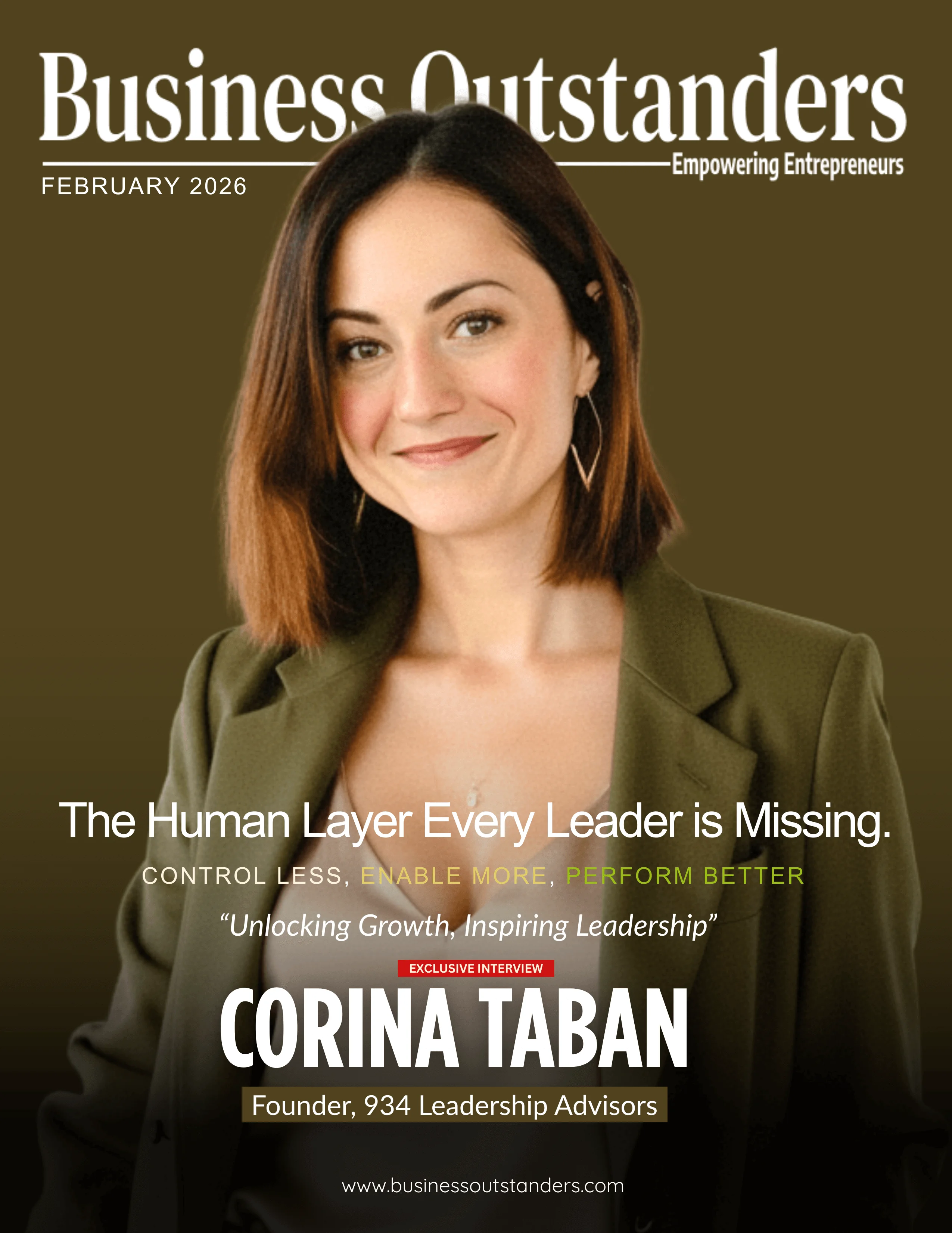
A leadership expert, researcher, founder, and executive advisor who has negotiated multi-million-dollar partnerships at Microsoft and Meta, Corina occupies a rare position at the intersection of high-stakes global business and the science of human behavior as an inspiring business leader. She has sat across the table from some of the world's most powerful organizations. She has led teams across cultures, time zones, and vastly different expectations of what leadership should look and feel like. And through all of it, she has arrived at a conclusion that is both simple and profoundly underestimated.
In this exclusive interview with Business Outstanders, Corina shares what she has learned at the crossroads of strategy and human psychology, and why the leaders who will define the next decade are not the ones with the best answers, but the ones most willing to sit with the right questions.
Interview Highlights:
Q. As someone who has negotiated multi-million-dollar partnerships in roles at Microsoft and Meta, what leadership lesson have you learned where strategy intersects with human psychology that guides your work to this day?
One of the biggest lessons I learned negotiating large partnerships at companies like Microsoft and Meta is that you can have the best commercial logic in the room, but if trust, identity, or perceived status aren’t aligned, the deal stalls or doesn’t happen at all.
Decisions are not primarily rational, they’re shaped by factors like fear of loss, reputation concerns, cognitive overload, or simply whether people feel respected and understood.
This insight now strongly guides my leadership work today. Whether I’m advising executives, teaching leadership development skills, or researching doing research, I focus on the human layer first: how people see themselves, how they interpret signals from their environment, and how that shapes decision-making, engagement, and trust.
Q. Often, you focus more on clearness instead of control, and safety instead of fear. How do global tech environments, which operate at high pressure, change from performance management to performance-enabling leadership?
You can’t micromanage innovation, creativity, or knowledge work, you must enable it. Performance-enabling leadership starts with clarity. When people clearly understand priorities, expectations, and the “why” behind decisions, cognitive load drops and autonomy increases. That clarity creates space for better judgment, faster execution, and more ownership.
The second lever is psychological safety. Not in the sense of comfort, but in creating environments where people can speak up, challenge ideas, admit uncertainty, and take intelligent risks without fear of disproportionate consequences. Innovation requires that.
What I’ve seen in global tech companies, and what my research on psychological contracts reinforces, is that sustained high performance comes less from pressure and more from alignment: alignment between identity, contribution, recognition, and opportunity.
Global tech environments used to do that really well before AI became such a disruptive force. Today, many organizations risk sliding back into control reflexes (more monitoring, more metrics, more pressure) exactly when what’s needed is the opposite: trust, adaptability, and human judgment. AI amplifies performance, but only if people feel safe enough to experiment and skilled enough to use it well.
Q. Your research on the concept of the psychological contract has achieved universal recognition on a global scale. What, in practice, can an organization do to safeguard the implied contract in the context of layoffs, restructuring, or any form of rapid change?
It’s kind of you to frame it in such a way, but slightly exaggerated. My research has been acknowledged at the Academy of Management global conference, which is a really cool achievement that I am extremely proud of. But I would not go as far as to say it got universal recognition. I am still at the beginning of my research journey, currently finalizing my doctoral thesis.
That said, what the research (mine and others’) consistently shows is that the psychological contract isn’t about avoiding change. People understand that organizations evolve. What damages trust is not change itself, but how it’s handled.
In practice, organizations can safeguard the implied contract through three things:
- First, radical clarity and transparency. When layoffs or restructuring happen, ambiguity creates more anxiety than bad news. Explaining the rationale, the constraints, and the long-term vision helps people make sense of what’s happening rather than filling the gaps with worst-case assumptions.
- Second, perceived fairness. Research shows that how decisions are made often matters as much as the decision itself. Consistency, clear criteria, and respectful communication reduce the sense of betrayal even in difficult situations.
- Third, maintaining dignity and future orientation. How organizations treat departing employees sends a powerful signal to those who stay. Support for transitions, reskilling, or honest career conversations helps preserve trust internally and externally.
Ultimately, safeguarding the psychological contract during rapid change isn’t about protecting stability; that’s rarely possible anymore. It’s about protecting trust, reciprocity, and a sense that the relationship remains fundamentally fair, even under pressure.
Q. In culturally diverse tech organizations, what are the personal leadership behaviors that are most likely to influence whether employees feel trusted rather than evaluated?
In culturally diverse tech organizations, trust is built less through formal authority and more through daily micro-behaviors. Especially in global environments, where norms around hierarchy, feedback, and risk differ, leaders must be intentional.
Here are the leadership behaviors that most strongly shift the experience from “I am being evaluated” to “I am trusted.”
Context-sharing instead of command-giving.: When leaders explain the reasoning behind decisions, not just the decision itself, employees feel treated as thinking partners. In diverse teams, this reduces misinterpretation and signals respect for different perspectives.
Explicit expectations, paired with autonomy.: Clarity reduces anxiety. But once outcomes are clear, stepping back and allowing people to decide how to execute signals competence trust. Micromanagement, especially across cultures, quickly translates into surveillance.
Intellectual humility.: Saying “I might be wrong” or “Help me understand how this lands in your market” creates psychological safety. In high power-distance cultures, this behavior is especially powerful because it lowers hierarchy barriers without erasing structure.
Consistency between words and actions.: Trust is not built in big speeches; it’s built in predictability. When recognition, feedback, and opportunities align with stated values, employees perceive fairness. And fairness is central to the psychological contract.
Ultimately, in global tech environments, trust grows when people experience leadership as enabling their judgment rather than auditing their output. Evaluation is inevitable. But when evaluation is embedded within fairness, clarity, and development, it feels like stewardship, not surveillance.
Q. The power of coaching-style leadership is often misinterpreted. What are the most common mistakes leaders may encounter when trying to practice this approach, and how can they be avoided?
The first mistake is confusing coaching with being “nice.”
Coaching is not about lowering standards or avoiding difficult conversations. In fact, it requires a lot of courage. It combines high expectations with high support. When leaders remove accountability in the name of empathy, performance drops, and trust erodes.
The second mistake is turning coaching into endless questioning.
Asking powerful questions is important, but leaders are not external coaches. They carry responsibility for direction and outcomes. Employees don’t want leaders who only ask, “What do you think?” They want clarity about priorities and constraints. Coaching-style leadership works when it sits on top of strategic clarity.
The third mistake is applying it uniformly in every situation.
In moments of crisis, tight deadlines, or high-risk decisions, teams often need decisiveness more than exploration. Coaching is contextual. Mature leaders know when to coach, when to direct, and when to collaborate.
The fourth mistake is neglecting capability gaps.
Coaching assumes a certain level of competence. If someone lacks skills, they may need teaching before coaching. Otherwise, it can feel like abandonment rather than empowerment.
How can these mistakes be avoided?
By understanding that coaching-style leadership is not just a technique, but also a mindset shift. It moves from control to enablement, from solving every problem to building problem-solvers. But it must be anchored in clear standards, fair expectations, and situational awareness.
At its best, coaching leadership increases ownership, resilience, and long-term performance. At its worst, when misapplied, it creates confusion. The difference lies in clarity, consistency, and leadership maturity.
Q. You refer to “Consistency under Pressure” as one of the most difficult skills for leaders to master. What practices or techniques can leaders employ to stay emotionally steady and consistent under conditions or situations of uncertainty or crisis?
Consistency under pressure is difficult because uncertainty activates our threat response. When stakes are high, even experienced leaders can become more reactive, less patient, or overly controlling. But teams take emotional cues from leaders, so steadiness can become a performance lever.
There are a few practices that really help:
- Creating deliberate pause moments.: Under stress, leaders often speed up when they actually need to slow down. Simple practices such as structured reflection time, short breathing resets, or even delaying non-urgent decisions help regulate emotional reactivity and improve judgment.
- Clarity of principles before clarity of answers.: In crisis, you rarely have perfect information. Leaders who anchor decisions in clear values and priorities remain more consistent, even when circumstances shift. That consistency builds trust.
- Sensemaking with others.: Isolation amplifies stress. Leaders who actively consult diverse perspectives (peers, teams, advisors) reduce cognitive bias and signal psychological safety. It also distributes emotional load.
- Emotional self-awareness.: Recognizing early signs of stress (impatience, abrupt communication, overcontrol) allows leaders to recalibrate before those reactions cascade through the team.
- Energy management, not just time management.: Sleep, recovery, and cognitive breaks are often treated as optional, but they directly affect decision quality and emotional regulation. Sustainable performance requires sustainable leaders.
Q. How do you balance tangible business measures with intangible results such as trust, engagement, and safety when driving long-term cultural transformation?
I don’t see tangible and intangible outcomes as opposites. In healthy organizations, they are causally linked.
Trust, engagement, and psychological safety can be leading indicators of very hard results: retention, discretionary effort, innovation quality, and execution speed. If you ignore the intangible drivers, the tangible metrics eventually deteriorate.
The first step is reframing the conversation. Cultural factors can become measurable patterns of behavior. For example:
- Are people speaking up in meetings?
- Are dissenting views surfacing early?
- Are top performers staying?
- Are teams escalating risks before they become crises?
Those are observable indicators.
Then you design dual dashboards.
One tracks traditional business metrics, such as revenue, productivity, cycle time, delivery accuracy.The other tracks cultural health: engagement data, internal mobility, attrition of high performers, psychological safety pulse scores, quality of feedback conversations.
When both dashboards are reviewed together, you begin to see correlations. For example, teams with higher safety often move faster because less energy is wasted on politics or risk avoidance.
Q. Looking to the future, what will the new model of global tech leaders be, and what must today’s leaders unlearn to ensure their relevance?
The model of global tech leadership is definitely shifting. In the past, leaders were often rewarded for expertise, decisiveness, and control. Increasingly, what matters is adaptability, sensemaking, and the ability to lead through ambiguity.
The next generation of tech leaders will need to be translators across multiple worlds: technology, business strategy, human psychology, and societal impact. AI especially is accelerating this shift. It’s not just a technical transformation; it’s a cultural and organizational one.
To stay relevant, there are a few things leaders need to consciously unlearn:
- The idea that expertise alone creates authority.: Technical knowledge remains important, but no leader can fully master the pace of technological change alone. Credibility increasingly comes from learning agility, curiosity, and the ability to orchestrate collective intelligence.
- The reflex toward control under uncertainty.: When environments become volatile, the instinct is often tighter oversight. But innovation, especially AI-enabled innovation, requires trust, experimentation, and distributed decision-making. Leaders must shift from controlling outcomes to enabling conditions.
- Linear career and organizational thinking.: Work is becoming more fluid, roles evolve faster, skills expire quicker, and careers are less predictable. Leaders need to support continuous reskilling, internal mobility, and adaptive organizational structures.
- The separation between business performance and human sustainability.: Burnout, disengagement, and loss of trust are major risks. Future leaders will be evaluated not just on results, but on whether those results are sustainable.
Ultimately, the leaders who thrive will combine technological literacy with human intelligence: clarity without rigidity, ambition without exhaustion, and innovation without losing trust.
“The future of leadership isn’t about having all the answers; it’s about supporting people in navigating ambiguity with confidence.”
Corina Taban | Founder, 934 Leadership Advisors
Decisions are not primarily rational. They are shaped by trust, identity, fear of loss, and whether people feel seen and respected. And until leaders understand that human layer, not as a soft add-on but as the primary driver of performance, they will keep wondering why their best-laid strategies are not landing.
Corina's work today centers on exactly this: helping executives and organizations shift from control-based leadership to what she calls performance-enabling leadership, a model built on psychological safety, clarity, and the kind of trust that sustains performance not just through good quarters but through disruption, restructuring, and the relentless pressure of a world being reshaped by AI.
Currently finalizing her doctoral research on psychological contracts, the implied, unspoken agreements between organizations and their people. Her work has been recognized at the Academy of Management global conference, and her insights are as relevant to a frontline manager navigating a difficult team conversation as they are to a CEO steering an organization through rapid change.
Connect With Corina Taban
If you found this interview valuable, you can follow Corina's work and connect with her directly:
Corina Taban’s LinkedIn: Click here
Website: https://www.corinataban.com/
About Business Outstanders
Business Outstanders is a business magazine featuring interviews, growth strategies, and leadership insights for entrepreneurs and small business owners. If you know a business leader with a story worth telling, nominate them for a feature interview.