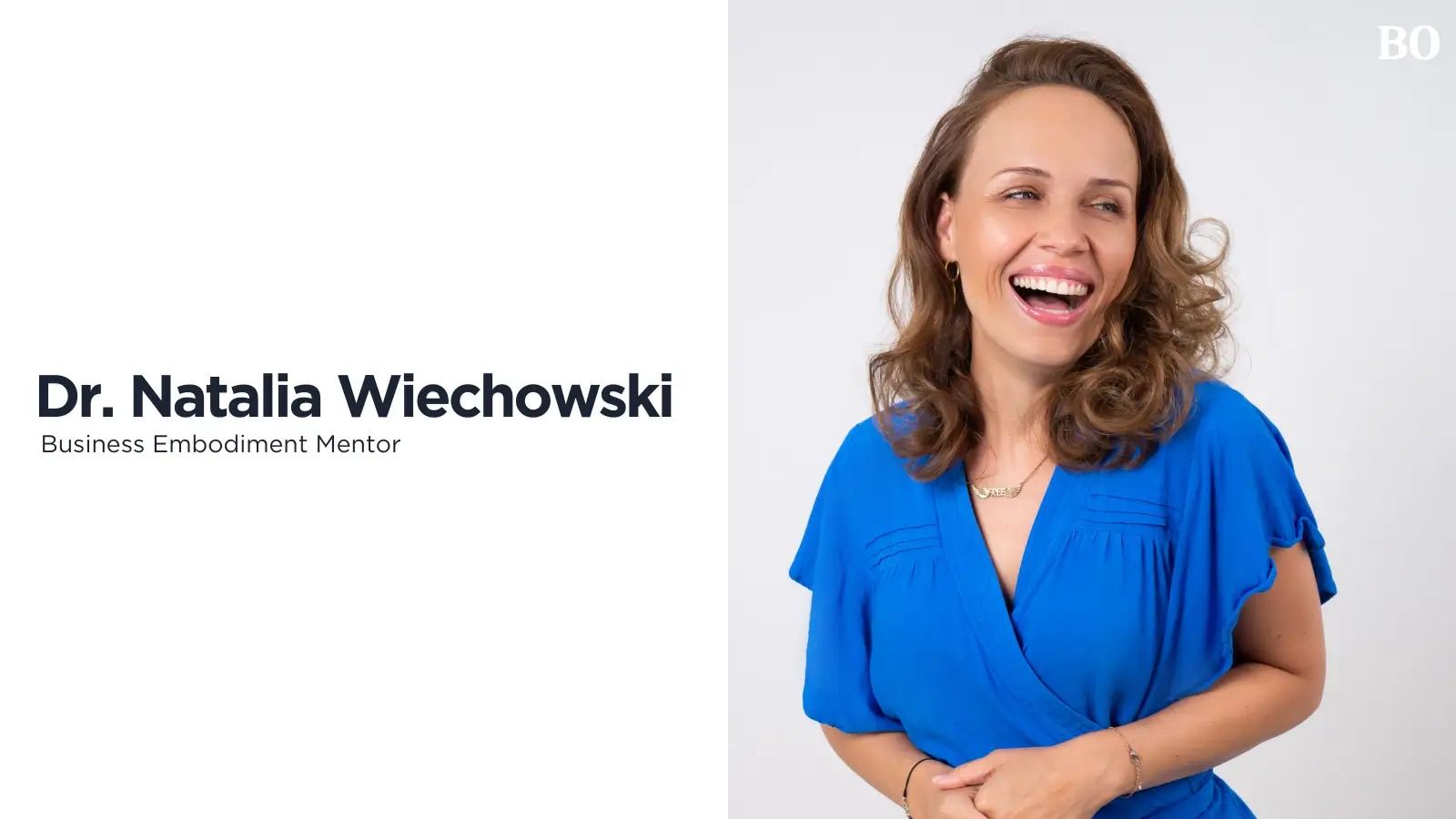
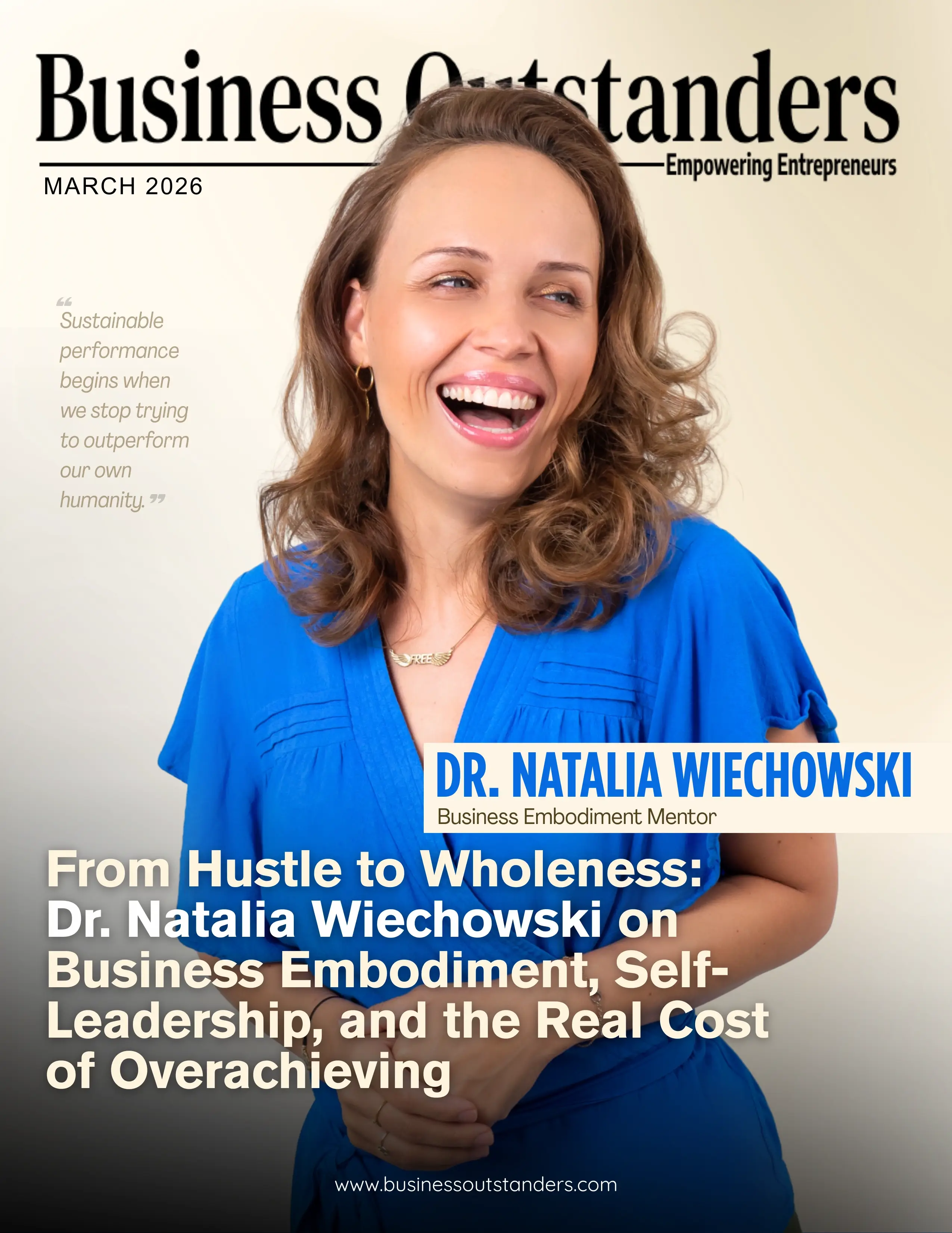
Dr. Natalia Wiechowski built the kind of career most entrepreneurs aspire to. A German-born social scientist turned Doctor of Philosophy, bestselling author, and Forbes-recognized "Top 10 Inspiring Businessperson to Watch in the Middle East," she became widely known as the "LinkedIn Unicorn", a personal branding powerhouse who turned authentic storytelling into a global following. To the outside world, she had cracked the code. Internally, something was quietly coming undone. That tension between external success and inner disconnection became the turning point that reshaped everything and today, as a Dubai-based Business Embodiment Mentor, she guides ambitious solopreneurs beyond the performance trap and toward businesses that are sustainable, authentic, and genuinely fulfilling.
In this interview, Natalia challenges some of the most deeply held assumptions in the entrepreneurial world. She makes the case that mindset work alone is not enough, that the body holds intelligence the mind cannot access, and that real visibility is not a branding strategy, it is an inside job. From cyclical work rhythms to the difference between self-trust and self-validation, her insights cut through the noise of hustle culture with clarity and precision. For anyone who has ever achieved more than enough and still felt it wasn't enough, this conversation is worth reading carefully.
Interview Highlights:
Q. You were a global presence, successful, and in high demand, yet you’ve spoken about how you felt empty and disconnected from yourself on the inside. Looking back, what were some of the subtle indicators that something was off, even when things seemed successful on the outside?
Nothing was obviously wrong, which is why it took me so long to recognize that something was. Decisions that once felt clear started to feel heavier. I needed more effort for results that had previously come naturally. Rest no longer restored me, it only prepared me to function again. Externally, everything - visibility, income, recognition - seemed to work but internally, I noticed a growing distance between who I was performing and who I actually felt myself to be.
I also became more irritable, less patient, and angrier. Yet I didn’t allow myself to truly feel any of this because I was afraid of what might happen if those emotions surfaced. At the time, I didn’t have the emotional maturity or tools to regulate myself. In short, the strongest indicator was this: success required increasing self-override. And self-override always collects interest, usually paid later through health, relationships, or meaning.
Q. You’ve talked about your sabbatical and your deep embodiment process as being radically transformative. What was the shift that occurred during that time – was it a mindset shift, a body awareness, or something more profound that fundamentally changed how you lead and live your life?
During my first sabbatical, I focused on mindset. During my second, I realized that some patterns cannot be changed through mindset alone. A helpful metaphor: mindset is like an app. You can update apps, but if the operating system carries unresolved bugs, performance remains limited. Many high performers try to optimize behavior while the underlying system still runs old survival adaptations. Beyond mindset lies somatic work. The body stores unprocessed experiences and emotions - what some call inner wounds. Instead of facing them, many of us learn to walk around them and then wonder why life feels heavy or strangely meaningless despite “success”.
Since then, I’ve shifted from managing life cognitively to experiencing it more somatically. Decisions became less analytical and more intuitive, guided by tension, expansion, and inner clarity. My leadership moved from control to attunement. I stopped asking, “What should I do?” and began listening: “What feels true and alive here?”
Q. You frequently talk about how “true visibility begins in the body.” For most entrepreneurs, visibility is a strategy and a positioning issue. How does embodied visibility differ from more traditional concepts of personal branding or performance-based marketing?
Traditional visibility focuses on messaging, positioning, and consistency of output. Embodied visibility asks: Can you internally tolerate being seen as you truly are? Many entrepreneurs know what to say but their body does not fully agree. They may express confidence outwardly, yet unconsciously contract at a certain stage - a pattern I often observe with high achievers whose strategy is solid but whose visibility suddenly plateaus. Based on past experiences, the body may interpret truth-telling and creative expression - often disguised as visibility - as risk. This leads to overperformance, perfectionism, or withdrawal because internal safety is missing.
Embodied visibility changes how visibility is experienced: from something you force or endure to something you can sustainably inhabit and enjoy. I guide clients to expand into fuller, more authentic expression at a pace their internal capacity can support. We’re stopping people from paying for classic KPIs with exhaustion and inner stress.
Q. You were previously known as the “LinkedIn Unicorn,” representing high performance and a strong online presence. What led you to deliberately shift away from that persona, and how has your audience reacted to this transformation?
At some point, I realized the persona was “successful” but incomplete. It represented competence and high-performance, yet not the full human experience behind it. Continuing would have meant reinforcing an identity that no longer matched my internal development and truth. I wanted more depth, authentic expression, and space for genuine recovery - not just optimization between outputs.
The audience reaction was mixed at first, which is natural. Some people preferred the former speed and overperformance energy, while others resonated deeply with the shift toward integration and aliveness. Over time, the audience size remained stable - people left and new ones arrived - but the resonance changed. The conversations became more honest, more courageous, and significantly more meaningful.
Q. With your background as a Social Scientist (Master of Arts) and your PhD in Philosophy, studying communication, socialization, and culture – how do these academic roots influence your current work in business embodiment and self-leadership?
My academic work explored how identity and behavior are shaped by social systems and cultural expectations. Today, I apply that lens to entrepreneurship. Many business struggles result from socialized patterns: achievement conditioning, the glorification of willpower, and learned self-suppression. These traits can create impressive success, but they can also lead to existential burnout, loss of meaning, or psychosomatic symptoms that send people from doctor to doctor, only to be told that medically everything looks fine.
Business embodiment combines my academic background with lived experience gained from guiding hundreds of entrepreneurs over the past eleven years. Through deep listening and observation, I help bridge intellectual understanding and somatic wisdom, translating that into practical actions within everyday work. Actions that support not only sustainable success, but also a deeper sense of well-being, aliveness, and integrity.
Q. You address your message to ambitious solopreneurs who are fed up with being functional, adaptable, and overachieving. Why do you think ambitious women specifically tend to fall into this trap, and what does “wholeness starts in the body” mean in terms of business?
Many ambitious women were rewarded early for being adaptable, competent, and emotionally aware. Over time, these strengths can become survival strategies. In business, this often appears as chronic self-optimization and over responsibility. Many women place their well-being last to contribute, belong, and care for others. Valuable qualities, but not when they lead to self-abandonment.
Healthy success begins when business results are no longer used to regulate self-worth. Many great entrepreneurs - my former self included - unconsciously use achievement as proof of worthiness. When we remember that our worth exists independently of performance, we reconnect with the body, which becomes a guide again. Business then shifts from compensation to authentic expression - a sustainable contribution grounded in self-leadership rather than an attempt to close an inner gap.
Q. You make it clear that success is achieved through self-leadership and not self-validation. How can solopreneurs differentiate between creating a business from self-trust and creating a business to validate themselves?
A simple distinction: Self-validation asks: Does this prove I am enough? Self-trust asks: Is this true for me right now? Validation-driven businesses lack a stable foundation and healthy distance. They feel urgent and comparative, and whatever happens in the business is taken deeply personally. Trust-driven business owners feel more mature and honest. They recognize I am not my business. My worth as a human being is not tied to monthly revenue.
You can recognize the difference by the emotional aftermath: validation creates temporary relief followed by renewed pressure to achieve and prove. Self-trust creates calm clarity even when outcomes remain uncertain. Having once tied my own self-worth too closely to revenue and external feedback, I recommend untangling this early - ideally before life forces the lesson through exhaustion or crisis.
Q. In a world that favors speed and continuous delivery, how does an embodied business model disrupt the hustle culture, especially when it comes to processes, marketing, and growth?
It changes the optimization target. Hustle culture optimizes output volume; embodied business optimizes energetic sustainability and decision quality. Practically, this leads to fewer but more aligned projects, marketing based on resonance rather than constant visibility, and growth measured by stability and depth - not only scale.
An example: I invited a client who once prided herself on speed and continuous delivery to slow down and listen before making decisions. She resisted at first but agreed to try. The result: she made fewer wrong decisions and no longer needed to spend time correcting them afterward, freeing significant time for what really mattered. Constraints often increase effectiveness. When focus and energy are no longer scattered, our work becomes more authentic and precise. And integrity and precision outperform intensity over time. Less, but better, works remarkably well in business - even though it takes courage to resist the pressure to do more.
Q. You recommend that solopreneurs work in a cyclical way rather than a linear way. How can solopreneurs incorporate cyclical patterns into their business without sacrificing structure, income, and consistency?
It’s interesting how quickly we assume cyclical work means inconsistency or instability. The real power of cyclical work lies in separating rhythm from discipline. Structure then often becomes clearer, more honest, and therefore more stable. Instead of forcing peak performance every day like a machine - which is ultimately delusional - entrepreneurs design systems that intentionally alternate between intensity and recovery. Within this structure execution adapts to phases: creation, expansion, maintenance, and integration.
In this model, consistency no longer comes from constant effort but from intelligent rhythm and inner attunement. Ironically, honoring human cycles often produces more reliable and inspired results than ignoring them. It also positively changes how we relate to ourselves and, as a result, improves overall well-being. Sustainable performance begins when we stop trying to outperform our own humanity.
Q. Mindset coaching is very popular in the coaching world, and you make it clear that it is not enough and that change happens only when the body is on board. Can you explain what this looks like in practice and how a person can know that their body is fully on board with the business journey?
The mind is powerful, but it is not our only source of intelligence. Trying to make aligned decisions purely mentally is like trying to screw a screw into a wall with a hammer. It works, but inefficiently. When decisions are body-aligned, three signals appear:
-
Decisions feel easier, with less internal negotiation.
-
Action requires effort but not strong inner resistance.
-
Success no longer produces exhaustion as a side effect.
In practice, this means slowing down enough to notice breath, muscular tension, and emotional contraction during decisions. When the body agrees, we make fewer misaligned decisions, waste less energy, and lead with greater clarity - outcomes most entrepreneurs are ultimately searching for, even if they initially come looking for business strategy.
“Less, but better, works remarkably well in business - even though it takes courage to resist the pressure to do more.”
“Sustainable performance begins when we stop trying to outperform our own humanity.”
Connect with Dr. Natalia Wiechowski
If you find this interview valuable, you can follow Natalia’s work and connect with her directly:
LinkedIn: Click Here
Websites: drnataliawiechowski.com – Click Here
About Business Outstanders
Business Outstanders is a business magazine featuring interviews, growth strategies, and leadership insights for entrepreneurs and small business owners. If you know a business leader with a story worth telling, nominate them for a feature interview.