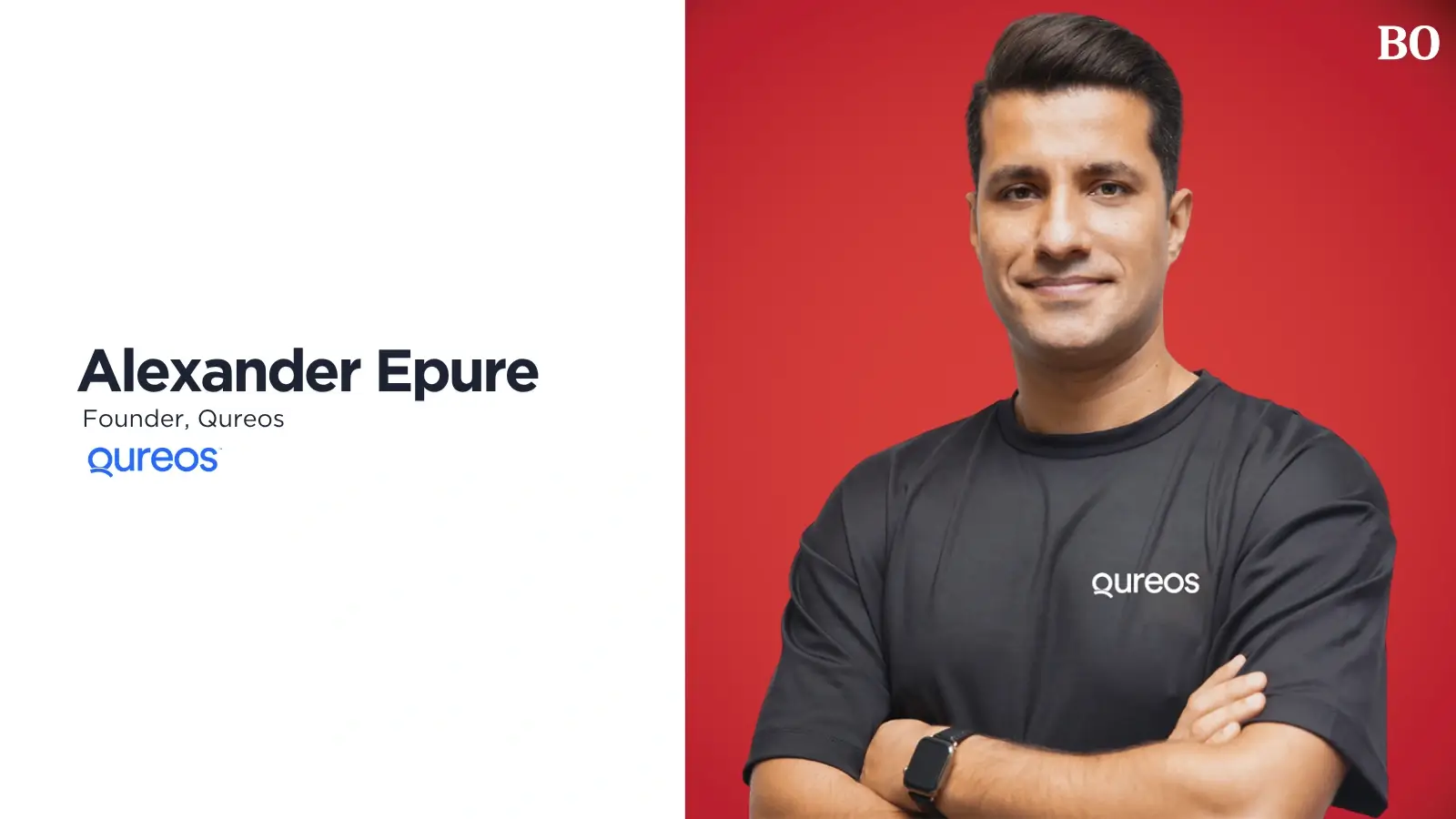
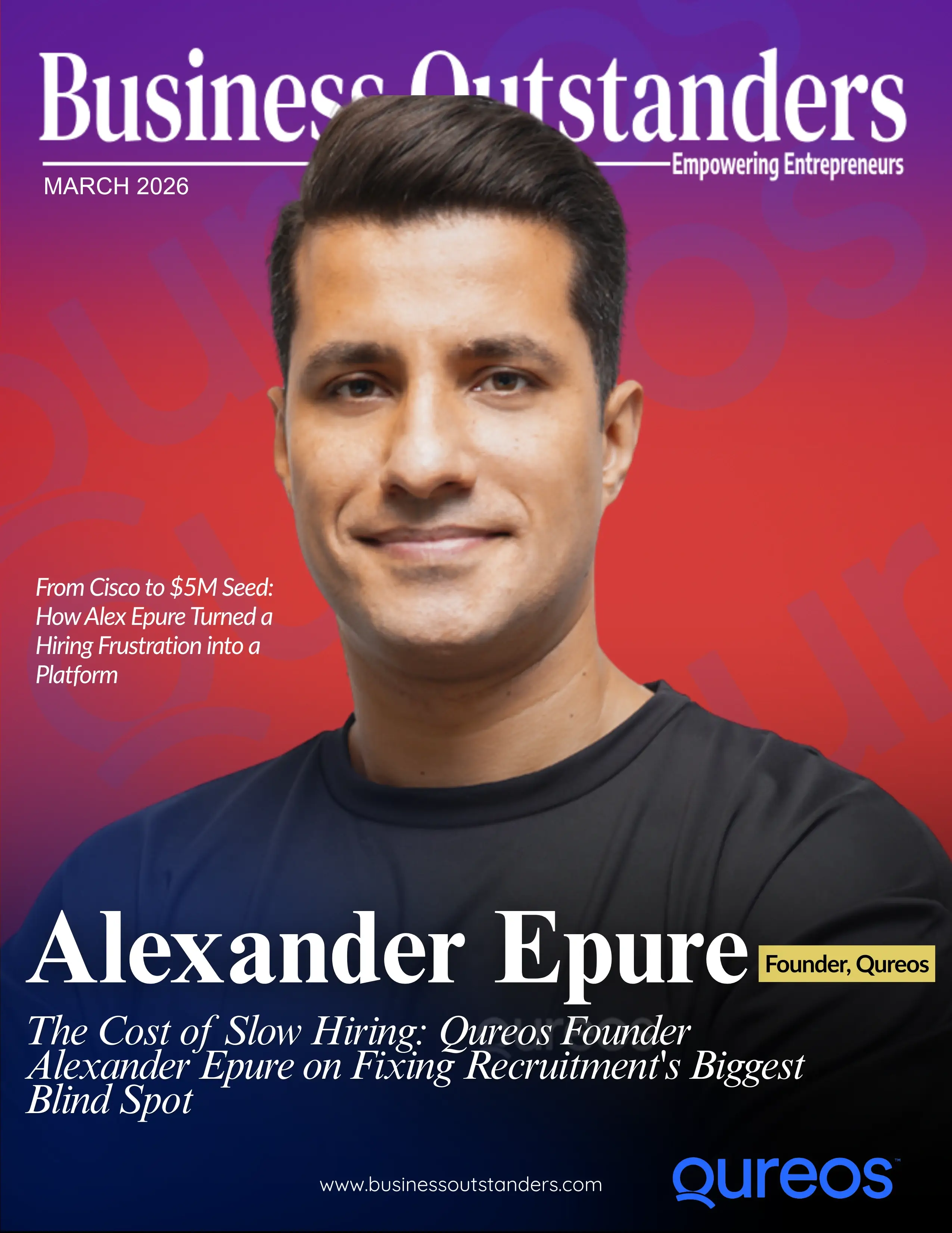
Alexander Epure and Usama Nini built Qureos around a conviction most companies still resist: the speed at which you hire is the speed at which you grow. Having raised $5 million in Seed funding to tackle one of recruitment's most persistent problems, time to hire, they explain why it's the most underrated variable in business, and what it actually takes to fix it.
There is a version of the hiring problem most executives will acknowledge over coffee: too many tools, too many steps, too much time lost between identifying a need and putting someone in a seat. Alexander Epure, founder of Qureos, thinks that framing is still too narrow.
His argument, sharpened over years of watching companies stall in fast-moving markets, is that hiring delay is not an inconvenience. It is a structural tax on growth. Every week, a critical role sits open, execution slows, product decisions queue up, and market windows narrow. Most companies absorb this cost without ever measuring it. Qureos was built to make it visible and then systematically eliminate it.
Business Outstanders had the privilege of sitting down with Alexander Epure, the founder behind Qureos, to talk about what it really takes to build a company around a problem most people feel but few have chosen to systematically solve. From early missteps and hard pivots to a $5 million seed round, their conversation was as honest as it was instructive.
Alex Epure Built Qureos to Solve a Problem He Lived Twice, Once as a Candidate, Once as a Hiring Manager
Interview Highlights:
ORIGINS
Q. Take us back to the beginning. What in your early career made you see hiring as a structural problem rather than just an operational headache?
Mentorship. That's where it started. I spent nine years at Cisco, moved from Amsterdam to Sweden, and then landed in Dubai. The office was in Knowledge Village, and students were everywhere around us. I'm a product of mentorship myself. I wouldn't be where I am without three specific people who opened doors for me. So, I wanted to give that back.
All my mentees had the same problem. They were sick and tired of learning more. They wanted a job. And the hard truth is: how do you get a job when you have nothing to show for it? No CV, no track record. I was trying to be the middleman, and it was really, really tough.
Later, I was building a B2B team at a high-growth startup, and I felt the other side of that problem firsthand. We were contracted with almost every recruitment agency. Subscriptions everywhere. And still, 90% of my days in the first four or five months were just screening and interviewing. More than 90% of those interviews, I knew in the first three minutes it was a no. Three minutes. If I'd had something like Qureos, then most of those interviews would never have happened. They'd have been filtered out long before.
That's when I stopped blaming the tools and started looking at the system. There has never been an easier time to hire than today. More platforms, more tools, and candidates who can build a stellar CV in under a minute. And everyone is still complaining about hiring. So, it's not a shortage of talent or effort. It is just so fragmented.
"90% of my days were just screening and interviewing. More than 90% of those, I knew in the first three minutes it was a no."
Q. Was there a specific moment, a situation you witnessed, that crystallized the problem for you?
There was no single dramatic moment. It was a pattern that became impossible to ignore. Founders are juggling multiple job boards simultaneously, none of them talking to each other. Candidates with exactly the right skills are falling through the cracks because the process ran three weeks longer than it needed to. Hiring managers make rushed decisions under deadline pressure, and then live with those decisions
And on the other side: talented people being overlooked. Not because they weren't strong enough. Because the systems built to find them were too slow and too disorganized to surface them at the right moment. When you see that mismatch at scale across industries, across markets, it stops feeling like a management problem. Nobody writes a post-mortem that says 'we lost because hiring took too long.' But when you trace back why a product launched six months late, or why a market entry stalled, the answer is almost always the same. The team wasn't ready. And the team wasn't ready because the process for building it was fragmented and reactive, and no one had ever treated it as something worth systematizing.
BUILDING QUREOS
Q. You've described Qureos as hiring infrastructure rather than a hiring tool. What's the practical difference?
Most tools optimize a specific workflow. Better job descriptions, faster screening, smoother scheduling. Fine. But they don't touch the underlying problem, the fact that most companies approach every hire as if it's the first one they've ever made. No institutional memory. No feedback loop. Nothing that makes the next hire faster because of the last one.
Think of it like a sales CRM. If your sales rep has a huge pipeline and a system behind it, you're going to hit the target. It's input-output. We bring that same logic to hiring. The platform is modular, think Lego. My process looks a certain way, and I configure it that way. It integrates with whatever system you already have, SAP, Oracle, anything. We're not replacing what's there. We're the operating layer on top of it.
Infrastructure means the process compounds. Every hiring cycle should generate data and clarity that improve the next one. When we talk about reducing time to hire, we're not talking about cutting corners. Speed should emerge from clarity, from a process that is structured enough that the right decision becomes obvious faster. That is a fundamentally different problem to solve.
Q. Early-stage companies often learn the hardest lessons about hiring when they can least afford to. What was Qureos's version of that?
We spread too thin, too early. Trying to serve every type of company, multiple markets, and every use case at once. I understand why we could see the problem everywhere, so we wanted to solve it everywhere. But the effect was the opposite of what we intended. We were everywhere and differentiated nowhere.
The fix was uncomfortable. We stopped theorizing internally and built feedback mechanisms to hear from the market directly. Narrowed the focus hard. Got to market faster with a tighter offering than we ever would have with a polished broad one. That is the lesson, and I'll be honest, you cannot borrow it from someone else's experience. The market teaches faster and more accurately than any internal strategy session. You have to feel it yourself.
"The market teaches faster and more accurately than any internal strategy session. You cannot borrow that lesson from someone else."
AI AND RESPONSIBILITY
Q. AI in recruiting has a complicated reputation bias, opacity, and decisions that affect people's careers are being made by systems they can't see or challenge. How do you navigate that?
The reputation is earned. There are tools in this space that have amplified bias rather than reduced it, optimizing for speed at the expense of fairness. That's real. It doesn't make AI in hiring inherently problematic, but it does mean the bar for doing it responsibly is genuinely high. You can't just bolt it on.
For us, it starts with being deliberate about where automation belongs. Surfacing candidates who would otherwise be missed, yes. Reducing the manual burden on recruiters, yes.
Identifying patterns across large volumes of data, yes. But consequential decisions about real people's careers need a human at the center. Automation should reduce noise so judgment can be better. It should not replace the judgment.
We also had to solve for this region specifically. Nationalization quotas here are real; some companies are required to meet gender and nationality targets or face penalties. Global job boards don't even carry those data points. Some CVs don't include them. So we built a prediction engine that can identify these attributes even when they're not stated, so companies can hire compliantly. That is a real, localized problem. AI solves it well, but only if you approach it carefully. We also continuously evaluate outcomes. If results look skewed in any direction, that is a signal to examine the system, not defend it. Trust in hiring systems is hard to build and very easy to lose.
"Automation should reduce noise so that judgment can be better. It should not replace the judgment itself."
LEADERSHIP UNDER PRESSURE
Q. Founders almost always hire reactively at some point. What does that actually cost, and how do you build the discipline to avoid it?
It costs more than people think, and it doesn't show up on a spreadsheet right away. When urgency is driving the decision, you compress the evaluation. You lower your standards under timeline pressure and then rationalize the gaps you're already seeing in the interview. Then you spend the next twelve months managing around those gaps instead of moving forward. I've seen it. I've done it.
The early hires matter more than any others because they shape the culture. They set the behavioral norms that everything else gets built on top of. The first ten people you hire define what 'good' looks like at your company. If those hires were made under pressure, that standard reflects the pressure, not the vision.
The discipline that actually works is building your evaluation framework before you need it. When you're calm, when you can think clearly. It feels excessive when you're four people in the same room. But the founders who do that early consistently make better hires and spend far less time recovering from bad ones.
Q. How do you personally stay grounded through the intensity of building a company at this stage?
Clarity about what actually matters. There are constant decisions at this stage, strategic, operational, and cultural, and the trap is treating them all as equally urgent. They are not. Most of what feels urgent in a given week is not actually consequential. When the long-term objective is clear, filtering the noise becomes much easier.
I also protect the conditions for thinking strategically rather than letting them be the first thing I sacrifice when time gets tight. Unstructured time. Sleep. Getting outside. I haven't perfected any
of it, not even close. But the version of me that is running on empty makes worse decisions, and those decisions compound the same way good ones do.
FOR THE NEXT GENERATION
Q. Advice to the coming entrepreneurs. You've made the mistakes, learned the lessons, and now have the funding to prove the thesis. What would you tell an entrepreneur who's standing where you were five years ago?
Choose a problem that compounds. There is a difference between a big problem and a durable one. You want a problem where solving it creates more value over time, not less, where every improvement makes the next one easier, and the gap between you and anyone starting fresh keeps widening. Hiring is that kind of problem. Every structured process you build, every cycle that generates better data, makes the next hire faster and more precise. Not every problem rewards long-term investment like that.
Get to market before you're ready. I mean that genuinely, not as a cliché. The instinct to perfect internally before exposing the product to real customers feels responsible. It isn't. The confusion, the resistance, the unexpected use cases make the information irreplaceable. We learned more in the first few weeks of real customer conversations than in months of internal sessions. The market is a faster and more honest teacher than anything inside your own walls.
Build the discipline early that you will need at scale. Structured thinking, evaluation frameworks, and feedback loops feel excessive when you're four people. But the habits you form in the early days are the ones the company inherits. If you are reactive and informal with four people, you will be reactive and informal at forty. And by then, it costs you far more to fix.
And find a co-founder you trust before you need to trust them. Usama and I built that foundation before Qureos was even a real company, working together daily in a hyper-growth environment, separated by a pandemic, figuring things out across borders. One night in a hotel lobby in Saudi Arabia at 1 am, I pitched him the idea for over three hours. He asked for 48 hours to decide.
That was it. You don't manufacture that kind of trust under pressure. You build it before you need it.
"The market is a faster and more honest teacher than anything inside your own walls. Get in front of it before you think you are ready."
THE NEXT FIVE YEARS
Q. The funding milestone: what does it actually unlock for Qureos?
It validates the core belief that time to hire is a growth constraint, not an HR metric. That matters because the conversation we have been trying to start, about hiring as infrastructure, about the real cost of delay, is one many companies are still resistant to. They know hiring is slow. They have not yet connected that slowness to the growth they are not achieving.
Practically, it means we can operate at the pace the problem demands. We have been building carefully, deliberately. Now we can accelerate more markets, deeper product, and the long-term infrastructure work that does not show immediate results but determines what this platform looks like in five years.
Q. Where do you see hiring going over the next five years, and what does that mean for companies that don't adapt?
Hiring is going outcome-driven in a way it has never been before. The proxy measures are losing signal. Years of experience, prestigious institutions, credential stacking, all of it is becoming less relevant as companies get better at actually measuring performance. What will matter is alignment. Does this person contribute measurably to what matters? Do they integrate quickly? Do they stay?
The companies that build the infrastructure to hire predictably and efficiently, that treat every cycle as a learning opportunity rather than a transaction, will have a compounding advantage. In high-growth markets, that gap becomes decisive faster than most executives expect. The ones still treating hiring as administration will consistently be outmaneuvered by those treating it as strategy. That shift is already underway. The question is which side of it you're on.
"The companies treating hiring as administration will be consistently outmaneuvered by those treating it as strategy. That shift is already underway."
About Qureos
Qureos is a hiring intelligence platform built on the principle that Time to Hire is a direct constraint on business growth. By combining structured recruitment process design with AI-driven talent matching, Qureos enables organizations to build teams faster, more predictably, and with greater alignment to business outcomes. The company recently closed a $5 million seed funding round and operates across high-growth markets globally.
Website: qureos.com
Connect with Alexander Epure
If you find this interview valuable, you can follow Alexander’s work and connect with him directly:
LinkedIn: Click Here
About Business Outstanders
Business Outstanders is a business magazine featuring interviews, growth strategies, and leadership insights for entrepreneurs and small business owners. If you know a business leader with a story worth telling, nominate them for a feature interview.