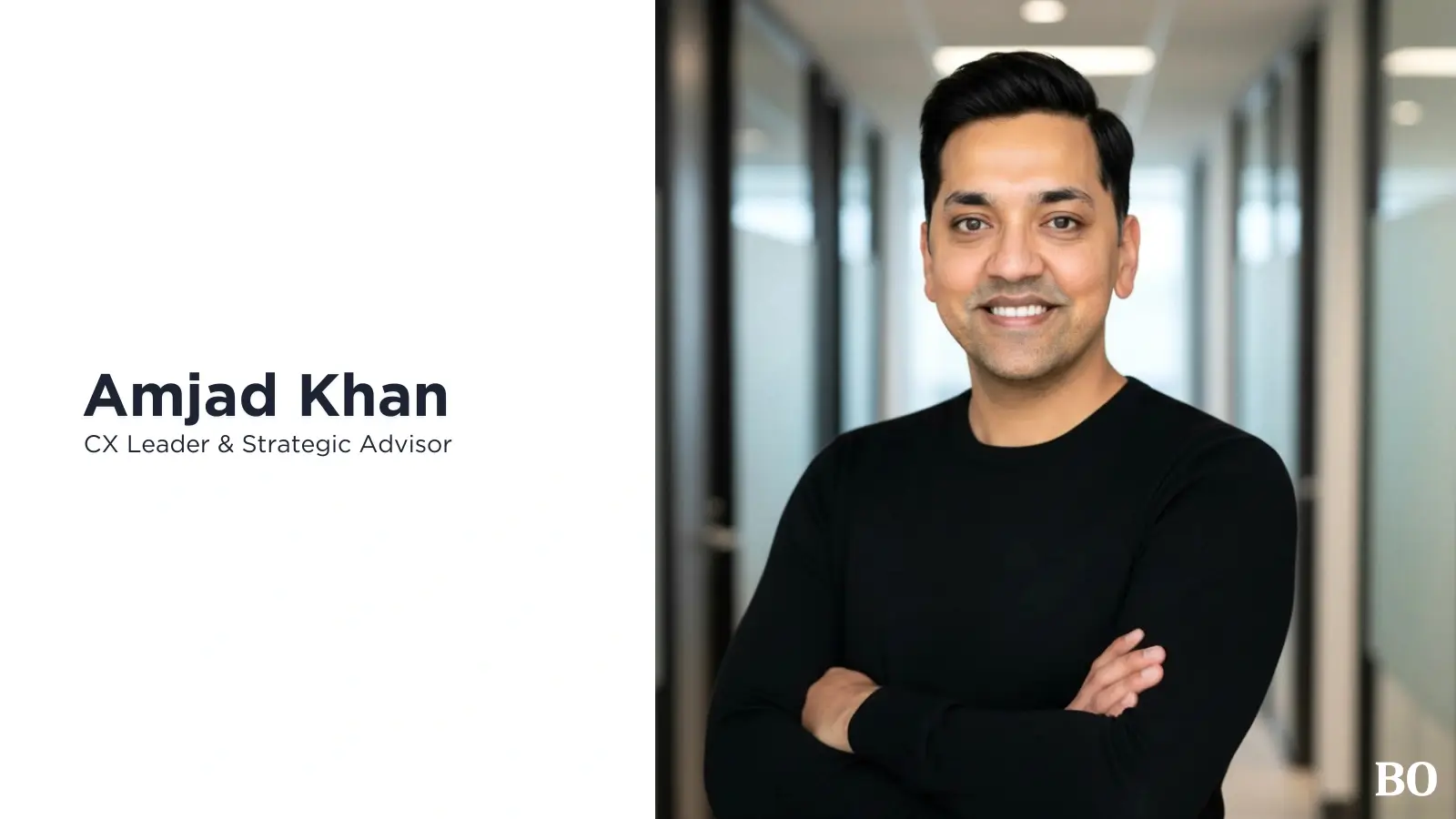
In industries with complex and stringent regulation such as banking, utilities and housing, meaningful change can only occur through the efforts of leaders who can pull together the strategic vision with an understanding of what will actually happen at the operational level. Among these leaders is Amjad Khan. Starting at the frontline working in a contact centre, Amjad understands what challenges customers face because of his early exposure to those issues.
Over his career, Amjad has ascended through a series of senior leadership roles in acquisition, operations, customer experience, transformation and product. He has overseen numerous successful large-scale initiatives focused on simplifying operating models, creating improved customer outcomes and strengthening financial performance. His diverse experience across the various functional areas have provided him with a leadership philosophy based on System Thinking, Operational Discipline (operating efficiently and effectively), and Strategic Clarity (focus on long-term strategy and strategic goals/deadlines).
Amjad talks through how his experiences on the front-line have influenced his leadership approach; why operating model design is critical to organisation performance; and how AI, automation and other technologies create value when applied with clear objective and governance. In addition, he discusses how the role of transformation leaders is changing, as well as how to align the customer strategy and long-term financial success.
Interview Highlights:
Q. Amjad, you started your career on the frontline. How has that shaped you as a leader?
The most useful thing I ever did was spend time in a contact centre at the start of my career. Not because it built empathy, though it did, but because it showed me something I've never forgotten: organisations don't experience themselves the way customers experience them.
On paper, a process can look completely logical. In a strategy deck, a customer journey looks clean and linear. But when you're actually on the phone with a customer who's been passed between three departments and told conflicting things, you understand very quickly that complexity gets created internally and then handed to the customer to deal with.
What stuck with me was watching customer facing colleagues absorb the consequences of decisions made three levels above them, decisions made by people who'd never sat where those colleagues sat. When something is poorly designed, customer facing colleagues feel it first and feel it constantly.
That's the reference point I've carried into every senior role since. Before I sign off on any strategy, I ask: what does this feel like at the edge of the organisation? If the answer is "more complicated," I push back, because that complexity will eventually come back as cost, complaints or regulatory problems. It always does.
Q. You’ve led across banking, utilities and housing. What defines your approach?
The sectors look different on the surface, but the underlying problems are remarkably similar. Cost pressure, complaint volumes, regulatory scrutiny - when you trace them back, they almost always point to the same thing: the organisation wasn't designed well in the first place.
My starting point is always to look at the organisation as a whole system rather than a collection of departments. Where do handoffs break down? Where are people doing work that exists because of a previous mistake rather than because it creates value? Where does the data not connect? Where does no one own the outcome?
When you look at it that way, the answer isn't usually "we need more people" or "we need new technology." It's usually "we need to simplify this." And simplification done properly is where you see the real gains. Repeat contacts fall, productivity improves, regulatory exposure reduces and financial performance follows, because operational excellence and customer excellence aren't in tension, they're the same thing, viewed from different angles.
Q. AI and automation are central to modern transformation. How do you ensure they create tangible value?
The honest answer is that most AI programmes fail not because the technology doesn't work, but because the underlying operations are a mess and AI just accelerates the mess.
My rule is to simplify first, automate second. If you automate a broken process, you get a faster broken process. If you simplify it first, then bring in intelligent tooling, you get something genuinely powerful.
In terms of where I focus that would include complaint triage, vulnerability detection, automated quality assurance across full interaction volumes, real-time support for frontline teams are all areas where AI can make a measurable difference to cost and customer outcomes. But only if the data is clean, the governance is serious and the people using it understand what it's doing and why.
That last point matters a lot in regulated sectors. AI needs to be explainable and auditable. You can't deploy something that affects customer decisions and then not be able to tell a regulator how it works. So strong governance isn't a constraint on AI, it's what makes it sustainable.
Q. You’ve held leadership roles across multiple disciplines. How does that breadth influence your strategic decisions?
It means it’s difficult to be fooled by a number in isolation.
When I see complaint volumes rising, I don't just see a customer service problem, I ask whether the product was designed with operational reality in mind. When I see cost inflation, I don't immediately think "headcount", I ask where the journey inefficiency is that's generating unnecessary work. When retention falls, I look at whether acquisition promised something that service can't actually deliver.
Having sat in commercial, operational, customer and transformation roles means I carry all of those lenses simultaneously. That's genuinely useful because transformation that only works in theory and that looks great at board level but hasn't been stress-tested against operational reality tends to fail expensively.
The integrated view is what stops that from happening. And frankly, it makes me a more useful person to have in a room, because I can bridge conversations that often talk past each other.
Q. Why do some organisations convert customer strategy into financial advantage while others struggle?
The honest answer is executive ownership and I mean real ownership, not the kind where customer metrics appear in a dashboard but don't actually change how money gets allocated.
In the organisations that do this well, the board genuinely understands the link between customer dissatisfaction and cost-to-serve, retention and regulatory risk. Customer outcomes aren't a separate agenda they're embedded in how the business measures itself and where it invests.
In weaker organisations, there's plenty of data and plenty of initiatives, but they're disconnected from the operating model and from financial accountability. So you end up with programmes that improve scores without improving the underlying economics and eventually the business can't justify continuing to fund them.
The shift happens when leadership starts treating customer strategy as the instruction manual for how the business should be built. That's when you start to see it translate into margin, retention and regulatory resilience.
Q. How do you balance executive-level strategy with operational discipline?
I stay close to the data and I mean the uncomfortable data. Complaint trends, workflow bottlenecks and the issues that keep resurfacing despite being "resolved." That's where the real picture lives.
There's a version of senior leadership that becomes detached, strategy gets set at the top, execution happens somewhere below and the gap between the two only surfaces when something goes wrong publicly. I've seen that pattern destroy significant transformation programmes.
My approach is to maintain a direct line between strategic intent and operational reality. Not micromanaging but genuinely understanding where friction exists and why. That keeps strategic decisions grounded. It also means that when I'm in a boardroom conversation about growth or cost or capability, I'm drawing on current evidence rather than assumptions.
Strategy without that operational anchor tends to drift and when it drifts, it costs money.
Q. Lastly, how do you see the role of transformative leaders evolving in the next decade?
The bar is rising significantly. Leaders used to be able to hand off "the technology stuff" to someone else, that's no longer viable. You need to understand AI capabilities, data infrastructure, regulatory expectations and cost structures, of course not at an engineer's level, but well enough to make good decisions and ask the right questions.
The organisations that win in the next decade will build operating models that are predictive rather than reactive, where problems are identified and addressed before they surface as complaints or regulatory issues. That requires leaders who can design those systems and govern them responsibly.
But here's what I think gets underestimated: the human judgment side becomes more important, not less. As automation scales, the decisions that remain for humans are the harder ones, the ambiguous ones, the ones with ethical dimensions, the ones that require trust and leaders need to be equipped for that too.
The intersection of intelligent systems, disciplined governance and genuine accountability for customer outcomes, that's where the next generation of competitive advantage gets built. And that's the space I find genuinely exciting to work in.
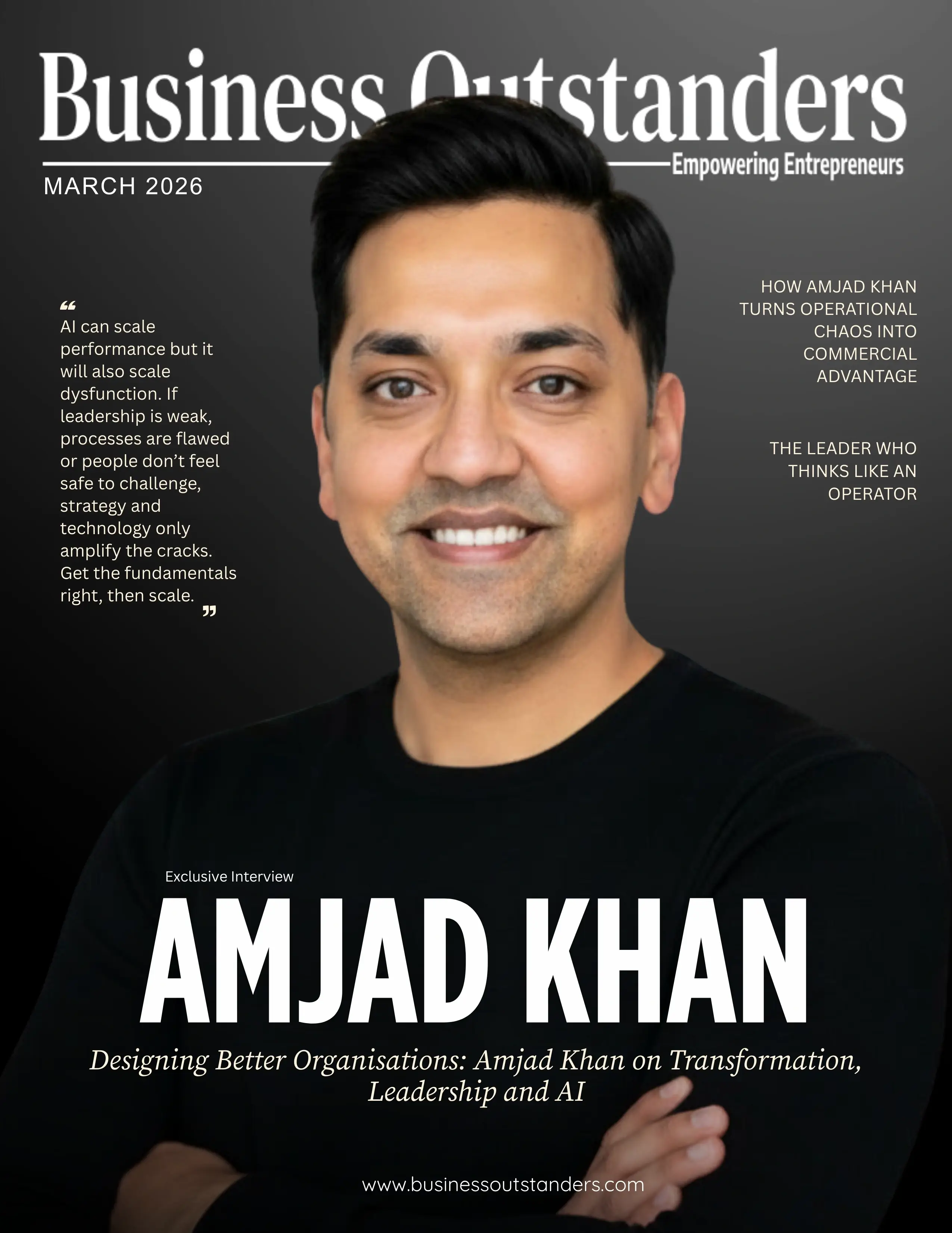
“AI can scale performance but it will also scale dysfunction. If leadership is weak, processes are flawed or people don’t feel safe to challenge, strategy and technology only amplify the cracks. Get the fundamentals right, then scale.”
Connect with Amjad Khan
If you find this interview valuable, you can follow Amjad’s work and connect with him directly:
LinkedIn: Click Here
About Business Outstanders
Business Outstanders is a business magazine featuring interviews, growth strategies, and leadership insights for entrepreneurs and small business owners. If you know a business leader with a story worth telling, nominate them for a feature interview.