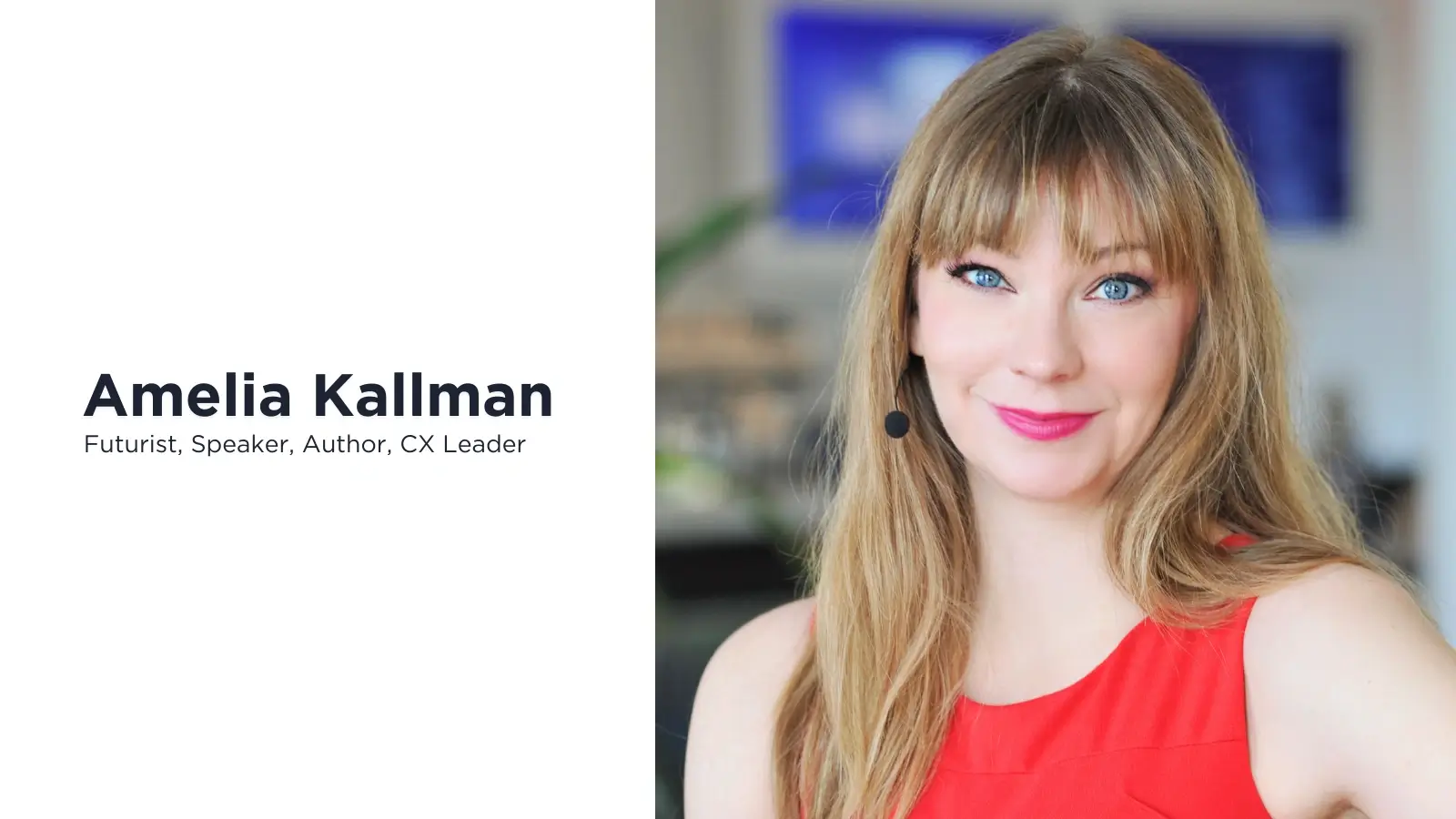
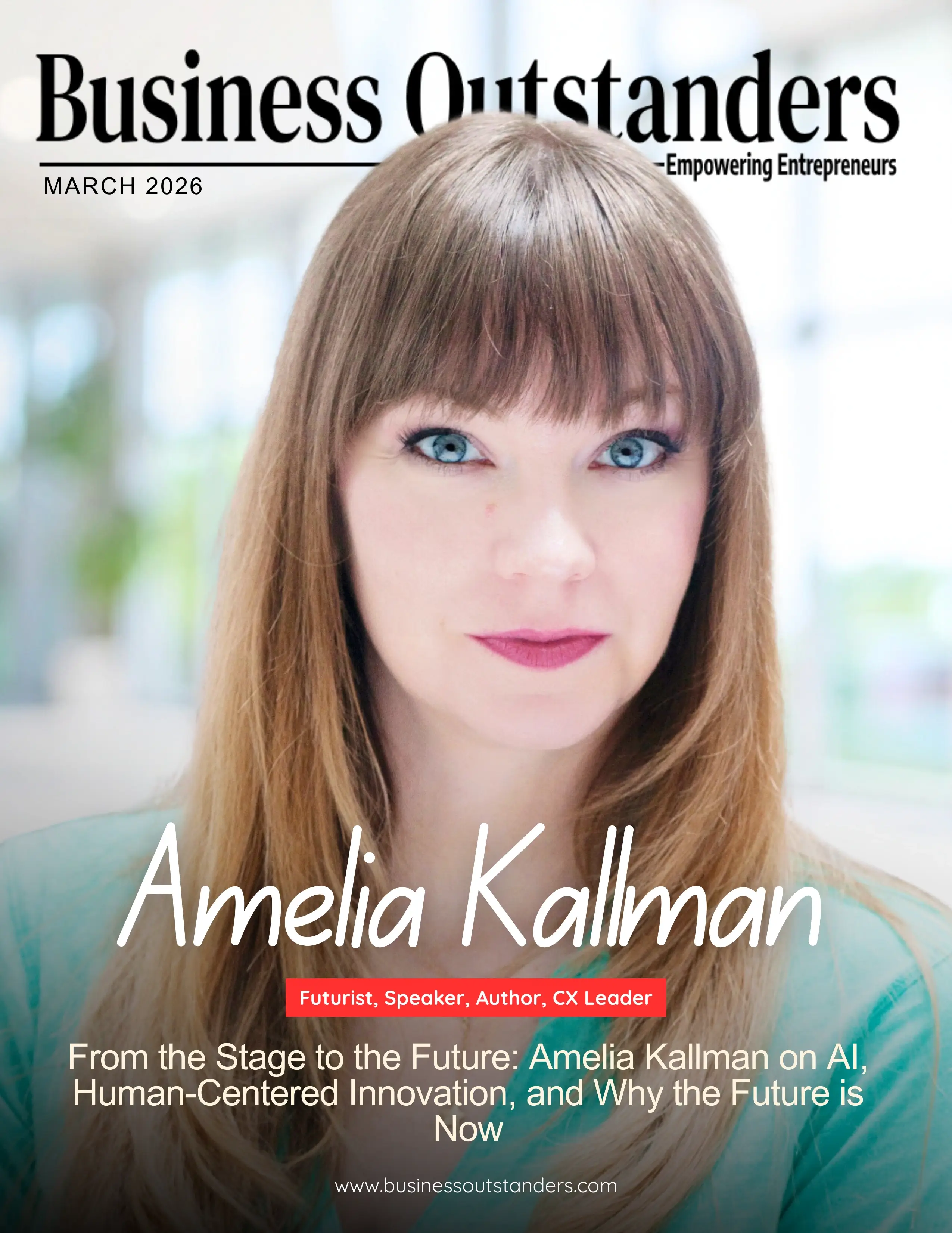
Amelia Kallman is not your typical futurist. Before advising Fortune 500 companies and speaking at conferences across 20+ countries, she was running cabaret clubs in New York and Shanghai. That unconventional background shaped everything, including her ability to walk into a room full of sceptics and make the future feel less like a threat and more like an opportunity. Today, as a London-based futurist, speaker, and author, and recognized as one of the Top 20 World-Leading Futurist Speakers, she has built a reputation for making complex technology accessible, relevant, and actionable for leaders across industries.
In this interview, Amelia gives her honest read on where AI is really taking us, and Our decisions today are pivotal. She argues that the organizations navigating this shift well are not the ones with the biggest technology budgets, but the ones investing seriously in their people. From rethinking how businesses measure success to ensuring AI works for women and not against them, her perspective is direct, experience-led, and refreshingly grounded. If you are trying to cut through the noise on AI transformation, this is a good place to start.
Interview Highlights:
Q. You are known widely as a futurist who helps shape the dialogue about new technologies and human-machine interfaces. Would you mind sharing your own story of how you became interested in the future and how that interest led you to become a futurist, author, and speaker?
I don’t actually come from a technology background. I grew up on stage as a child actress, then went on to own cabaret nightclubs in New York City and Shanghai where I also performed and directed shows. When I finally got a visa to work in the UK, I talked my way into a role at a creative technology agency where I worked my way up to become their Global Head of Innovation. It was my job to host and manage innovation labs in London and Dubai, as well as curate and design labs for companies like KPMG, EY, Accenture, and PwC. I was one of the first people in this country to have hands-on experience with Google Glass, Oculus Rift and IBM Watson, and helped organise the UK debut of Pepper Robot, Microsoft’s HoloLens, and the Magic Leap. It excites me to be on the cutting edge where there is always something new to learn, so this industry suits me well.
In 2017 I went independent as a futurist. Since then, I’ve spoken at over 100 conferences in over 20 countries, written industry-leading reports, and consulted for a number of Fortune 500 companies. I pride myself on being able to make the complex accessible, empowering audiences with the foundational knowledge, language, and context they need to make the most informed, responsible, strategic, and ethical decisions today that are going to lead us into the best possible future tomorrow. While I speak about both opportunities and risks, my aim is always to leave the audience feeling inspired and empowered, with actionable insights they can immediately apply.
Q. Your research and writing examine how technology is changing our lives, our work, and our relationships. In your opinion, what are the most significant technological changes taking place today that people may still be underestimating?
The biggest change we are going to see over the next 3-5 years won’t come as a surprise to anyone: it is AI.
We are now leaving the Age of Digital Transformation and entering the age of AI Transformation. In the Big Picture, we’re going to be able to achieve more with less: Less time, less money, less resources, less people. Everything that is digital today will become AI enabled, and everything that is AI enabled, we’ll be able to communicate with through natural language conversation, and this is going to fundamentally disrupt the future of business, as well as the future of our lives.
Old systems, strategies, workflows, hierarchies, metrics, and mindsets are going to have to change in order to meet the challenges that lie ahead. In 2026 transformation means Reinvention, it looks like Proactive Innovation, and it requires Rapid Adaptability
Q. As someone who advises organisations across multiple sectors, how do you help leaders transcend fear and hype and adopt a more balanced, human-centred perspective on innovation and technology transformation?
In the short term, the most important thing companies can do right now is give people Time within their workdays to learn, play, experiment, and train with AI technology. And the time that they gain back through automation, should go to the employees. If you don’t have employee buy-in, you don’t have an AI strategy.
Secondly, we must establish new metrics. In addition to measuring monetary ROI, we also have to measure Human ROI - things like improvements in focus, time-management, wellness, and happiness even. We need to be able to prove that this technology is working for us as people, and not just as a company.
But if you want to think about the long term of how AI is reshaping the future of the Employee Experience, consider this: In the past we’ve had major breakthroughs with tools like the microscope and the telescope, and these have allowed us to see things we could not see on our own. And you can think of generative AI as an evolution of one of those tools—it’s able to merge together disparate datasets and allow us to see patterns that we could not see otherwise. So you can think about how it applies to the future of the Employee Experience. We are able to merge together historical data, real time data, environmental data, emotional data, and biodata to create: Generative, Adaptive, and Responsive Products, Services, and Experiences.
When it comes to Talent Management, AI is going to allow us to become more predictive and therefore, more proactive. Because we can merge together disparate datasets, not only are we going to have a more 360-degree view of an individual employee and their unique talents, workstyles, and preferences; We are going to have a more 360-degree view of entire teams, entire branches, our entire organisation, and even our entire industry, allowing us to see clearly our strengths and weaknesses and areas we can improve. And this is going to empower us to become workforce architects. We are going to be able to optimise and design the most efficient, effective, dynamic, and high-achieving workforce possible. And in the age of AI, it’s your people that will be your ultimate differentiator.
Q. You frequently discuss the relationship between humanity and technology. How can we, as a society, ensure that the rapid development of technology improves the human condition rather than exacerbating divides and disconnections?
One major shift I’m seeing is AI Accountability moving from the IT department to HR. This means it is up to HR to shape how we build trust around AI. Trust is a currency and a competitive advantage. Several ways we can work to build that trust today include: Continuing to deliver a consistent front-end while ensuring that any AI interactions are auditable in the backend; Radical transparency; making sure that company values are prioritised and represented in AI design; Establish guardrails against risks; and create protocols for human oversight and accountability.
Q. As an author, how does writing compare to speaking or consulting for you? What is the one thing you hope readers take away from your books and ideas?
One thing about me is I love to learn, so doing in-depth research and then making sense of it all through writing so other people can easily understand ideas too is something I am passionate about.
My first book, Diary of a Shanghai Showgirl, is a memoir about my experience opening the first burlesque and cabaret nightclub in China. The book I’ve just finished writing, Chelsea Women: The Remarkable Lives of Rebels & Risk-Takers is a feminist counter-history of American counterculture told through one building (New York City’s iconic Chelsea Hotel) and sixteen lives, as well as my own experience as the last woman to live in its pyramid penthouse.
Blending biography, women’s history, and cultural narrative with elements of memoir, the book is a story about place as destiny: how one address became a recurring site of rebellion, refuge, and reinvention for women across generations.
Through deeply researched, character-driven chapters, this book reclaims the stories of iconic figures such as Janis Joplin, Nico, Edie Sedgwick, Nancy Spungen, and Patti Smith, alongside overlooked pioneers including America’s first female journalist Jennie June, dance innovator Katherine Dunham, Stonewall revolutionary Stormé DeLarverié, trans film icon Holly Woodlawn, and others. Spanning the late 19th century to the present, Chelsea Women reveals hidden connections and overlooked truths that reshape how we understand culture, feminism, and artistic rebellion in America.
The book grew from a longing to find my female lineage - not of blood, but of boldness. I wanted to learn from women who came before me that had claimed space, spoke up, called themselves artists before the world agreed, changed the world by simply being themselves, and survived the cost of their defiance. In researching their lives, I found a roadmap showing where we’ve been, how we got here, and how we might move forward. This is a book about how one place, one community, and a handful of remarkable women helped change American culture and, in doing so, the world.
The next book I write is going to be an actionable guide for women about what we can do to ensure AI is working for us and not against us.
Q. Futurists are frequently asked to make predictions about what the future may hold. What are some of the common misconceptions that people have about the future, and what do you think are some of the realities that are more likely to occur than the doomsday scenarios that are often depicted in the media?
We’ve been trained to believe that a dystopian future is inevitable, but it’s not. We are at a pivotal moment when it comes to—not just our relationship with technology—but also, a pivotal time in history. Our decisions matter. Our leadership matters. We have a responsibility to empower ourselves with knowledge and to amplify our intelligence to ensure we are making the most informed, responsible, strategic, and ethical decisions today that are going to lead us to the best possible future tomorrow.
Q. For young professionals, particularly women, who may be interested in pursuing a career in the area of technology, innovation, or futurism, what advice would you give about how to establish credibility, confidence, and a viable career path?
Shortcuts don’t lead to a sustainable career. Building trust takes time and consistency, but the more effort you put in, the more you’ll get out of it. While it’s tempting to get AI to do research and writing, I still prefer to do it myself because that’s how I learn, and decipher what’s real and important from what’s not. Ultimately, it’s that very human skill—one I practice and strengthen like a muscle—that makes me an expert in my field, and builds trust between me and my clients.
When it comes to giving keynotes, part of the reason I think mine are so effective is because I go out of my way to make sure everyone comes along for the ride. I don’t take it for granted that everyone knows or understands some of the hyped-up terms of my industry, and try to talk about things in ways that are clear and inclusive of everyone. It’s easy for people to feel intimidated, overwhelmed, or fearful of topics like technology and the future, but I strongly believe that the key to changing that is education. My goal is always to empower people with knowledge and inspire them to take what they’ve learnt back into their teams and communities, and to be leaders within this technological renaissance we are all a part of.
In general, my advice to women is always to speak up and be seen. We need representation, role models, allies, champions, and mentors. We need to support and stand up for each other. Be the change you want to see.
“Be the change you want to see.”
Connect with Amelia Kallman
If you find this interview valuable, you can follow Amelia’s work and connect with her directly:
LinkedIn: Click Here
Website: ameliakallman.com – Click Here
Instagram: @futurist_amelia
About Business Outstanders
Business Outstanders is a business magazine featuring interviews, growth strategies, and leadership insights for entrepreneurs and small business owners. If you know a business leader with a story worth telling, nominate them for a feature interview.