
Introduction
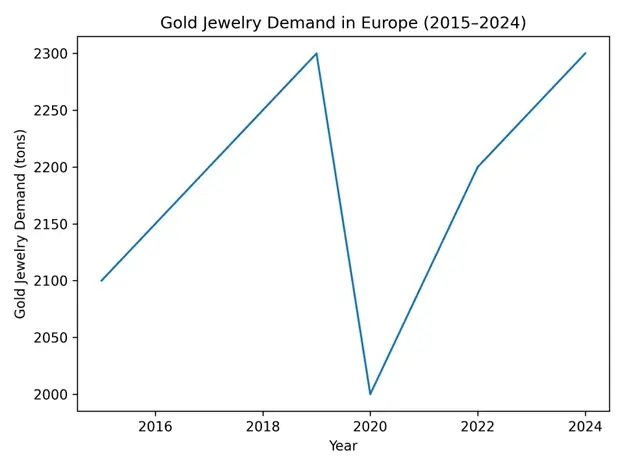
The European jewelry market is characterized by high competition, sensitivity to macroeconomic factors, and changing consumer preferences. In conditions of rising gold prices and increasing regulatory requirements, the choice of an effective business model becomes particularly important. For B2B companies working with corporate clients, the key success factors are accurate assortment planning, effective inventory management, reliable supply, and adaptation of offerings to local demand.
The purpose of this article is to analyze the specifics of the B2B model in international trade of jewelry, focused on demand analysis and individually tailored product batches for clients in Central and Eastern European countries.
Characteristics of the Jewelry Market in Central and Eastern Europe
Jewelry markets in the Czech Republic, Slovakia, Poland, and Romania are considered moderately developing markets with stable demand for gold products. The main characteristics of the region include:
- predominance of B2B sales over direct retail;
- significant role of traditional offline channels;
- customer preference for liquid and familiar product models;
- price sensitivity while maintaining quality requirements.
Unlike Western European markets, experimental designer collections are less significant here, and demand is formed around proven product categories.
Traditional Wholesale Purchasing Model and Its Limitations
The classic model for wholesale jewelry companies involves purchasing standard collections from manufacturers in Italy, Turkey, and other exporting countries. The assortment is formed based on available supplier offerings rather than actual client needs.
The main limitations of this model include:
- risk of excessive inventory;
- low turnover of certain product items;
- necessity to apply discounts to sell illiquid items;
- weak adaptation to regional preferences.
Data-Driven Approach in B2B Jewelry Trade
An alternative to the traditional model is an approach based on prior demand analysis. Under this strategy, a company studies:
- the structure of client sales;
- seasonality of demand;
- price ranges with the highest turnover;
- preferences for design and weight of items.
Based on this data, individual orders are placed with manufacturers, which allows minimizing risks and increasing the efficiency of the entire supply chain.
Advantages of International Supply from Italy and Turkey
Italy and Turkey are key exporters of gold jewelry due to a combination of developed production, flexibility in working with B2B clients, and competitive conditions.
The main advantages of these sourcing regions include:
- a wide range of technologies and designs;
- the ability to produce batches on demand;
- consistent product quality;
- optimal balance between price and margin.
Utilizing these production bases is especially effective when operating under a model of individually tailored assortments.
Family Business as a Factor of B2B Company Stability
In international jewelry trade, the family-owned business structure often serves as a competitive advantage. Centralized control over procurement, logistics, sales, and customer service allows for faster decision-making and maintains a high level of trust among partners.
The existence of long-term relationships with more than 100 regular B2B clients confirms the sustainability of this model and its focus on strategic development rather than short-term profit.
Conclusion
The analysis demonstrates that the B2B model in international jewelry trade, based on demand analysis and individually tailored assortments, has significant competitive advantages. This approach reduces inventory risks, increases capital turnover, and contributes to the formation of long-term partnership relationships.
For the Central and Eastern European markets, this strategy is particularly relevant, as it takes into account the specifics of demand and consumption structure in the region. In conditions of growing competition and price volatility for raw materials, a data-driven approach becomes a key factor for sustainable development of B2B jewelry companies.
References
- World Gold Council. Gold Demand Trends 2023–2024. London, 2024.
- Statista. Jewelry Market Revenue in Europe. 2024.
- Deloitte. Global Powers of Luxury Goods. 2023.
- OECD. International Trade in Consumer Goods. Paris, 2023.
- European Commission. Market Analysis of Precious Metals and Jewelry. Brussels, 2024.
Author:
Oleksii Kovernikov
Business with Specialization in International Trade
Business Outstanders brings you sharp insights on tech, business, entrepreneurship, law, crypto, and more. We uncover what’s next. Stay updated, sign up for our newsletter and be part of the future!