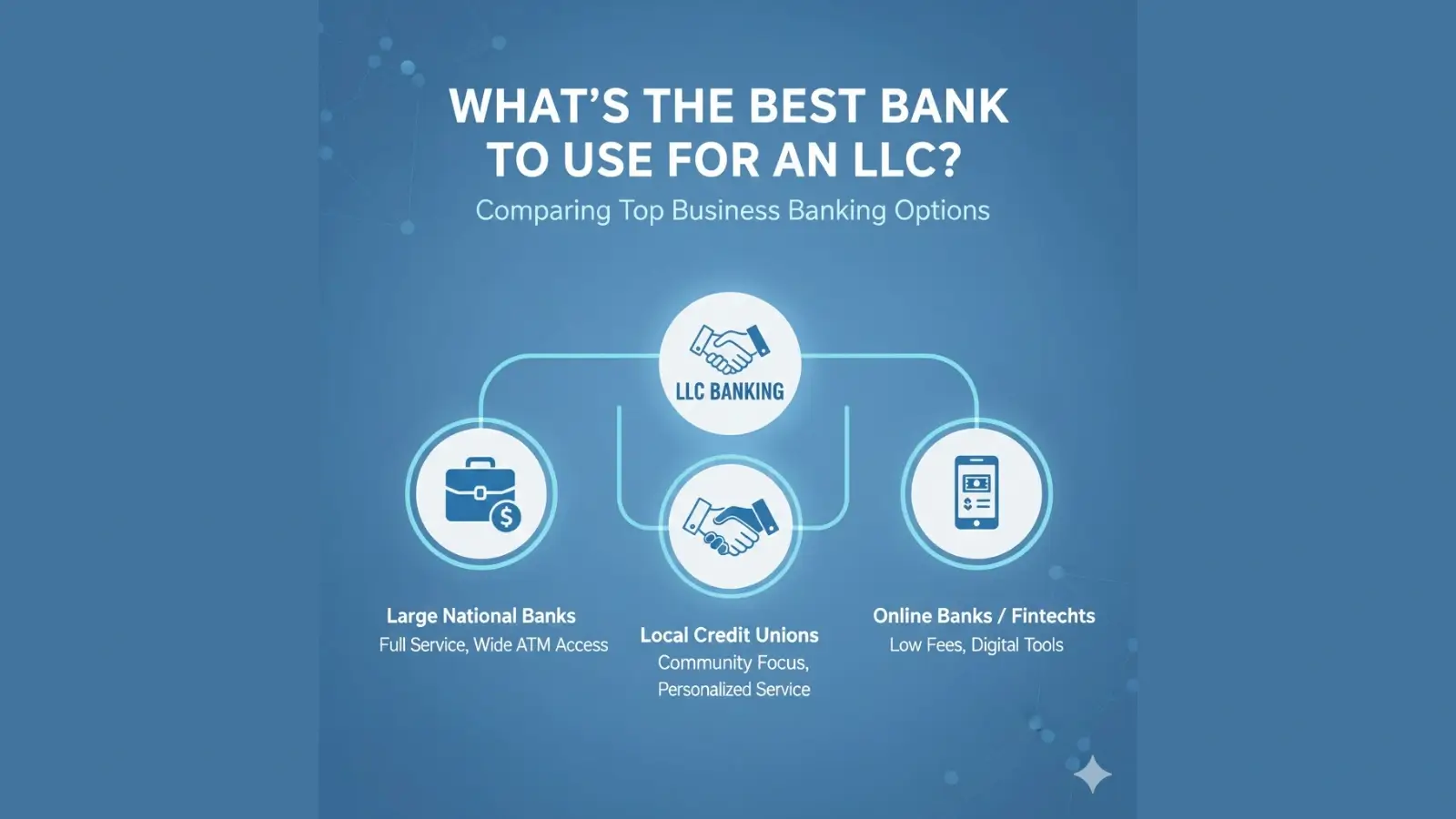
Choosing the right bank for your Limited Liability Company is one of the most important financial decisions you'll make as a business owner. According to the U.S. Small Business Administration (SBA), separating your personal and business finances is essential to maintain your LLC's personal asset protection. The right business bank account not only preserves your limited liability shield but also streamlines expense tracking, simplifies tax preparation, and integrates with tools you already use to run your business. With over 4,000 FDIC-insured banks in the United States offering business accounts, finding the perfect fit can feel overwhelming.
Why Your LLC Needs a Dedicated Business Account
The SBA emphasizes that when you register an LLC online, forming an LLC protects you from personal liability in most instances but that protection only holds if you keep your finances separate. Using a personal bank account for your LLC can blur the legal distinction between you and the business, risking personal liability. Most banks require a separate business bank account to maintain LLC protection and to comply with tax and regulatory requirements. It is important to know the local regulations especially when opening an LLC and a bank account in France or any other foreign country
Beyond legal protection, a dedicated business account helps you manage cash flow, track deductible expenses, and present a professional image to clients and vendors. BusinessRocket research indicates that LLCs with dedicated business accounts receive 30% more credit approvals than those using personal accounts, significantly increasing business opportunities.
Top Banks for LLCs in 2025
Based on comprehensive industry analysis and expert reviews, here are the best business banking options for LLCs across different needs and priorities:
1. Best Overall: Mercury
Mercury has revolutionized business banking by creating a platform that truly understands what modern companies need. This fintech company offers digital-first banking services equipped with advanced features for optimal financial management. Mercury's approach combines the reliability of traditional banking with the innovation of a tech company.
Key Features:
-
No monthly maintenance fees
-
Treasury accounts offering up to 4.27% APY on idle cash
-
Built-in expense management and team cards
-
Integration with popular accounting software
-
FDIC insured through multiple partner banks
-
Same-day account setup for eligible businesses
According to industry reports, cash sitting idle in traditional business checking accounts earning 0.01% APY represents a missed opportunity. An LLC maintaining $250,000 in cash could earn nearly $10,000 annually with a 4% APY account compared to just $25 with a traditional bank.
2. Best for Startups and Freelancers: Bluevine
Bluevine is consistently rated as the best overall option because it's well-balanced, has no transaction fees, and provides lending options for those who qualify. The application process is simple and can be completed in minutes, with the possibility of your account up and running the same day.
Key Features:
-
1.3% to 3.25% APY depending on account tier
-
No monthly fees or minimum balance requirements
-
Unlimited fee-free transactions
-
Access up to $3 million in FDIC insurance
-
Bill pay tools and invoicing with payment links
-
Small business lending options available
BusinessRocket notes that Bluevine's combination of high interest rates and no-fee structure makes it ideal for LLCs just starting out or established businesses wanting to maximize cash management.
3. Best for Traditional Banking: Chase Business Complete Banking
Chase Bank is widely recognized as the best bank for LLCs due to its flexible business checking, online banking tools, and easy LLC account setup. With over 4,900 physical branches nationwide, Chase offers the perfect blend of digital innovation and in-person support.
Key Features:
-
Nationwide branch access for in-person support
-
Earn up to $500 cash bonus with qualifying activities
-
QuickAccept for mobile card payment processing
-
Integration with QuickBooks accounting software
-
Multiple business account tiers for growing companies
-
Robust merchant services and payment solutions
The SBA recognizes Chase as one of the most active SBA lenders in the United States, making it an excellent choice for LLCs that may need financing as they grow.
4. Best for Interest Earnings: Axos Business Interest Checking
Axos Bank provides a rare combination of checking account functionality with savings account interest rates. If your LLC is primarily an online business, Axos could be an excellent fit for your needs.
Key Features:
-
1.01% APY on checking account balances
-
$100 minimum opening deposit
-
$10 monthly fee (waived with $5,000 balance)
-
Unlimited domestic ATM reimbursements
-
Mobile check deposit capabilities
-
No physical branches (online-only)
According to financial experts, earning interest on checking account balances is uncommon and represents significant value for LLCs maintaining operating cash reserves.
5. Best for Single-Member LLCs: Lili
Lili is a leading fintech company that partners with Sunrise Banks to offer business checking accounts specifically tailored to single-member LLCs and small business owners. Named as one of the 50 Most Innovative Companies of 2022 by Fast Company, Lili is marketed as a tech-forward, user-friendly mobile app.
Key Features:
-
No credit check or minimum opening deposit required
-
Built-in expense categorization and tax tracking
-
2.50% to 4.00% APY on savings accounts
-
BalanceUp feature allowing up to $200 overdraft with no penalties
-
AI-powered bookkeeping in premium tiers
-
Cashback on select debit card purchases
The SBA emphasizes that single-member LLCs benefit significantly from banking solutions that simplify bookkeeping and tax preparation, making Lili an excellent choice for solo entrepreneurs.
6. Best for Cash-Heavy Businesses: U.S. Bank
U.S. Bank stands out for its ability to handle cash deposits and provide in-person assistance through brick-and-mortar branches. The Silver Business Checking option has no monthly maintenance fees, eliminating concerns about meeting waiver requirements.
Key Features:
-
Physical branches for cash deposits
-
No monthly fees on Silver Business Checking
-
Integration with accounting software
-
Strong SBA lending relationships
-
Mobile banking with remote deposit
-
Business credit card options
According to the SBA, U.S. Bank ranks among the top SBA lenders, providing excellent opportunities for LLCs seeking future financing. U.S. Bank is particularly recommended for businesses requiring regular cash deposits or preferring in-person banking relationships.
Comprehensive Bank Comparison Table
|
Bank |
Monthly Fee |
APY |
Minimum Deposit |
Best For |
Key Advantage |
|
Mercury |
$0 |
Up to 4.27% (Treasury) |
$0 |
Tech-savvy businesses |
High yields on idle cash |
|
Bluevine |
$0 |
1.3% - 3.25% |
$0 |
Startups |
No transaction fees |
|
Chase |
$15* |
0% |
$0 |
Traditional banking |
4,900+ branches |
|
Axos |
$10* |
1.01% |
$100 |
Online businesses |
Interest on checking |
|
Lili |
$0-$25 |
2.50% - 4.00% |
$0 |
Single-member LLCs |
Built-in bookkeeping |
|
U.S. Bank |
$0* |
0% |
Varies |
Cash businesses |
Cash deposit handling |
|
Wells Fargo |
$10-$75* |
0% |
Varies |
Established businesses |
Comprehensive services |
|
Bank of America |
$16-$29.95* |
0% |
Varies |
Multi-branch needs |
Rewards programs |
*Fees may be waived with qualifying balances or activities
Essential Features to Look for in an LLC Bank Account
When evaluating business banking options, BusinessRocket recommends prioritizing these key features:
- Low or No Monthly Fees: Monthly maintenance fees can range from $0 to $95 depending on the institution and account type. Look for accounts with no monthly fees or easy-to-meet waiver requirements. According to financial experts, understanding the total cost that comes with a particular bank helps you make informed decisions while allowing you to put more funds towards business growth instead of banking expenses.
- Competitive Interest Rates: Modern LLCs no longer have to settle for low yields on cash reserves. Some accounts now offer APYs exceeding 4% on business deposits, turning operating cash into a revenue-generating asset. For growing businesses managing larger cash reserves between funding rounds or during profitable quarters, these earnings compound quickly.
- Integration Capabilities: Your bank should seamlessly integrate with accounting software like QuickBooks, Xero, or FreshBooks. This automation saves hours of manual data entry and reduces errors during tax season. The IRS emphasizes proper recordkeeping for all business transactions, and integrated banking simplifies compliance.
- Transaction Limits: Some accounts restrict the number of free monthly transactions. If your LLC processes numerous payments, ensure unlimited transactions or high limits that match your business volume. According to industry standards, most active businesses need at least 100-200 free monthly transactions.
- Multiple Account Options: Modern LLCs require flexibility in managing their cash. Leading providers now offer multiple account types within a single platform, each optimized for specific purposes. Look for banking accounts with checking accounts, treasury accounts to earn high yields, and savings accounts with FDIC insurance.
- Mobile Banking: With remote work becoming standard, mobile banking capabilities are essential. Look for banks offering mobile check deposit, instant notifications, and full account management through apps.
SBA Resources and Banking Support
The Small Business Administration provides extensive guidance for small businesses seeking banking relationships. According to the SBA, business structure choice influences everything from day-to-day operations to taxes and how much of your personal assets are at risk.
The SBA's key recommendations for LLC banking include:
- Maintain Separate Accounts: Operating agreements give members protection from personal liability to the LLC. Without this specific formality, your LLC can closely resemble a sole proprietorship or partnership, jeopardizing personal liability protection.
- Build Banking Relationships Early: Wells Fargo is recognized as one of the most active SBA lenders in the United States, both in terms of actual financing and loan quantity. Establishing relationships with SBA-preferred lenders early can facilitate future financing needs.
- Understand SBA Loan Requirements: According to SBA data, 64% of applicants for SBA-backed loans receive at least partial approval. However, requirements typically include two or more years in business, personal credit scores of at least 690, and business and personal tax returns for the last three years.
- Personal Guarantees: The SBA requires personal guarantees for business owners holding 20% or more equity. If your business defaults or fails to repay SBA-backed loans, you remain personally responsible regardless of your LLC structure.
Documents Required to Open an LLC Business Account
Banks have varying requirements for opening business checking accounts, but most require similar documentation:
Formation Documents:
-
Articles of Organization filed with your state
-
Operating Agreement (even for single-member LLCs)
-
LLC Certificate of Good Standing
Identification:
-
Government-issued photo ID for all authorized signers
-
Social Security Number or EIN from the IRS
-
Business license (if applicable to your industry)
Verification Materials:
-
Proof of business address
-
Initial deposit (varies by institution)
-
Member/Manager resolution authorizing account opening
The IRS provides free Employer Identification Numbers through their website at IRS.gov. Most banks require an EIN for multi-member LLCs, though single-member LLCs can often use the owner's Social Security Number.
Online Banks vs. Traditional Banks for LLCs
The banking landscape has evolved significantly with the rise of fintech companies. According to industry analysis, nearly 76% of small business owners who applied for funding in Q4 2024 chose non-bank lenders over traditional banks, indicating that alternative financial services are increasingly important.
Online Banks (Fintech) Advantages:
Pros:
-
Higher interest rates on deposits (often 1-4% APY)
-
No or low monthly fees
-
Advanced technology and integrations
-
Faster account opening (often same-day)
-
Better mobile apps and user experience
-
Innovative features like automated savings and AI bookkeeping
Cons:
-
No physical branches for in-person support
-
Limited cash deposit options ($1,500-$5,000 monthly limits)
-
May not offer full range of services (international wires, safe deposit boxes)
-
Building relationships with loan officers is more difficult
Traditional Banks Advantages:
Pros:
-
Physical branch access for cash deposits and in-person support
-
Established relationships with business bankers
-
Full range of financial services (wealth management, business loans)
-
Better for businesses handling significant cash
-
Strong SBA lending relationships
-
Face-to-face customer service
Cons:
-
Higher monthly fees ($10-$95)
-
Lower or no interest on checking accounts
-
More stringent approval requirements
-
Slower account opening process
-
Less innovative technology
-
Often outdated mobile apps
BusinessRocket recommends that cash-heavy businesses like restaurants or retail stores prioritize traditional banks with branch access, while service-based and online businesses benefit most from fintech solutions offering higher yields and better technology.
Mistakes to Avoid When Choosing a Bank for Your LLC
- Using Personal Accounts: This is the most critical mistake. The SBA explicitly states you should not use a personal account for your LLC, as doing so can blur the legal distinction between you and the business, risking personal liability.
- Ignoring Transaction Limits: Many "free" business accounts limit monthly transactions to 50-200. Exceeding these limits results in per-transaction fees of $0.20-$1.00, which accumulates quickly for active businesses.
- Overlooking Integration Needs: If your bank doesn't integrate with your accounting software, you'll spend hours manually entering transactions. This increases errors and complicates tax preparation.
- Focusing Only on Fees: While low fees matter, they shouldn't be your only consideration. A bank charging $10 monthly but offering 2% APY on $100,000 in deposits generates $2,000 annually in interest, far exceeding the $120 in fees.
- Neglecting Growth Needs: Your LLC's banking needs will evolve. Choose institutions offering business credit cards, lines of credit, and lending options to support future growth without switching banks.
- Skipping Customer Service Research: Poor customer service can cost you hours of frustration and potential downtime. Research online reviews and test customer support before committing.
Industry-Specific Banking Recommendations
Different industries have unique banking needs that influence optimal bank selection:
|
Industry |
Recommended Bank Type |
Key Features Needed |
|
E-commerce |
Online banks (Mercury, Bluevine) |
Payment processor integration, high transaction volumes |
|
Restaurants |
Traditional banks (Chase, U.S. Bank) |
Cash deposit capabilities, merchant services |
|
Professional Services |
Online or hybrid (Axos, Lili) |
Invoicing tools, expense categorization |
|
Construction |
Traditional banks (Wells Fargo, Bank of America) |
Equipment financing, contractor payment systems |
|
Healthcare |
Traditional banks with SBA relationships |
Professional liability understanding, HIPAA compliance |
|
Real Estate |
Banks with strong lending (Chase, Wells Fargo) |
Multiple property management, investment financing |
The SBA notes that LLCs are ideal for medium- to higher-risk businesses and owners with significant personal assets they want protected, regardless of industry.
Building Business Credit Through Your Bank
Your banking relationship plays a crucial role in establishing business credit. According to BusinessRocket, building business credit reduces personal guarantee exposure, with the goal of qualifying for financing without personal guarantees after 18-24 months of building credit.
Steps to Build Credit Through Banking:
- Maintain Positive Balances: Consistently keeping positive balances demonstrates financial stability to credit bureaus. Avoid overdrafts, which can negatively impact business credit scores.
- Use Business Credit Cards: Many banks offer business credit cards with your checking account. Using these responsibly and paying balances in full builds credit history.
- Establish Lines of Credit: After 6-12 months of positive banking history, apply for a small business line of credit. Even if you don't use it, having available credit improves credit utilization ratios.
- Pay Bills Through Your Business Account: Using your business account for all business expenses creates a clear financial trail that credit bureaus can verify.
- Request Periodic Credit Limit Increases: As your business grows, request credit limit increases on business cards and lines of credit. This demonstrates growth and improves credit metrics.
Federal Banking Regulations and FDIC Insurance
The Federal Deposit Insurance Corporation (FDIC) protects depositors against bank failures. Standard FDIC insurance covers up to $250,000 per depositor, per insured bank, for each account ownership category.
Enhanced FDIC Protection: Some fintech banks partner with multiple FDIC-insured institutions to provide coverage exceeding $250,000. For example:
-
Mercury offers access up to $3 million in FDIC insurance
-
Bluevine provides coverage up to $3 million through Coastal Community Bank
-
Traditional banks typically offer standard $250,000 coverage
The IRS requires all LLCs to maintain detailed financial records. Your business bank statements serve as primary documentation for income, expenses, and tax deductions. According to IRS guidelines, maintaining separate business accounts simplifies compliance and reduces audit risk.
The Bottom Line: Choosing Your LLC Bank
According to comprehensive industry analysis, the best bank for your LLC depends on your specific business model, transaction volume, and growth plans. Here's a quick decision framework:
Choose Mercury if:
-
You're a tech-savvy business comfortable with digital-only banking
-
You maintain significant cash reserves and want high yields
-
You need advanced financial management tools
-
You process most transactions electronically
Choose Bluevine if:
-
You're starting a new LLC with limited capital
-
You want no-fee banking with competitive interest rates
-
You may need small business lending in the future
-
You prefer straightforward, no-nonsense banking
Choose Chase if:
-
You regularly deposit cash or checks
-
You value in-person customer service
-
You anticipate needing SBA loans or traditional financing
-
You want a full-service banking relationship
Choose Lili if:
-
You're a single-member LLC or freelancer
-
You want built-in bookkeeping and tax tracking
-
You're comfortable with mobile-first banking
-
You need simple, affordable banking ($0-$25 monthly)
The SBA emphasizes that regardless of which bank you choose, maintaining proper separation between personal and business finances is non-negotiable for preserving your LLC's liability protection. According to BusinessRocket research, over 70% of small businesses choose LLC structures specifically for asset protection, and proper banking practices are essential to maintaining that protection.
Most successful business owners recommend opening accounts with multiple institutions: a primary operating account with one bank and a high-yield savings account with another to maximize both functionality and returns. This multi-account structure helps LLCs maintain better financial discipline by automatically allocating percentages of incoming revenue to different accounts, ensuring you're always setting aside money for taxes, building reserves, and optimizing yields based on when you'll need access to funds.
Ultimately, the best bank for your LLC is one that aligns with your business model, provides the features you need at a price you can afford, and supports your growth trajectory for years to come.
Business Outstanders brings you sharp insights on tech, business, entrepreneurship, law, crypto, and more. We uncover what’s next. Stay updated, sign up for our newsletter and be part of the future!