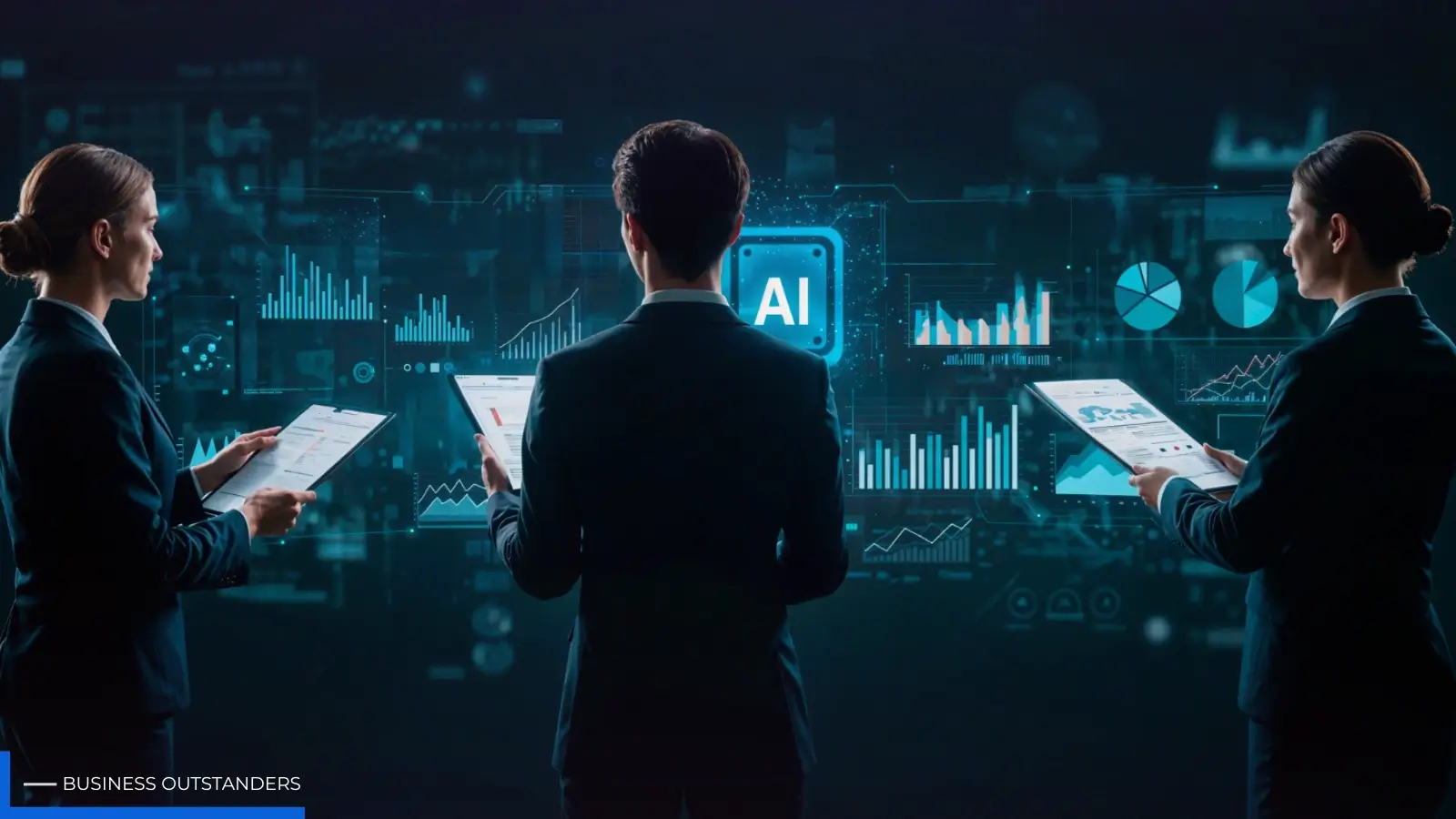
There is a version of the AI conversation that sounds like this: robots are coming, jobs are disappearing, and the future belongs to whoever builds the best algorithm. It is dramatic. It makes headlines. And it mostly misses the point.
The more interesting, and more urgent, conversation is not about what AI will replace. It is about what it will demand. Because as artificial intelligence takes over the routine, the repetitive, and the predictable, it is raising the bar for everything that remains. And what remains, overwhelmingly, is leadership.
The role of a business leader is changing at a pace that most organizations are not yet prepared to handle. Not because business leaders are being replaced by robots, but because the value they deliver must change. The leaders who understand this shift, and act on it, will shape the next decade of business. Those who do not will find themselves running processes that AI does better, and wondering why their influence is shrinking.
What AI Is Actually Taking Over
To understand how leadership is changing, you first need to be clear about what AI is genuinely good at. It is good at processing large volumes of data quickly. It is good at pattern recognition, automating repetitive decisions, and delivering scaleable outputs. In practical terms, this means AI is increasingly handling things such as performance reporting, customer query routing, scheduling, monitoring for compliance, and even first-draft content creation.
For business leaders, this is significant. A meaningful portion of what used to occupy a manager’s day, gathering information, report writing, coordinating routine communications, is being delegated to machines. And that creates both an opportunity and a challenge.
The opportunity is that leaders can redirect their energy toward higher-value work. The challenge is that if they do not, they will simply become expensive human administrators of systems that run themselves.
The Human Skills That Matter More Than Ever
Here is the counterintuitive truth about AI in the workplace: the more capable it becomes, the more valuable certain qualities of humanity get. Not despite AI, but because of it.
Judgment in ambiguous situations
AI excels at optimizing within defined parameters. It struggles with the genuinely novel, the moral ambiguities, the unprecedented crises, the decisions that require reading a room, weighing competing values, and making a call that no dataset could fully inform. That is where human leadership earns its value.
Emotional intelligence
As Helen Bywater-Smith, Global CX Advisory Lead at Ipsos, puts it: the most important thing a leader can do is move beyond empathy into compassion, not just understanding how someone feels, but acting on it. A script can simulate empathy. It cannot replace a leader who genuinely cares about the people they serve and the teams they lead. In a world of automated interactions, that human warmth becomes a competitive differentiator.
Vision and meaning-making
Teams do not follow strategies. They follow people who make them believe the strategy matters. The ability to articulate a compelling vision, to connect what people do every day to a bigger meaning, and to inspire people through uncertainty, this is irreducibly human. And as AI taeks care of more of the operational layer, the cultural and visionary layer becomes the primary job of senior leadership.
Trust-building
As AI increases its touch point with customers and internal decisions, the question of trust becomes paramount. Who do employees and customers ultimately trust? Not the algorithm. The leader who stands behind it, who can explain it, who takes accountability for its outcomes. Building that trust, across teams, across customers, across stakeholders, is a skill no AI can outsource.
How the Day-to-Day of Leadership Is Shifting
The practical reality of leading in an AI-enabled organization looks very different from even five years ago. Leaders who are adapting to this new reality are doing several things differently.
They are spending less time on information and more time on interpretation
Data is abundant. Insight is not. The best leaders in today’s world are not the ones who gather the most information, AI can do that better than any human. They are the ones who ask the best questions of that information and translate it into decisions that their organizations can act on.
They are managing human-AI collaboration, not just human teams
This is genuinely new ground. Leaders today need to think about how to deploy AI tools effectively, how to put guardrails around automated decisions, and how to keep accountability when a machine makes a call that goes wrong. As Jay Baer, one of the world’s leading CX experts, argues, businesses must adapt to the tools that are available to them. Leaders who resist this are not protecting their teams. They are leaving them behind.
They are doubling down on culture
When routine work is automated, what keeps an organization together is its culture, its values, its sense of shared purpose, its standards for how people treat each other and the customers they serve. Culture cannot be automated. It must be modelled, reinforced, and led. This makes it, increasingly, the primary lever of organizational performance.
They are becoming more visible, not less
There is a temptation, as AI takes on more of the operational detail, for leaders to become more removed from the front line. The best leaders are doing the opposite. They are getting closer to their customers, their frontline workers, and the real human texture of their business, because that is where the insight resides that no AI will ever uncover on its own.
What Leaders Need to Unlearn
Adapting to an AI-driven world is more than just learning new skills. It is also about unlearning of some old ones.
The impulse to be the most informed person in the room needs to go. In a world where AI can brief any leader on any subjects in seconds, informational authority is no longer a power base. What counts now is what you do with the information, the judgment, the guts, the humanity you bring to it.
The practice of measuring output over impact needs to go as well. AI is extraordinarily good at generating output. Leaders who evaluate their teams strictly on volume, reports written, calls handled, tasks accomplished, will find AI doing those jobs cheaper and faster. The leaders who will succeed are those who measure the things AI cannot: the quality of a relationship, the trust in a team, the emotional value of a customer experience.
The Leadership Mindset for an AI Era
The leaders navigating this moment best share a common orientation. They view AI not as a threat to manage but as a tool to deploy, one that liberates them to do the work that only humans can do. They invest in the skills that compound over time: curiosity, empathy, communication, ethical judgment. And they remain close to the people in their organizations and the customers they serve, because they know that the human layer of business is not just surviving the AI era. In many ways, it is becoming more important than ever.
The future does not belong to the machine or the human alone. It belongs to the leaders who know how to combine both., Inspired by Helen Bywater-Smith’s HI + AI philosophy
The question for every business leader today is not whether AI will change your role. It already is. The question is whether you are changing with it.
Also Read: Interview with Irina Pugliese on “How AI Can Help your Business Succeed?”
Business Outstanders brings you sharp insights on tech, business, entrepreneurship, law, crypto, and more. We uncover what’s next. Stay updated, sign up for our newsletter and be part of the future!