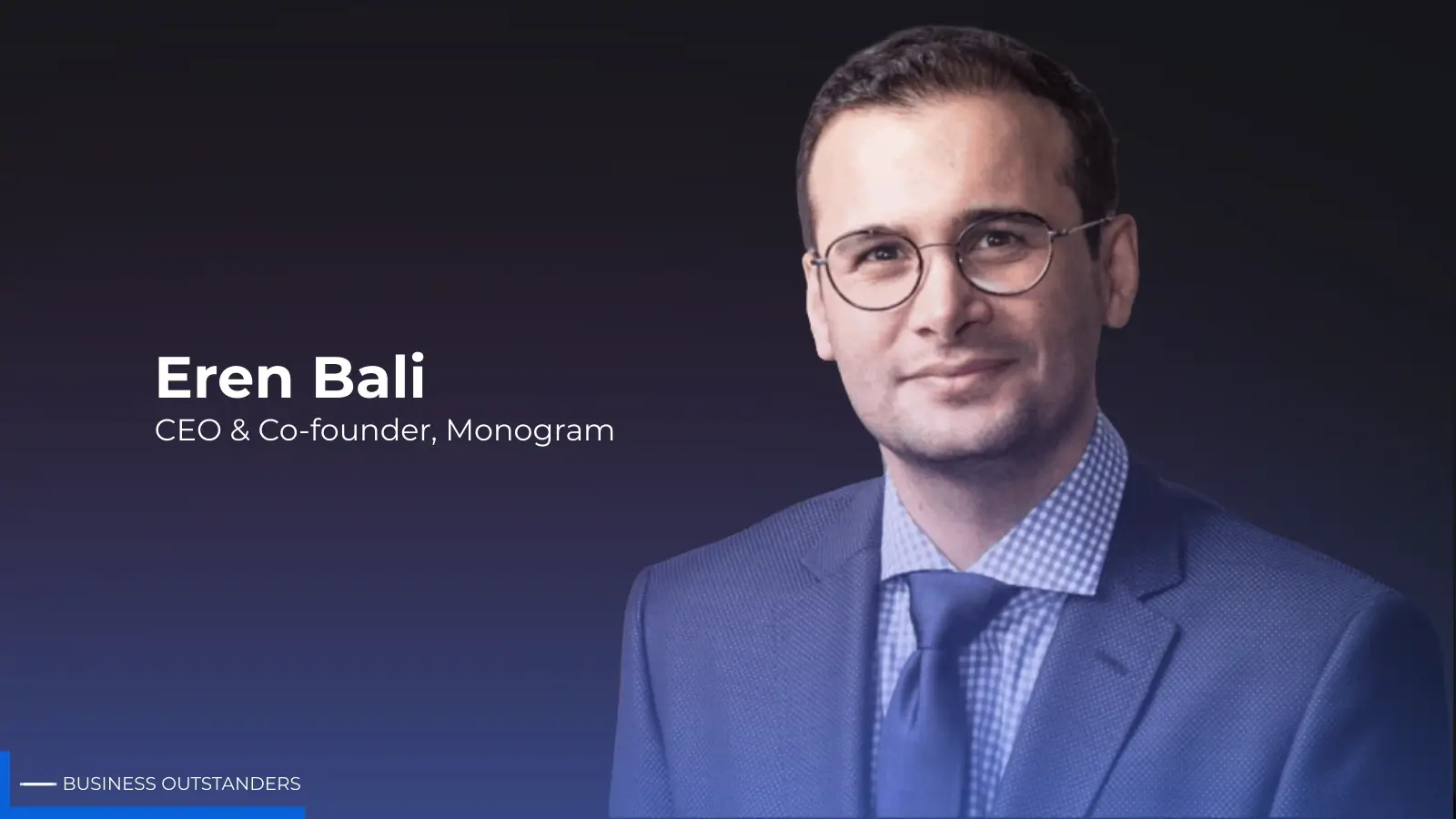
There is a particular kind of ambition that only gets forged in scarcity. Not the polished ambition of someone who always had options, but the kind that grows slowly and quietly in a place where the internet has not yet arrived. That is where Eren Bali’s story begins, not in a university lab or a Silicon Valley coffee shop, but in Durulova, a small apricot-farming village in southeastern Turkey, where education was something you had to fight for just to receive.
Today, Eren Bali is recognized as one of the rare founders in tech history to have built two separate billion-dollar companies from scratch. Udemy, the online learning platform he co-founded in 2010, went public on the Nasdaq in 2021 before being acquired by Coursera in December 2025. Carbon Health, the primary care startup he launched in 2015, reached a peak valuation of $3.3 billion in 2021. Both companies have since faced the harder chapters that come after the highs. And in 2025, he quietly started building again. But none of that starts in Silicon Valley. It starts in a one-room classroom, with a mother who was the only teacher.
The Village That Built the Founder
Eren Bali was born in 1984 in Malatya, Turkey, in a village called Durulova. His mother was the sole teacher at the village’s one-room primary school, rotating instruction across five grades simultaneously. When she had to attend to another grade, the rest of the class was expected to learn from books on their own.
“My primary school was a one-room schoolhouse where a single teacher tried her best to teach five different grades at the same time. That meant we were often left to try and learn from books on our own.”
He was a mathematically gifted kid who grew up convinced that curiosity was its own kind of resource. That belief was tested, and ultimately proven correct, when his family purchased a secondhand computer with internet access. The moment Eren found online math forums, something clicked. He had never seen anything like it, a place where you could access knowledge from people across the world, without a teacher, without a curriculum, without permission. He threw himself into it.
Math Olympiads and Middle East Technical University
Through online forums and self-directed study, Eren prepared himself to compete in mathematics competitions. In 2001, he won a gold medal at the Turkish National Mathematics Olympiad and followed it with a silver medal at the International Mathematical Olympiad in Washington D.C., one of the highest-ranked academic competitions in the world.
That same year, he enrolled at Middle East Technical University in Ankara. He graduated in 2005 with a double major in computer engineering and mathematics. The experience of learning through forums , the idea that the internet could give someone from a forgotten village the same knowledge as someone at the best schools in the world , had planted something in him that wouldn’t go away.
The First Try: KnowBand and the Failed Prototype
Before Udemy existed, Eren Bali tried to build it. In 2008, still in Turkey, he launched a livestream-based learning platform called KnowBand. The concept was ahead of its time: a place where instructors could teach live sessions to students anywhere online. It didn’t work. The infrastructure wasn’t ready, the market wasn’t ready, and Eren didn’t yet have the network or funding to push it forward.
KnowBand failed. But it gave him clarity. He knew the idea was right. He just needed a different moment and a different place. That place was Silicon Valley, and the moment came when a startup called SpeedDate, an online dating company based in San Francisco, recruited him as an engineer. Eren moved to the United States in 2010.
Building Udemy: Access for Everyone, Everywhere
Eren Bali co-founded Udemy in May 2010 alongside Oktay Caglar and Gagan Biyani. The mission was to democratize access to education , a marketplace where anyone could teach, and anyone could learn. Early seed financing of $1 million came from Russ Fradin and Keith Rabois. Angel investors Keith Rabois and Naval Ravikant also backed the vision early. The founders had been rejected by 30 venture capital firms before securing that first funding.
“Even though the internet doesn’t completely level out education, it does give people the chance to catch up.”
The first years were grinding. But by 2012, the platform had real momentum , and real tension. Gagan Biyani’s management style had started to cause friction within the team. Employees brought their concerns directly to Eren. After giving Biyani time to work with an executive coach, Eren made the difficult call to let him go in 2012. It was one of the hardest decisions of his tenure as CEO, but one Biyani himself later described with respect.
“Eren’s top priority at the time was to build a company that people wanted to work at.”
Eren remained CEO until April 2014, by which time Udemy had grown to 4 million students and 15,000 teachers. That same year, he was named to Forbes’ 30 Under 30 list. He then stepped back to become Chairman of the Board, handing operational control to the executive team that would take the company forward. Udemy went public on the Nasdaq on October 29, 2021, at $29 per share, targeting a valuation of up to $4 billion. In December 2025, Coursera agreed to acquire Udemy for approximately $930 million in equity, valuing the combined company at $2.5 billion.
The Detour That Became Carbon Health
In 2014, shortly after stepping down as Udemy CEO, Eren Bali spent several months in Turkey to help his mother through a health scare. He accompanied her through appointments, watched doctors work on outdated systems, and observed the friction between a patient who needed answers and a healthcare infrastructure that seemed designed for something other than the patient.
“I just directly observed that the technology for doctors was really far from what they needed to operate at a high productivity level. And that idea stuck in my head , that the largest, the most expensive resource of any country was one of the worst utilized.”
He came back to San Francisco with a clear idea of what a modern primary care system could look like. In 2015, he founded Carbon Health with Tom Berry. In 2016, the founding team expanded to include Pablo Stanley and Dr. Greg Burrell. In 2018, Carbon Health merged with Direct Urgent Care and added its owner, ER physician Caesar Djavaherian, as a co-founder.
Carbon Health grew rapidly. It ran mass COVID-19 vaccination sites, including Dodger Stadium in Los Angeles. In July 2021, a $350 million funding round led by Blackstone’s Horizon platform valued the company at $3.3 billion. Total funding across the company’s lifetime reached more than $600 million, from investors including BlackRock, Lux Capital, Silver Lake, and Elad Gil.
“I’m gonna start a company that believes that karma exists in business.”
Carbon Health’s model , integrating in-person clinics, virtual care, and proprietary digital tools into a single patient experience , was built around the idea that primary care had never been designed from the patient backward. Carbon was Eren’s attempt to fix that at scale.
The Hard Years: Valuation Cuts and Bankruptcy
The post-pandemic years brought a reckoning. As pandemic-driven demand subsided and capital markets for healthcare growth companies tightened, Carbon Health’s valuation was cut from $3.3 billion to approximately $1.4 billion by early 2023. The company restructured operations and reduced headcount as it worked to right-size its cost base.
On February 2, 2026, Carbon Health Technologies Inc. and 28 affiliated entities filed for Chapter 11 bankruptcy protection in the U.S. Bankruptcy Court for the Southern District of Texas. At the time of filing, the company operated approximately 93 urgent care and primary care clinics across eight states, serving over 800,000 patients annually with 1,400 employees and $77 million in funded debt outstanding. The company secured $19.5 million in debtor-in-possession financing to keep clinics operating through the restructuring process. Carbon Health is pursuing a dual-track process: either a debt-for-equity swap with existing lenders or a court-supervised sale of all or part of its assets, with a sale hearing targeted for March 24, 2026.
CEO Kerem Ozkay, who had succeeded Eren as chief executive in August 2024, stated plainly that clinics would remain open and patient care would continue without interruption. Eren, who had moved to the Executive Chairman role, was no longer in day-to-day control when the filing occurred.
Returning to Udemy, and Leaving Again
In August 2024, the same month he stepped down as Carbon Health CEO, Eren returned to Udemy as Chief Technology Officer , effective August 12, 2024. He reported directly to CEO Greg Brown and oversaw engineering, data science, and technical program management. It was a homecoming that the company welcomed publicly.
“We founded Udemy in 2010 to democratize access to quality education, making it truly accessible to everyone, everywhere, no matter their circumstance.”
In June 2025, Eren transitioned out of the CTO role, succeeded by Ozzie Goldschmied , and moved to Head of Innovation. Then, in September 2025, he did what he has always done when he sees a gap worth closing: he left to start building again.
Monogram: Building the Interface for AGI
On October 2, 2025, Eren Bali announced Monogram on X, co-founded alongside Edouard Tabet and Murat Akbal. The company is building what Eren describes as the user interface for AGI , artificial general intelligence. The premise: frontier AI models have become remarkably capable, but the applications built on top of them are still constrained by old design logic. Monogram is an attempt to rethink how humans and AI systems interact at the application layer.
“Today we adapt to apps. Our dream is for apps to adapt to us. We can now see that this is possible.”
It is, structurally, the same bet he has made twice before: that a foundational system has been built around the wrong assumptions, and that the person willing to rebuild from first principles will define what comes next. Whether Monogram becomes his third billion-dollar company remains to be seen. But the pattern of thinking that got him from Durulova to Udemy to Carbon Health to Monogram has not changed.
What Eren Bali’s Story Actually Tells Us
The honest version of the Eren Bali story is messier than the highlight reel. Udemy, the company he poured his life into, was ultimately sold to a competitor for $930 million , a fraction of the $4 billion it was once worth on the open market. Carbon Health, which he scaled to $3.3 billion in valuation with over $600 million in investor capital, filed for bankruptcy in February 2026. These are not footnotes. They are central to understanding what it actually means to build at this level.
He started in a one-room schoolhouse in Durulova where his mother taught five grades at once. Every company he has built since has been, in some way, a response to that room. The outcomes have been mixed. The instinct has never wavered.
Also Read: How Ankiti Bose Turned $30K Into a $1B Fashion Tech Unicorn
Explore More Success Stories: Discover more inspiring entrepreneurial journeys, leadership lessons, and business success stories in the BusinessOutstanders.com Success Stories category.
Business Outstanders brings you sharp insights on tech, business, entrepreneurship, law, crypto, and more. We uncover what’s next. Stay updated, sign up for our newsletter and be part of the future!