From Chaos to Cohesion: What Exactly Is a Marketing System?
Many businesses operate on a campaign-by-campaign basis, launching initiatives that, while sometimes successful, often feel disconnected and temporary. This approach can lead to wasted resources, inconsistent branding, and a constant scramble for the next big win. We believe there’s a more strategic, sustainable path: implementing a robust marketing system.
At its core, a marketing system is a structured, repeatable, and scalable framework that integrates all your marketing activities into a cohesive whole. It’s about viewing your marketing efforts not as isolated events, but as interconnected parts of a larger, predictable engine designed for long-term growth. This approach emphasizes repeatability, a long-term perspective, continuous feedback loops, and the inherent interconnectedness of all marketing functions. When executed effectively, companies with defined systems often see up to 30% higher marketing ROI, demonstrating the tangible benefits of this systematic approach.
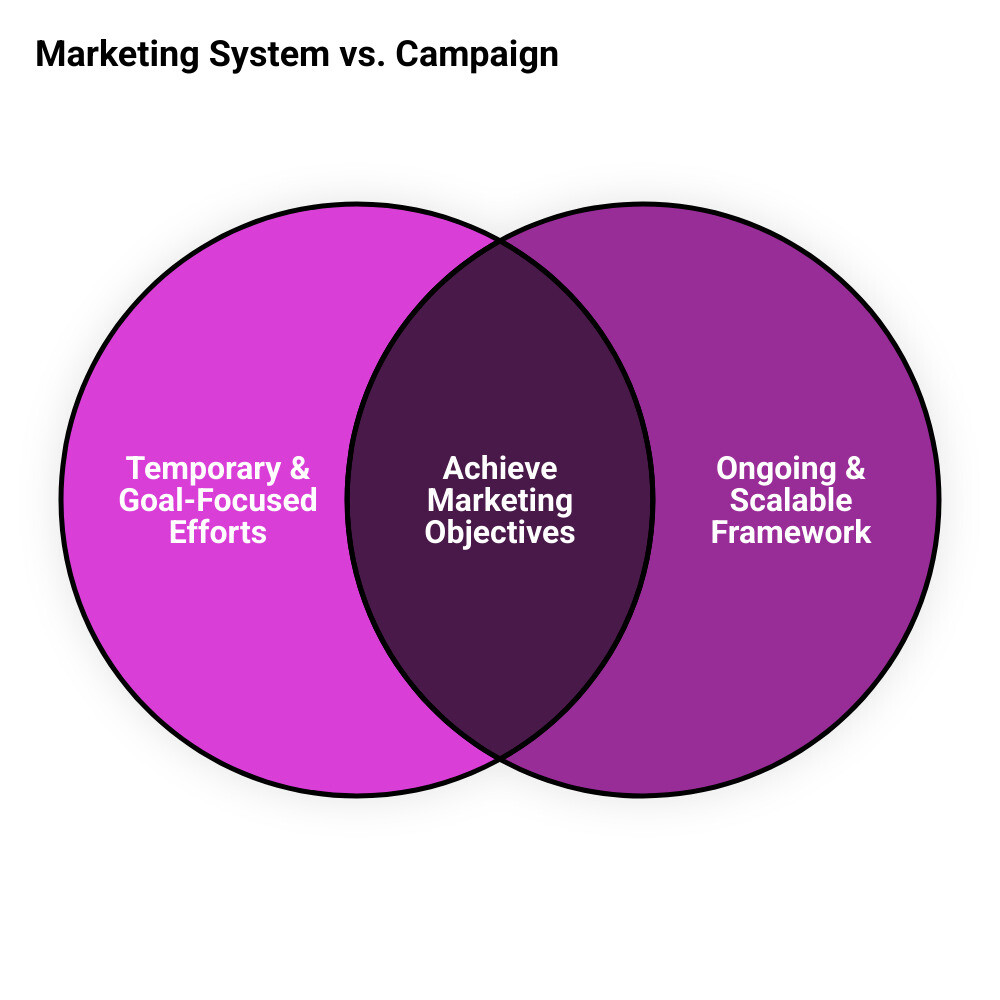
Marketing System vs. Marketing Campaign
To truly grasp the power of a marketing system, it's crucial to understand how it differs from a marketing campaign. While both are vital, they serve distinct purposes:
Feature Marketing System Marketing Campaign Nature Ongoing, continuous, and evolving Temporary, with a defined start and end date Focus Process-oriented, building repeatable workflows Goal-oriented, achieving specific, short-term targets Scalability Highly scalable, designed to grow with the business Limited scalability, often resource-intensive Learning Continuous improvement through feedback loops One-off learning, often starting from scratch Asset Building Creates lasting assets (processes, data, content) Primarily delivers short-term results Predictability High, provides consistent results over time Variable, success can be difficult to replicate A marketing campaign is like a single firework – bright, impactful, but fleeting. A marketing system, on the other hand, is a constellation of stars, each contributing to a larger, enduring light. It's about building predictability and sustainability into your marketing efforts, changing them into valuable business assets. For a deeper dive into this structured approach, consider exploring resources on systems thinking, which views activities as interconnected parts of a larger whole.
The Core Benefits of a System-Driven Approach
Embracing a system-driven approach to marketing offers a multitude of benefits that directly impact your business's bottom line and long-term viability:
- Time Savings: By documenting processes and automating repetitive tasks, your team spends less time reinventing the wheel and more time on strategic initiatives.
- Cost Efficiency: Optimized workflows and reduced redundancies lead to lower operational costs and a better return on your marketing investment.
- Improved Lead Quality: Consistent nurturing and targeted messaging, driven by a well-defined system, attract higher-quality leads who are more likely to convert.
- Improved Brand Consistency: Systems ensure that your brand message, tone, and visual identity remain uniform across all channels and touchpoints, building trust and recognition.
- Data-Driven Decisions: Integrated systems provide a clearer picture of performance, allowing for real-time adjustments and informed strategic choices.
- Scalable Growth: As your business expands, a robust marketing system can scale with it, handling increased volume and complexity without breaking down. This is particularly relevant as we look towards future marketing landscapes, as highlighted in "The Ultimate Guide to Building a Marketing System in 2026" on therckt.com, which emphasizes the need for adaptable frameworks.
Applying Systems Thinking to Your Marketing Strategy
Systems thinking is a powerful lens through which to view your marketing. It moves us beyond simply executing isolated tactics and encourages a holistic view of how all marketing components interact. By understanding these relationships, we can identify leverage points where small changes can create significant, positive ripple effects across the entire system. This means continuously optimizing processes, not just individual campaigns, and fostering a culture of ongoing improvement. It’s about building a marketing machine that not only runs efficiently but also learns and adapts over time.
The Anatomy of a High-Performing Marketing System
Just like a complex machine, a high-performing marketing system is composed of several interconnected parts, each playing a crucial role. These components work in harmony to attract, engage, convert, and retain customers, driving predictable business growth.

Key Components of an Effective Marketing System
While the specifics may vary by business, most effective marketing systems share a common set of core components:
- Strategy and Goals: This is the blueprint. It defines your target audience, value proposition, overarching objectives, and measurable KPIs. Without a clear strategy, your system lacks direction.
- MarTech Stack: The technology backbone. This includes CRM, marketing automation platforms, analytics tools, content management systems, and other software that enables efficiency and data collection.
- Documented Processes: The operating manual. Clear, step-by-step guides for every repeatable marketing activity ensure consistency, facilitate training, and reduce errors.
- People and Roles: The human element. Clearly defined responsibilities for team members, whether in-house or external, ensure accountability and efficient execution.
- Data and Analytics: The feedback loop. Systems for collecting, analyzing, and reporting on performance data are crucial for understanding what's working and where adjustments are needed.
- Content Engine: The fuel. A systematic approach to planning, creating, distributing, and repurposing valuable content across various channels.
Examples of Essential Marketing Sub-Systems
Within the broader marketing system, several specialized sub-systems handle specific functions:
- Lead Generation System: This system focuses on attracting potential customers through various channels (e.g., SEO, paid ads, content marketing, events) and capturing their information. Think of it as the engine that continuously fills your pipeline.
- Lead Nurturing System: Once leads are captured, this system engages them with relevant content and communications over time, building trust and moving them closer to a purchase decision. Automated email sequences and personalized content are often key here.
- Content Marketing System: This involves the strategic planning, creation, distribution, and analysis of valuable content to attract and retain a clearly defined audience. It ensures a consistent flow of engaging material.
- Community Building System: For businesses that thrive on engagement, this system focuses on fostering a loyal community around your brand through social media, forums, events, or exclusive groups.
- Customer Onboarding System: This system ensures new customers have a smooth and positive initial experience, helping them realize the value of your product or service quickly and reducing churn.
- Referral System: A structured way to encourage existing, satisfied customers to refer new business, leveraging word-of-mouth marketing for efficient growth.
These sub-systems, when integrated, create a powerful and comprehensive marketing machine. For more detailed insights into these essential components, resources like "The 7 Key Marketing Systems That Drive Business Development" on robesonmarketing.com offer valuable perspectives.
How to Automate Your Marketing Systems for Maximum Efficiency
Automation is the secret sauce that amplifies the power of your marketing systems, turning manual, time-consuming tasks into seamless, self-executing processes. By leveraging automation, we can significantly increase efficiency, reduce human error, and ensure consistent execution.
Key areas for automation include:
- Workflow Automation: Streamlining repetitive tasks like data entry, lead assignment, and reporting.
- Email Sequences: Automated welcome series, nurture campaigns, abandoned cart reminders, and re-engagement emails.
- Social Media Scheduling: Planning and publishing content across platforms in advance, freeing up time for real-time engagement.
- Lead Scoring: Automatically assigning scores to leads based on their engagement and demographic data, helping sales teams prioritize.
- AI-Powered Personalization: Delivering highly relevant content and offers to individuals based on their behavior and preferences.
It's clear that the industry recognizes this value: 70 percent of marketers prioritize integration in their MarTech stack, understanding that connected tools are essential for effective automation. This focus on integration and automation is a hallmark of modern, high-performing marketing systems, as further discussed in sources analyzing marketing automation market growth.
Building Your Blueprint: How to Construct an Agile Marketing System
Building a robust marketing system isn't a one-time project; it's an ongoing journey that benefits immensely from an agile approach. Agile marketing emphasizes flexibility, collaboration, and continuous improvement, allowing your system to adapt quickly to market changes and customer needs.

Structuring Your Modern Marketing Team for Agility
An agile marketing system requires an agile team structure. This often means moving away from rigid hierarchies towards cross-functional teams that can quickly respond to opportunities. Key roles in such a team might include:
- Marketing "Product Owner": Defines the vision, prioritizes the marketing backlog, and represents the customer's voice.
- "Scrum Master": Facilitates team processes, removes impediments, and ensures adherence to agile principles.
- T-shaped Marketers: Specialists in one area (e.g., SEO, content) with a broad understanding across other marketing disciplines.
- Data Analysts: Provide insights and ensure data-driven decision-making.
- Content Creators: Develop engaging and relevant content across various formats.
- Operations Specialists: Focus on optimizing workflows, managing the MarTech stack, and ensuring smooth system functionality.
Some businesses find immense value in leveraging fractional marketing systems to gain specialized expertise without the overhead of a full-time hire. This allows them to bring in seasoned professionals for strategic guidance or specific project execution, integrating them seamlessly into their agile framework.
A Step-by-Step Guide to Building Your First Marketing System
Starting small and iterating is key to successfully building your marketing system. Here’s a pragmatic approach:
- Define Your Goals: What specific business outcomes do you want your system to achieve? (e.g., increase qualified leads by 20%, reduce customer churn by 10%).
- Map the Customer Journey: Understand every touchpoint a customer has with your brand, from awareness to advocacy. This helps identify where systems are needed.
- Identify Repeatable Processes: Pinpoint tasks or series of tasks that occur regularly and can be standardized. Start with one or two high-impact areas.
- Select Your Tools: Choose the right MarTech solutions to support your identified processes. Prioritize integration capabilities.
- Document Everything: Create clear, concise process documents, flowcharts, and guidelines. This is crucial for consistency and scalability.
- Test and Iterate: Launch your system on a small scale, gather feedback, analyze performance, and make continuous improvements. This iterative process is central to Creative Shizzle agile marketing systems.
Overcoming Common Implementation Challenges
Building a marketing system isn't without its problems. Common challenges include team resistance to new processes, fragmentation caused by disparate tools, insufficient documentation, and unclear ownership of specific system components. To overcome these, focus on:
- Clear Communication: Explain the "why" behind the system to foster buy-in.
- Phased Implementation: Introduce changes gradually, allowing teams to adapt.
- Training and Support: Provide adequate resources for learning new tools and processes.
- Centralized Documentation: Ensure all system components and their instructions are easily accessible.
- Defined Ownership: Clearly assign responsibility for each part of the system.
A well-built framework evolves into one of the most effective growth marketing systems, providing a sustainable engine for business expansion.
The Engine Room: Fueling Your System with Technology and Data
In the modern marketing landscape, technology and data are the lifeblood of any effective marketing system. They provide the infrastructure for automation, the insights for optimization, and the power for personalization.
The Role of Technology and Your MarTech Stack
Your MarTech (Marketing Technology) stack is the collection of tools that enable your marketing system to function. A well-integrated stack ensures seamless data flow and efficient execution across all marketing activities. Key components often include:
- CRM (Customer Relationship Management): Platforms such as HubSpot and Salesforce centralize customer data, track interactions, and manage the sales pipeline.
- Marketing Automation Platforms: Tools such as Adobe Marketo Engage or advanced CRM features automate email campaigns, lead nurturing, and personalized communications.
- Analytics Tools: Platforms such as Google Analytics and Adobe Analytics are critical for tracking website performance, user behavior, and campaign effectiveness. Specialized tools like Amplitude and Mixpanel offer deeper product analytics.
- Content Management Systems (CMS): For managing website content, blogs, and other digital assets.
- SEO Tools: Ahrefs, Semrush, and Google Search Console help optimize visibility in search engines.
- Social Media Management Tools: Hootsuite or Sprout Social streamlines social content scheduling and engagement.
- Email Marketing Tools: Dedicated platforms like Mailchimp or GetResponse for email list management and campaign execution.
Integrating these tools is paramount. As indicated by "US Marketing Analytics Market Trends" on globenewswire.com, cloud technology and big data are enabling easier, more powerful integration, allowing businesses to build comprehensive, data-driven dashboards.
How to Measure the Success and ROI of Your Marketing Systems
Measuring the success and ROI of your marketing systems is non-negotiable. It's how we justify investment, identify areas for improvement, and demonstrate value. Companies that consistently track KPIs grow 20% faster, underscoring the importance of this step.
Key metrics and approaches include:
- Key Performance Indicators (KPIs): Define specific, measurable metrics aligned with your goals (e.g., lead conversion rate, customer acquisition cost, website traffic).
- Customer Acquisition Cost (CAC): The total cost of sales and marketing efforts required to acquire a new customer.
- Customer Lifetime Value (CLV): The predicted total revenue that a customer will generate throughout their relationship with your business.
- Attribution Modeling: Understanding which touchpoints and channels contribute to conversions, allowing for optimized budget allocation.
- Funnel Conversion Rates: Tracking the percentage of users who move from one stage of the marketing funnel to the next.
- ROI Calculation: Directly linking marketing spend to revenue generated.
Regularly reviewing these metrics helps ensure your marketing system is not just running, but running effectively.
Leveraging Data and AI for Continuous Optimization
Data and Artificial Intelligence (AI) are changing marketing systems, enabling unprecedented levels of optimization and personalization. AI adoption is projected to reach 80% by 2026, highlighting its growing importance.
- Predictive Analytics: Using historical data to forecast future trends, customer behavior, and campaign performance. This allows for proactive adjustments and strategic planning.
- Audience Segmentation: AI can analyze vast datasets to create highly granular customer segments, enabling more targeted messaging.
- A/B Testing and Experimentation: Automated tools enable continuous testing of elements (headlines, CTAs, visuals) to identify what resonates most with your audience.
- Personalization at Scale: Delivering individualized content, product recommendations, and user experiences across all touchpoints. Brands that master cross-channel integration see higher customer retention and ROI, as noted in the "State of Marketing Europe 2026 Report" from McKinsey.com, a capability significantly improved by AI.
By embracing these technologies, we can build marketing systems that are not only efficient but also intelligent, constantly learning and adapting to deliver superior results.
Frequently Asked Questions about Marketing Systems
What is the single most important component of a marketing system?
The most crucial component is a clearly defined and documented strategy. Without knowing your goals, target audience, and messaging, any process or technology you implement will lack direction and ultimately be ineffective. The strategy is the blueprint that guides the construction of the rest of the system, ensuring that every action contributes to your overarching business objectives.
How long does it take to build a functional marketing system?
Building a basic, functional marketing system can take anywhere from one to three months, depending on the complexity of your business and the resources available. This initial phase focuses on establishing core processes and integrating essential tools. However, a marketing system is never truly "finished." It's an evolving entity that requires continuous testing, optimization, and adaptation to market changes, making it a perpetual journey of improvement.
Can a small business or solopreneur implement a marketing system?
Absolutely. In fact, marketing systems are especially valuable for small businesses and solopreneurs who are short on time and resources. By automating repeatable tasks and creating efficient workflows, a system allows a small team (even a team of one) to achieve a level of consistency and output that would otherwise be impossible. It frees up valuable time for strategic thinking and client interaction, enabling sustainable growth without needing a large team.
Conclusion
The journey from marketing chaos to predictable growth is paved with well-designed marketing systems. By shifting our mindset from reactive tactics to proactive, integrated strategies, we empower our businesses to scale efficiently and sustainably. We've seen how a systematic approach offers unparalleled benefits, from increased ROI and improved lead quality to improved brand consistency and data-driven decision-making.
Starting with one small, repeatable process, documenting it, and then iterating can set the foundation for a comprehensive system that fuels your long-term vision. Accept the power of systems thinking, leverage the right technology and data, and foster an agile team culture. This will not only streamline your marketing efforts but also transform them into a powerful engine for enduring business success.
Ready to build a marketing system that delivers consistent, scalable growth? Explore how strategic planning can transform your business by visiting our pricing page and finding custom solutions.
Business Outstanders brings you sharp insights on tech, business, entrepreneurship, law, crypto, and more. We uncover what’s next. Stay updated, sign up for our newsletter and be part of the future!