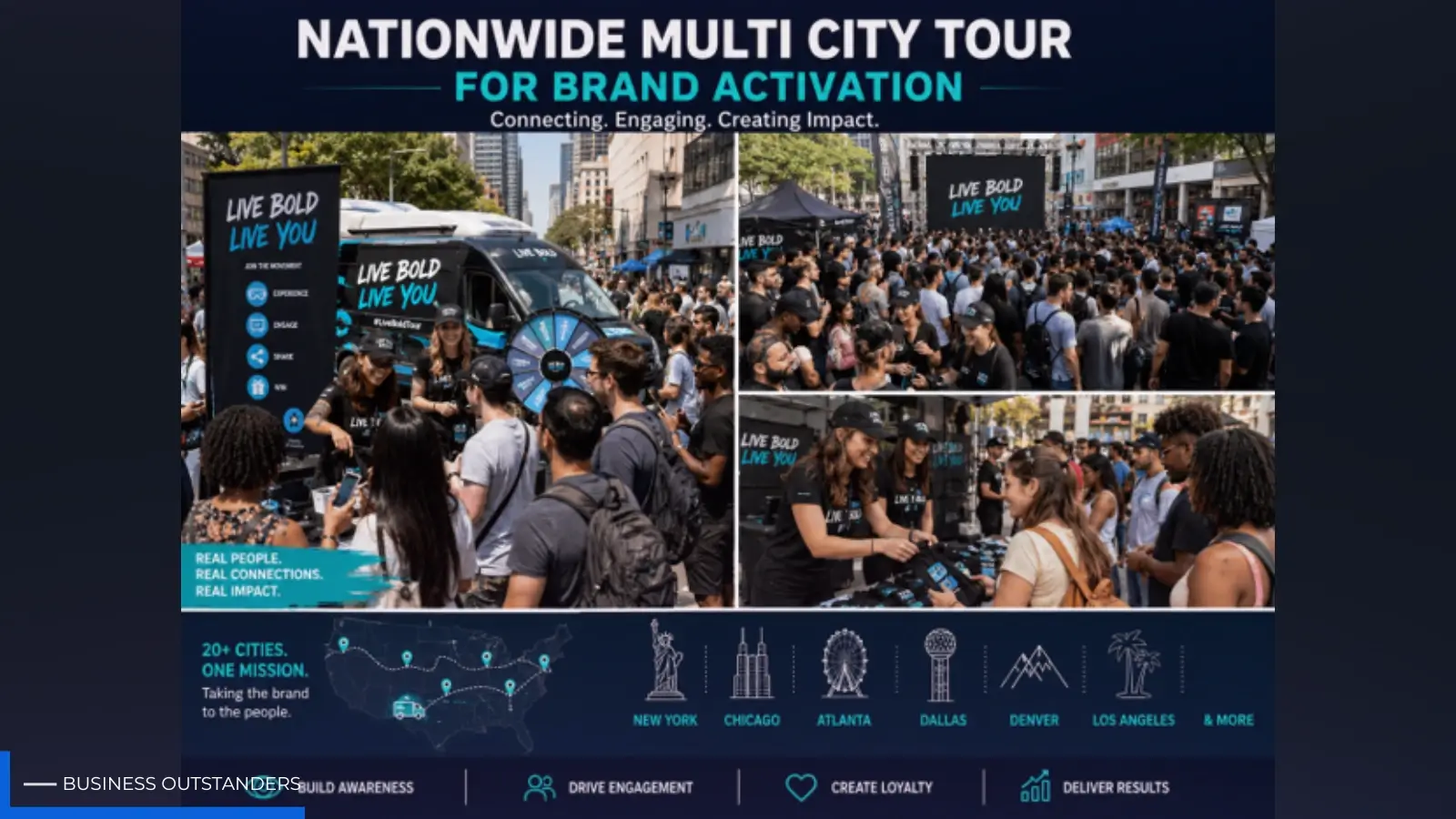
Running a brand activation in one city is a moment. Running one across ten cities is a movement. The gap between those two outcomes is not just scale. It is strategy, operational infrastructure, and a production approach that treats every market stop as part of a larger story rather than a standalone event. Multi-market brand tours are one of the most powerful programs in experiential marketing, and one of the most misunderstood. Here is what actually goes into making them work.
The Tour Is a Campaign, Not a Series of Events
The biggest mistake brands make when planning multi-market activations is treating each city as its own project. When that happens, execution quality varies, brand consistency erodes, and the compounding effect that makes tours so valuable never materializes.
A great multi-market program is designed as a single campaign with a clear narrative arc. Each market stop builds on the last. This broader approach reflects a strong marketing strategy that prioritizes long-term brand building over isolated promotional activities. The content from Boston feeds the anticipation in Philadelphia. The tour tells a story, and every city is a chapter. That continuity is what transforms a series of good activations into a national brand moment.
Choosing the Right Experiential Marketing Vehicles
The vehicle format anchors the entire program, so selecting it is a strategic decision, not a logistical one. Experiential marketing vehicles need to travel reliably across thousands of miles, perform consistently in varying weather, and hold up to the daily wear of high-volume consumer interactions market after market.
Branded food trucks are the workhorses of multi-city touring: versatile, highly customizable, and built for sustained operation. Glass-walled box trucks create visible, transparent brand environments that work especially well in dense urban markets. Airstreams carry aesthetic equity that compounds as consumers begin to recognize and anticipate the vehicle across cities.
The right choice depends on the brand's objectives, target consumer, and the nature of the experience being delivered. What matters most is that the vehicle performs at the same standard on day one and day forty-five.
Permitting Is Where Tours Succeed or Stall
Nothing disrupts a multi-city tour faster than a permit that does not clear in time. Every market has its own requirements, timelines, and agency relationships. What works in Los Angeles does not automatically transfer to Chicago, and what clears quickly in Austin may take three weeks in New York.
Experienced experiential marketing trucks operators have navigated this across dozens of markets. They have the agency relationships, the timeline knowledge, and the contingency protocols to keep a tour moving when the paperwork gets complicated. For brands managing this process without that institutional knowledge, permitting is typically where the first significant delays originate.
Staffing Consistency Is the Hardest Variable to Control
A brand can fabricate a beautiful vehicle and plan a brilliant route, but if the ambassador team in market three is not performing at the same level as market one, the tour loses consistency where it matters most: the consumer interaction.
Multi-city tours require staffing infrastructure beyond local recruitment. Detailed brand training, standardized interaction protocols, on-site production management, and quality control mechanisms that travel with the program are all necessary to maintain the experience standard across every stop.
The Data Gets More Valuable With Every Stop
One of the most underutilized advantages of multi-market programs is the comparative data they generate. The same activation deployed consistently across ten cities produces ten data points on consumer response by geography. Which markets generated the longest dwell times? Where did opt-in rates peak? Which cities produced the most organic social content?
That data does not just measure the tour. It informs every subsequent campaign decision, from market prioritization and product positioning to the activation formats that resonate most with specific audiences. A multi-market brand activation is one of the most complex programs in experiential marketing. It is also one of the most rewarding for the brands willing to invest in doing it right.
Business Outstanders brings you sharp insights on tech, business, entrepreneurship, law, crypto, and more. We uncover what’s next. Stay updated, sign up for our newsletter and be part of the future!