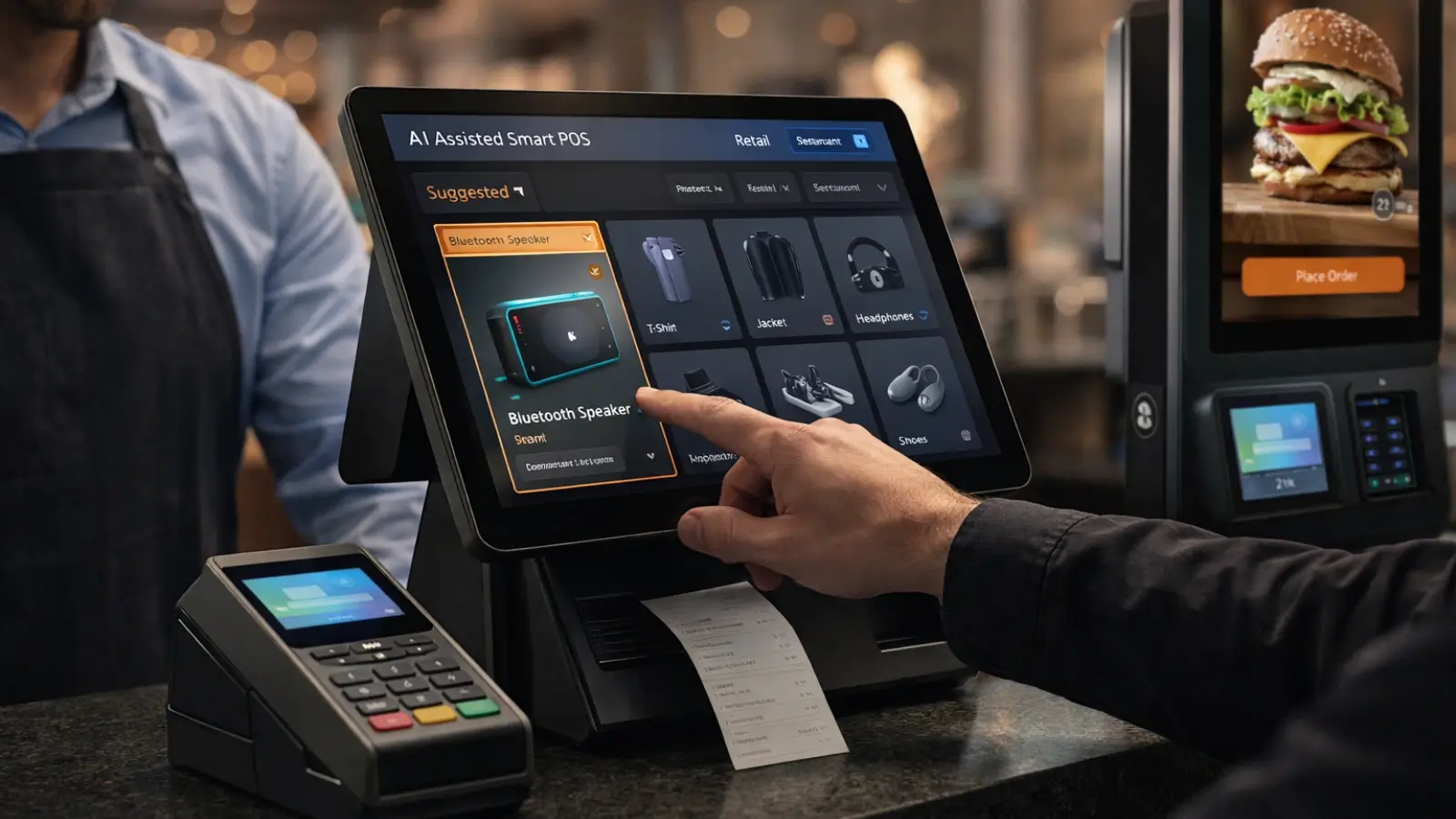
In retail and hospitality, change is constant. Strategies and tools that worked yesterday may feel outdated tomorrow. Customers expect faster service and personalized experiences. A single delay can destabilize supply chains. Add here digital-first competitors pushing companies to evolve faster than ever. The pace of disruption is no longer measured in years—it is counted in quarters, sometimes even weeks.
At the same time, artificial intelligence (AI) is moving from concept to practice at a remarkable pace. As found by IBM’s Global AI Adoption Index 2023, AI is already adopted by 42% of enterprise-scale organizations. These numbers indicate that AI is becoming a strategic tool for businesses competing in rapidly evolving markets.
Point-of-sale (POS) systems have always been a central part of retail and hospitality operations. For a long time, their role was straightforward: process payments, record sales, and manage receipts. Those functions still matter, but the scope of expectations has expanded dramatically.
-
Customers move between online and in-store shopping, expecting the same level of personalization and convenience in both.
-
Managers strive for real-time visibility into stock levels.
-
Executives need accurate data for informed decisions.
Traditional POS systems fail to meet those expectations. What was initially built as a tool for checkout is evolving into a platform for connecting sales, customer engagement, and operational intelligence.
Introducing TOP 5 AI enhancements in POS
Artificial intelligence is redefining what a POS system can deliver. No longer limited to recording transactions, these platforms are beginning to act as decision-support tools that learn from patterns in data and respond to changes in real time.
TOP 5 AI capabilities of POS software
-
Demand forecasting enables the anticipation of sales fluctuations and aligns inventory with customer needs.
-
Recommendation engines use purchase history to сreate a more personalized shopping experience with tailored offers.
-
Fraud detection algorithms spot unusual activity before it turns into financial loss.
-
Dynamic pricing adjusts to shifts in demand or market conditions.
-
Sales data analytics supports decisions such as identifying top-selling products, optimizing prices, and tracking performance.
All these features form a system that not only processes sales but also generates insights that shape future business strategy. For retail and hospitality leaders, the promise of AI-enhanced POS is efficiency paired with foresight—helping organizations move from reacting to problems toward anticipating opportunities.
TOP 4 Benefits of AI-powered POS systems
The advantages of bringing AI into point-of-sale systems for retailers and hospitality businesses lie in the efficiency gains and the quality of decisions that AI makes possible. Let's name the four main benefits of AI-driven POS systems.
1. Better inventory management
More accurate demand forecasts help prevent both stockouts and overstocking, reduce waste, and ensure products are available when customers need them.
2. Improved customer loyalty
Personalized recommendations and targeted promotions encourage repeat visits and strengthen brand relationships.
3. Increased revenue
Armed with AI-driven insights, businesses can better adapt pricing, product placement, and promotions that result in capturing sales that might otherwise be lost.
4. Operational efficiency
Automated analysis reduces the burden on staff, freeing teams to focus on customer service instead of manual routine tasks delegated to AI. In practice, this can be achieved through automated scheduling during peak seasons, faster reconciliation of sales across channels, or real-time alerts when inventory levels drop below a set threshold. Small changes in these areas can save hundreds of staff hours across a chain of stores or hotel properties.
Each of these four benefits solves the challenges retailers and hospitality operators face daily.
Use case: AI demand forecasting in action
One of the clearest examples of AI’s value in POS systems is demand forecasting. Instead of relying solely on historical averages or seasonal assumptions, AI forecasting models analyze sales patterns, customer behavior, and external factors to anticipate what products will be needed and when.
The impact can be impressive. According to a use case from POS software development company MobiDev, businesses that applied AI-driven demand forecasting integrated into POS software were able to cut stockouts by 65% and increase customer retention by 25%. From inventory planning to staffing levels to targeted marketing campaigns, predictive insights transformed reactive decision-making into a proactive strategy.
For retailers and hospitality businesses, these improvements can make the difference between staying ahead of customer expectations and falling behind competitors.
4 Key Future Trends in AI-driven POS
As AI capabilities advance, new possibilities are emerging that will continue to reshape retail and hospitality.
1. Edge computing
Processing data closer to where transactions occur enables real-time responses at the checkout or service counter.
2. Computer vision
Cameras paired with AI can enable automated checkout, detect fraud, or even analyze customer behavior in physical spaces.
3. Voice and gesture-controlled interfaces
These interactions may soon complement or even replace touchscreens, creating more accessible and efficient experiences for both customers and staff.
4. AI agents
Intelligent systems adjust pricing, schedule staff, and order replenishments.
These trends indicate a future where AI-driven POS systems will function as intelligent hubs that orchestrate business processes.
The Road Forward for AI-Driven POS
Artificial intelligence reshapes all the systems that retailers and hospitality leaders once treated as background infrastructure. The point-of-sale systems are evolving into a command center that connects customer behavior, operational data, and strategic goals.
The practical gains of AI-driven POS systems are already visible: fewer stockouts, smarter staffing decisions, and experiences that keep customers coming back. What makes this moment different from past technology shifts is the speed of change. New capabilities, such as predictive analytics, edge computing, and computer vision, are rapidly transitioning from pilot projects into daily practice.
For executives, the path forward is about identifying where AI built into POS systems can deliver a measurable impact—whether through demand forecasting that reduces waste, personalization that strengthens loyalty, or automation that frees employees to focus on providing exceptional service.
The companies that treat POS as a strategic asset will be best positioned to thrive in an environment defined by constant change. Those that do not risk watching competitors set new standards for efficiency and customer experience.
For leaders willing to act, the message is clear: AI-driven POS systems are not just about keeping up with change; they are about using intelligence to set the pace of change. That distinction will define the market leaders of the next decade.
Business Outstanders brings you sharp insights on tech, business, entrepreneurship, law, crypto, and more. We uncover what’s next. Stay updated, sign up for our newsletter and be part of the future!