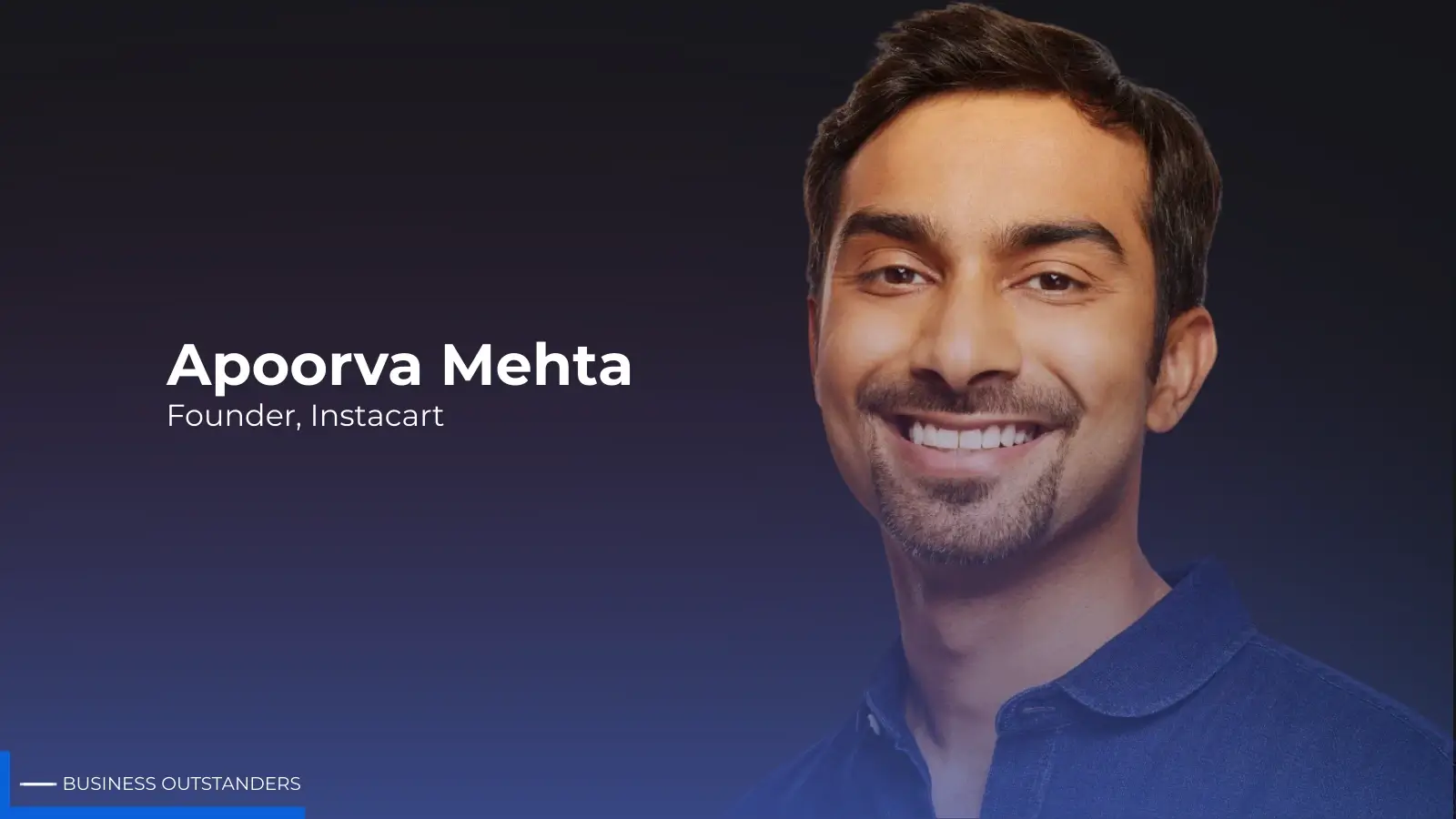
Most people give up after one failed business. Some push through two or three. Apoorva Mehta launched twenty before he finally found what he was looking for.
That persistence is what makes his story worth understanding , not just the billion-dollar valuation at the end of it.
A Childhood Spent Moving
Apoorva Mehta grew up in Jodhpur, India, before his family relocated to Libya and eventually to Hamilton, Ontario, when he was fourteen. Changing countries multiple times during his formative years meant constantly adjusting to new surroundings, new schools, and new social environments.
One thing that stayed consistent across all those moves was his frustration with grocery shopping. He hated it , the time it took, the effort involved, the sheer inconvenience of it. A minor complaint, most would say. But minor complaints, when the right person holds onto them long enough, sometimes turn into something significant.
He eventually enrolled at the University of Waterloo to study electrical engineering, graduating in 2008. Waterloo has a reputation for producing technically sharp graduates with a practical, startup-oriented mindset, and Mehta left with both.
Learning the Craft at Amazon
His early career moved quickly. Short tenures at Blackberry and Qualcomm gave him foundational industry experience, but it was his role as a supply-chain engineer at Amazon that proved most formative.
Amazon in the late 2000s was obsessive about delivery efficiency and customer experience. Working inside that system gave Mehta a ground-level education in what it actually takes to move products from one place to another reliably and at scale , knowledge that would directly inform what he built later.
By 2010, though, he had made a decision. He left Amazon, moved to San Francisco, and committed to building his own company. He had no specific idea yet. He just knew the corporate path wasn't where he was headed.
"I didn't know what my idea was going to be, the reason why I quit my job at Amazon was because I wanted to become an entrepreneur." he admitted to CNBC years later.
The Years Nobody Talks About
What followed between 2010 and 2012 was two years of repeated attempts and repeated failure.
Mehta started roughly twenty companies during that period. An advertising network for social games. A food-focused deals platform. A professional network for lawyers called LegalReach, which collapsed because the team invested in building before they confirmed lawyers actually wanted it.
None of them worked. But each one left him with a clearer picture of what he was doing wrong. He got better at questioning his assumptions early. He learned to talk to potential users before writing code. He developed a discipline around testing ideas against actual market demand rather than internal enthusiasm.
By the time the right idea came along, he had already made most of the common mistakes. That mattered more than people realize.
An Empty Fridge and a Real Problem
The summer of 2012 brought a moment of clarity that Mehta has described many times since.
He was in his San Francisco apartment, his fridge nearly empty, and it struck him , almost everything in daily life could be ordered online and delivered, except groceries. Retail, entertainment, travel , all had been reshaped by the internet. But the grocery industry, worth trillions, was still almost entirely dependent on people physically walking into stores.
He saw a gap that was both obvious and largely ignored. And this time, before building anything, he asked himself whether people would actually use it.
The answer was yes. So he started coding.
Three weeks later, he had a working prototype. He placed the first order himself, fulfilled it himself, and delivered it to his own apartment , just to see the full experience end to end.
Getting Into Y Combinator
Pitching a grocery delivery app to investors in 2012 was not easy. The industry remembered Webvan , a heavily funded dot-com era company that tried to build its own warehouse infrastructure for grocery delivery and burned through $800 million before shutting down. The comparison came up constantly.
Mehta's model was fundamentally different. Rather than building warehouses or holding inventory, Instacart would work with existing grocery stores and use independent shoppers to fulfill orders. The asset-light structure kept costs down and allowed the company to scale without massive upfront investment.
To get a foot in the door at Y Combinator, he did something unconventional , he used the Instacart app to deliver a six-pack of beer to one of YC's partners. It was a practical, memorable demonstration of the product in action. It worked. He got the meeting, and eventually secured a spot in YC's Summer 2012 batch.
At Y Combinator, he met Max Mullen and Brandon Leonardo, who became his co-founders. The three of them refined the business and launched Instacart publicly.
The Work Before the Scale
Getting Instacart off the ground in the early days meant doing things manually that would eventually be automated.
When there weren't enough shoppers to fulfill orders, the founders went to stores themselves and bought the items directly , a workaround they called "ninja shopping." To build a usable product catalog, they walked through stores, collected one of every item, photographed everything in a studio, and uploaded it to the app. The whole effort ran about $50,000. For the first store they fully cataloged this way, demand doubled the following day.
It was unglamorous, time-consuming work. But it got the product to a place where it could actually be used.
Retail Partnerships That Changed the Trajectory
Mehta has always had one thing clear in mind for grocery retailers: Instacart is there to partner with them, not compete with them. He gave grocery chains an easy way to deliver to their customers online without having to develop that technology on their own. This approach made it easier to talk and struck deals.
Whole Foods partnered with Instacart in 2014 as the first big national partner. Then came Costco, Kroger, and Safeway within a year after, giving Instacart a national reach that few could have expected for a company that was barely two years old at the time.
Investor support increased with the retail partnerships. Instacart finished its initial seed round at $2.3 million via Y Combinator, then raised money through a series of larger rounds in the years that followed, reaching a $39 billion valuation by 2021.
When Grocery Delivery Became a Necessity
The pandemic of 2020 brought grocery delivery to a place that no one had anticipated. Visiting stores became more difficult, and families who never thought about grocery delivery before were left with no other choice. Demand hit Instacart hard and fast – the firm was able to bring in 300,000 more shoppers in a matter of weeks, all while implementing contactless delivery and ensuring that the staff on the ground had what they needed.
"We saw five years of growth in a matter of five weeks, it was both exhilarating and terrifying. We had to completely transform our operations while maintaining service quality." Mehta said.
Online grocery shopping was a niche interest before the pandemic. By 2021, it had become more than 10% of the total market, up from 3% before. The change in behavior proved to be a permanent one – people who tried delivery out of necessity stuck with it even after the pandemic restrictions were lifted, putting Instacart in a much better position in the market than it was before.
A New Chapter
July 2021 was a turning point in Mehta's relationship with the company he founded. He stepped down from the CEO position to become an executive chairman, promoting Fidji Simo, a veteran executive from Facebook, to lead the company.
"I'm really proud of what we've accomplished at Instacart, but I also think that in order to continue to innovate, sometimes you need new ideas and new perspectives." he said
It was a deliberate choice. Mehta knew that the skills that make a person good at building a company from scratch aren't necessarily the same skills that make a person good at running a company when it's larger, and he chose to take the leap rather than sticking around out of loyalty.
By 2022, he had already moved on to his next project. He started Cloud Health Systems, focusing his efforts on the healthcare space. The company hasn't been extensively covered in the press, but the idea behind it is the same one that has driven Mehta throughout his career: find an industry where the current way of doing things is good enough but not great, and do something better.
Final Thoughts
Instacart's tale is, at its core, the story of the long haul before it became Instacart.
Two years of trying with no success. Quitting a job without a plan. Pitching a product that invited immediate comparisons to one of the biggest failures in the history of Silicon Valley. Apoorva Mehta navigated all of this, and what he created on the other side of it changed an industry that had remained remarkably static for decades.
He brought the right experience to the table, the right timing, and, importantly, a business model that was stable enough to actually work. Food delivery wasn't a new idea. Getting it to work for all parties was what took some actual thinking.
Apoorva Mehta's pedigree puts him squarely in that camp, not because of the rapid success of Instacart but because of the way he deliberately built it.
Also Read: Inventor of Gorilla Glue: The Mark Singer Story
Explore More Success Stories: Discover more inspiring entrepreneurial journeys, leadership lessons, and business success stories in the BusinessOutstanders.com Success Stories category.
Business Outstanders brings you sharp insights on tech, business, entrepreneurship, law, crypto, and more. We uncover what’s next. Stay updated, sign up for our newsletter and be part of the future!