Introduction
Many manufacturing enterprises face the persistent challenge of cost overruns, delayed deliveries, and quality instability, often stemming from improper selection of CNC machining services. Industry reports indicate that a staggering 30% of projects exceed budgets due to supplier-related mistakes. The root cause frequently lies in a traditional selection approach that overemphasizes initial price quotes while neglecting critical factors like technical capabilities, quality certifications, and long-term reliability.
This guide provides a systematic evaluation framework, integrating best practices from precision manufacturing and industrial automation, to empower engineers in making scientifically sound supplier choices. The following sections will delve into the essential criteria for selecting a reliable partner.
What Are the Essential Criteria for Selecting a Reliable CNC Machining Supplier?
Selecting a reliable CNC machining supplier is a strategic, multi-dimensional decision that fundamentally impacts project cost, timeline, and quality. Moving beyond simple price comparisons requires a holistic evaluation of a partner’s capabilities across the entire product development lifecycle. The most significant value and risk mitigation are achieved not through a transactional relationship, but through deep, phase-gated collaboration that leverages the supplier’s expertise from the very beginning.
The true measure of a supplier is demonstrated through proactive partnership across every stage of development. The following table, modeled on a collaborative framework, illustrates how a strategic supplier integrates their core competencies — technical capability, quality systems, and project management — to deliver value and de-risk your project from concept to continuous improvement.
|
Collaboration Phase |
Core Actions & Supplier Value Integration |
Expected Benefits & Risk Mitigation |
|
Concept Design |
Early DFM consultation with supplier engineers to assess manufacturability and material selection. |
Avoid fundamental design flaws and lock in the majority of potential cost savings before the design is finalized. |
|
Detailed Design |
Joint Critical Function Analysis and tolerance optimization based on process capability and application needs. |
Achieve significant cost savings while ensuring performance, by specifying only the necessary precision. |
|
Prototype Validation |
Form, fit, and function testing using rapid prototyping and pre-production parts. |
Verify design intent and assembly, reducing the risk of costly revisions during production tooling. |
|
Production & Quality |
Leverage the supplier’s closed-loop quality assurance system (e.g., SPC, CMM inspection, full traceability). |
Ensure parts consistently meet specifications, avoiding downstream assembly failures, delays, and warranty costs. |
|
Continuous Improvement |
Implement feedback loops from production data and quality metrics for future design iterations. |
Build a lasting competitive advantage through ongoing product and process optimization. |
Table 1: Key collaborative phases between manufacturer and supplier, illustrating how early and ongoing partnership optimizes for cost, quality, and time-to-market.
Therefore, the essential criteria extend beyond a static checklist. They are embodied in a supplier’s willingness and ability to engage as a true partner throughout this collaborative journey. Selecting the right CNC machining services partner on this basis lays the foundation for project success, ensuring not just a one-time delivery, but a long-term strategic advantage.
How Can Precision Manufacturing Technologies Reduce Production Costs by Over 20%?
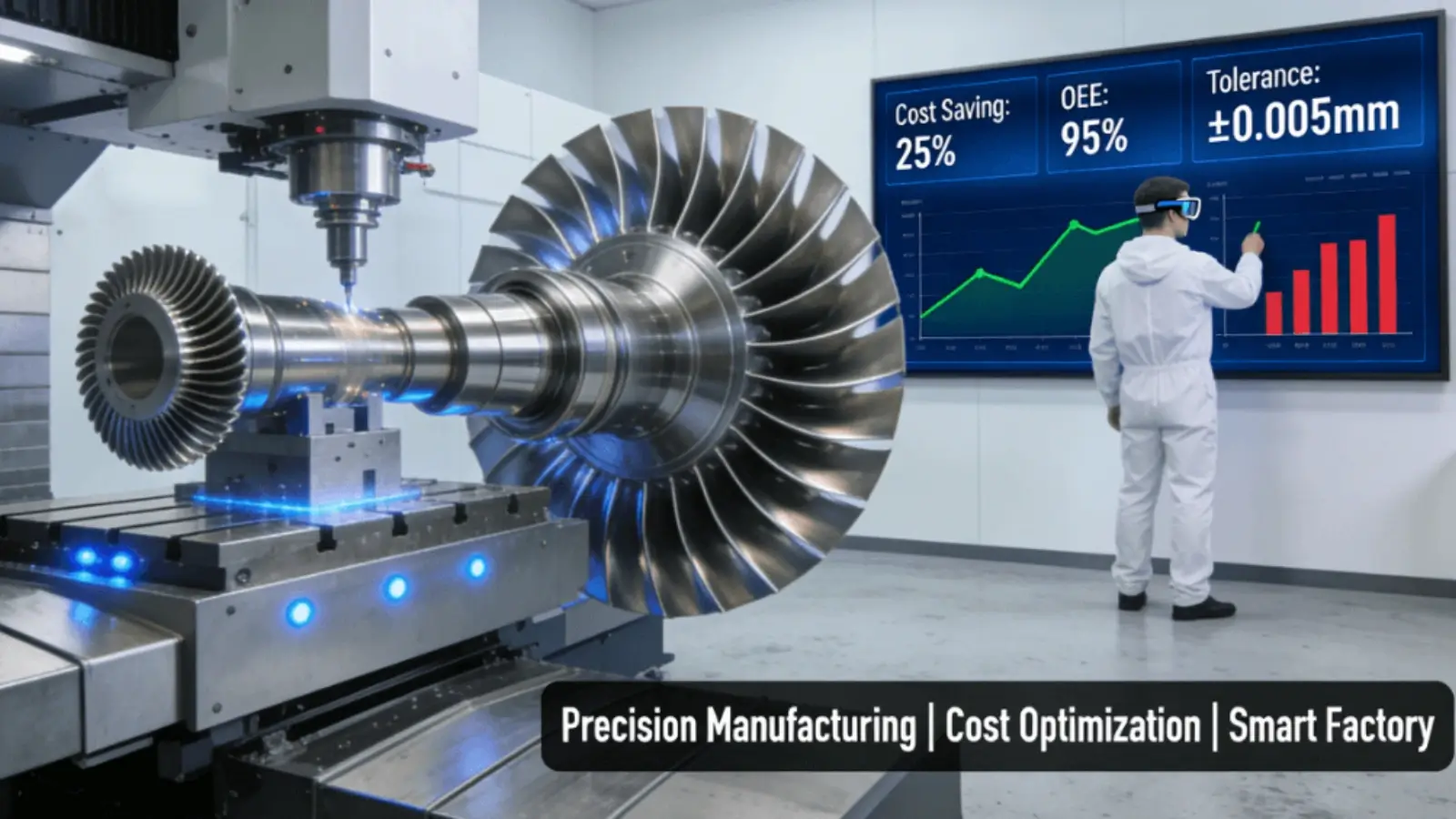
Precision manufacturing is not solely about achieving ultra-tight tolerances; it is a comprehensive philosophy that leverages advanced manufacturing technologies to eliminate waste, optimize processes, and drive substantial cost savings. By focusing on efficiency and first-pass yield, these technologies can directly reduce total production costs by more than 20%.
1. The Role of Design for Manufacturing (DFM) Analysis
A pivotal cost-reduction strategy begins long before the machine starts cutting. Systematic DFM analysis conducted by experienced engineers can identify and rectify design inefficiencies that lead to high machining costs and potential failures.
-
Structural Simplification and Part Consolidation: Through DFM, engineers can suggest design optimizations that simplify complex assemblies. For example, converting a multi-part sheet metal assembly into a single, integral CNC-machined component eliminates assembly steps, reduces fasteners, and maintains structural integrity. This consolidation directly cuts down on processing time, material usage, and labor costs associated with assembly.
-
Material and Tolerance Optimization: A deep understanding of material properties allows suppliers to recommend more economical alternatives that meet performance requirements, potentially reducing material costs by over 15%. Similarly, applying manufacturing-friendly tolerance design by relaxing non-critical tolerances avoids unnecessary machining expenses without compromising functionality, striking an optimal balance between quality and cost.
2. Leveraging High-Efficiency Machining Strategies
The adoption of advanced CNC technologies like 5-axis machining directly contributes to cost efficiency. Research from organizations like the American Society of Mechanical Engineers (ASME) underscores the impact of industrial automation on productivity.
-
Single-Setup Machining: 5-axis technology enables the complete machining of complex parts in one setup. This eliminates the cumulative errors and time consumption associated with multiple fixturing and repositioning required by 3-axis machines. A turbine blade that previously needed three setups and 12 hours can be completed in a single setup under 6 hours, reducing machining time and associated costs by over 30%.
-
Optimized Toolpaths and Cutting Parameters: Advanced CAM software generates highly efficient toolpaths that maximize cutting tool engagement and lifespan. Strategies like flank milling and dynamic milling strategies can increase material removal rates while reducing tool wear. One case study showed that optimizing the toolpath strategy for a medical device casing reduced machining time by 35% and achieved a superior surface finish.
By integrating these precision manufacturing technologies into the production workflow, manufacturers can achieve faster turnaround times, higher quality yields, and significantly lower total cost of ownership, far outweighing the initial investment in a sophisticated CNC machining quote.
What Is the Impact of Industrial Automation on CNC Machining Efficiency?
Industrial automation is a cornerstone of modern manufacturing, transforming CNC machining from a standalone process into a highly efficient, interconnected system. Its impact extends beyond simple mechanization to encompass data-driven process control, which dramatically enhances efficiency, consistency, and traceability.
1. Real-Time Monitoring and Adaptive Control
Automated systems are equipped with sensors that continuously collect data on spindle load, temperature, and vibration. This real-time monitoring enables adaptive control, where the machining parameters (like feed rate) are automatically adjusted in response to actual cutting conditions. This optimization prevents tool breakage, maintains consistent quality, and maximizes tool life, directly reducing downtime and consumable costs.
2. The Integration of Digital Twins and Smart Factories
In the context of Industry 4.0, CNC machining services are evolving into data nodes within a smart factory. The concept of a digital twin — a virtual model of the physical machining process — allows for simulation and optimization before any material is cut.
-
Process Simulation: The digital twin can simulate the entire machining process, identifying potential collisions, optimizing toolpaths for time efficiency, and predicting outcomes, which drastically reduces the risk of errors and scrap.
-
Predictive Maintenance: By analyzing data trends from machine sensors, the system can predict maintenance needs before a failure occurs. This predictive maintenance approach minimizes unplanned downtime, a critical factor in maintaining production schedules and reducing costs.
-
Production Flow Optimization: Linking machine data to a Manufacturing Execution System (MES) provides a holistic view of the production floor. This enables better scheduling, reduces bottlenecks, and optimizes energy consumption, contributing to overall operational efficiency.
3. Ensuring Quality through Automated Inspection
Automation extends to quality assurance with the integration of on-machine probing and inline measurement systems. These systems perform in-process inspection of key dimensions, feeding data back to the CNC controller to make real-time compensations for tool wear or thermal drift. This closed-loop quality control ensures that parts consistently meet tight tolerances without manual intervention, enhancing reliability and reducing final inspection time. Adherence to stringent quality standards, such as IATF 16949 for automotive, is thus seamlessly integrated into the automated workflow.
The synergistic effect of these automated systems is a highly efficient manufacturing environment where projects are completed faster, with greater precision and lower operational costs, making a compelling case for partnering with suppliers who have embraced industrial automation.
How Do Online CNC Machining Services Streamline Project Management?
The rise of online CNC machining services has revolutionized the procurement and management of custom parts. These platforms leverage digital tools to create a transparent, efficient, and collaborative project management experience, effectively streamlining operations from quote to delivery.A primary advantage is the acceleration of the quotation process. Traditional quoting can be slow and opaque. In contrast, advanced online platforms feature intelligent quoting engines that automatically analyze uploaded 3D models (e.g., STEP, IGES files) to generate instant, preliminary quotes. For complex parts, a detailed quote with comprehensive DFM analysis is typically provided within 24-48 hours, significantly speeding up the project initiation phase.
Furthermore, these services introduce unprecedented communication transparency and project tracking. They replace fragmented email chains with dedicated web-based collaboration platforms. Key mechanisms include:
-
Dedicated Project Managers: Providing a single point of contact for requirements and ensuring accountability.
-
Regular Progress Reports: Featuring images and videos that visually demonstrate processing progress and key quality control milestones.
-
Centralized Document Management: Ensuring real-time synchronization of design documents, process drawings, and revision comments.
This systematic communication framework ensures all stakeholders are aligned, changes are managed efficiently, and potential risks are identified proactively. For example, a rapid engineering change request (ECR) system ensures that any design modifications are assessed, approved, and implemented without derailing the project timeline. This level of oversight is crucial for avoiding delays and is a hallmark of professional online CNC machining services. By making the supply chain as visible as an internal project, these platforms build trust and facilitate successful project outcomes.
Why Are Advanced Manufacturing Technologies Critical for High-Quality Output?
Advanced manufacturing technologies are the non-negotiable foundation for achieving the high-quality output demanded by sectors like aerospace, medical, and automotive. Their role transcends incremental improvement; they enable a fundamental shift from simple part production to reliable, value-added engineering. This transformation is driven by three interconnected pillars.
1. Enabling Uncompromised Design through Advanced Equipment
Core to precision manufacturing are technologies like 5-axis simultaneous machining. This capability provides the essential geometric freedom to machine complex free-form surfaces and deep cavities in a single setup. By maintaining optimal tool orientation, it ensures consistent cutting force and delivers a superior surface finish, allowing engineers to realize ambitious designs without performance compromise.
2. Institutionalizing Quality via Certified Management Systems
Consistent quality is underpinned by integrated quality management systems certified to international standards. Adherence to certifications like ISO 13485 (medical devices) mandates rigorous control over the entire production environment and process, ensuring every component meets exacting specifications. Complementary standards like ISO 14001 further demonstrate a commitment to sustainable practices, supporting long-term operational stability.
3. Creating a Self-Optimizing Production Virtuous Cycle
The highest level of quality assurance emerges from the closed-loop integration of hardware, software, and data analytics. High-precision equipment and sophisticated CAD/CAM software produce accurate parts, which are then verified by automated inspection systems. The collected data feeds back in real-time for continuous process optimization, creating a self-reinforcing cycle that guarantees reliability, performance, and transforms machining into a true engineering partnership.
Conclusion
In summary, avoiding costly CNC supplier mistakes requires a paradigm shift from a price-focused to a value-driven selection process. By implementing a systematic evaluation framework that prioritizes technical capabilities, quality certifications, and project management transparency, engineers can significantly enhance project success rates. The integration of precision manufacturing principles and industrial automation technologies offers a proven path to reducing production costs by over 20% while ensuring superior quality. A strategic approach to selecting CNC machining services is not an expense but a critical investment in project success.
FAQs
Q1: What is the average lead time for precision CNC machining services?
A: Lead times vary by complexity, but professional services utilizing advanced scheduling and digital workflows often deliver prototypes in 3-5 days, ensuring minimal downtime for urgent projects.
Q2: How can I verify a supplier's quality certifications like ISO 9001?
A: Reputable suppliers provide transparent audit reports and certification documents. These can often be verified through online databases maintained by accreditation bodies, ensuring adherence to international standards.
Q3: What are the benefits of online CNC machining services for small batches?
A: They offer real-time quotes and immediate DFM feedback, which can accelerate the prototyping phase by up to 40% while maintaining quality through integrated digital tools and expert review.
Q4: How does industrial automation impact CNC machining costs?
A: Automation reduces direct labor costs by up to 30% and enhances process consistency, leading to fewer errors and higher throughput. This results in significant long-term savings despite a higher initial investment.
Q5: What criteria should I prioritize when comparing CNC machining quotes?
A: Focus on technical capability, documented quality controls (e.g., certifications), and post-sales support. Evaluating these factors holistically, rather than focusing solely on the lowest price, helps avoid hidden costs and ensures long-term reliability.
Author Bio
The author is a precision manufacturing expert with over a decade of experience in the CNC machining sector, specializing in solving complex part challenges for high-tech industries. The expert is part of the team at LS Manufacturing, which holds IATF 16949 and AS9100D certifications, and is dedicated to advancing industrial innovation through high-quality, engineered solutions.
Business Outstanders brings you sharp insights on tech, business, entrepreneurship, law, crypto, and more. We uncover what’s next. Stay updated, sign up for our newsletter and be part of the future!