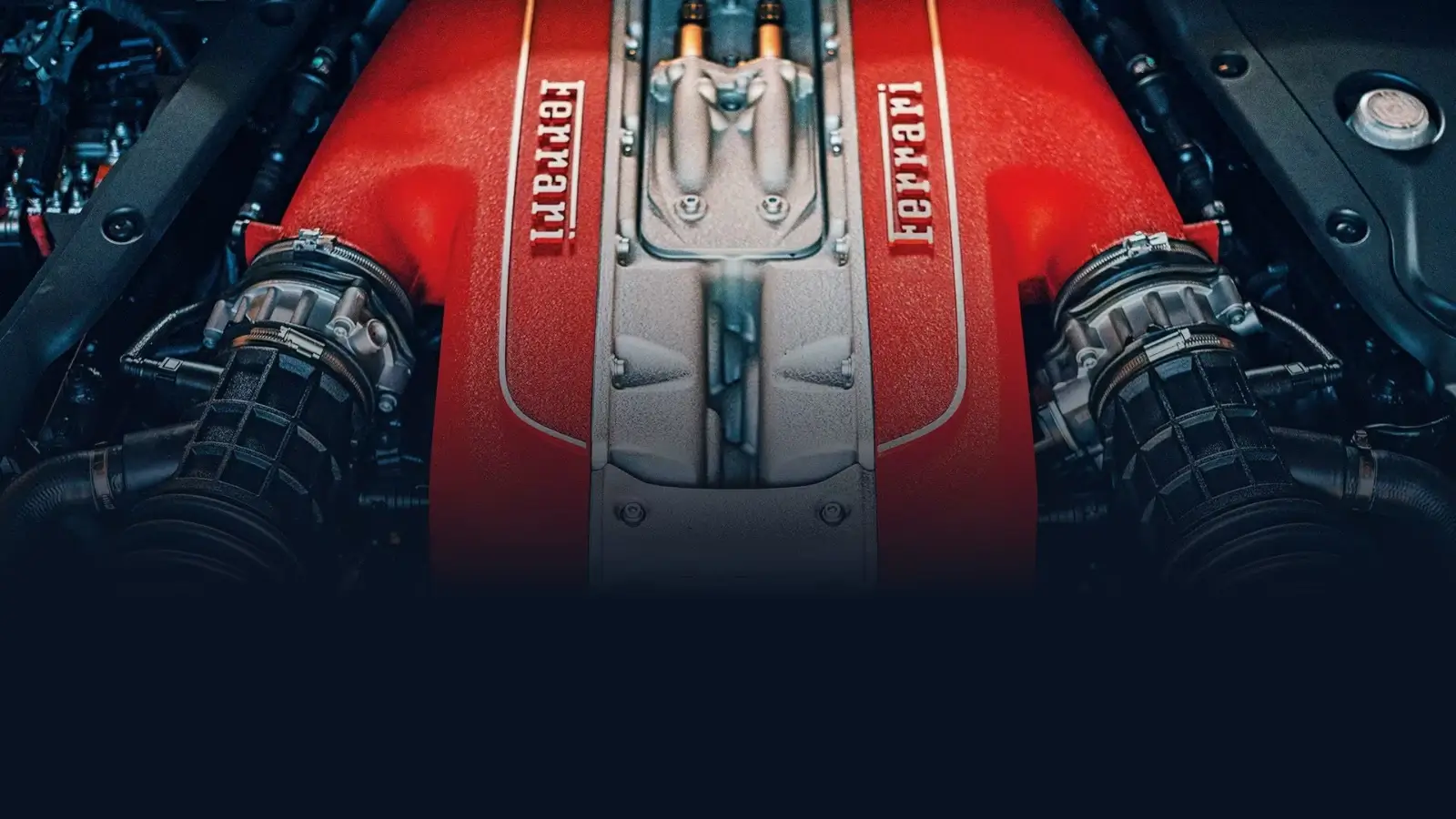
A V12 engine—one with 12 cylinders—is seen by many as something special. Whether it’s in a luxury car or a high-speed sports car, V12s can be smooth and grand, or wild and thrilling. In this article, we focus on the most exciting V12 engines ever built.
Ferrari Tipo F130B
Ferrari has always tried to make its road cars connected to its racing heritage. The Tipo F130B engine is proof of that. It powered the Ferrari F50 in the 1990s, a car sold as a race car for the road. This 4.7-litre V12 was closely related to a 3.5-litre racing V12 from an Alain Prost Formula 1 car.
Ferrari increased its size for more torque and set its redline at 8,500 rpm—lower than the racing version, but still remarkable. The engine had five valves per cylinder, a carbon-fibre air intake system, lightweight titanium connecting rods, dry-sump lubrication, and a special variable exhaust.
With 519 PS (≈382 kW) of power and 471 Nm of torque, the F50 could go from 0-62 mph in 3.8 seconds and reach a top speed of 202 mph. It could also lap Ferrari’s Fiorano test track four seconds faster than the F40. What this engine lacked in absolute revs, it made up for with feeling and emotion.
Mercedes-AMG M120
In the early 1990s, Mercedes-AMG built the M120 engine. It was first used in their S-Class cars. It was smooth, dependable, and powerful. Over time, the engine was enlarged to 7.3 litres and used in the Pagani Zonda, a high-end hypercar, where it made over 750 PS.
The same basic engine also had success in motorsport—for example, in the Mercedes CLK GTR. Its sound, performance, reliability, and pedigree helped it earn a place among the greatest V12s.
Ferrari F140
Ferrari’s F140 V12 began in the Enzo in 2002. Since then, versions of it have powered many models, including the 599 GTB. The latest version, called F140HC in the Daytona SP3, makes about 840 PS at 9,250 rpm.
This V12 engine has won in racing (for instance, in the MC12 GT1) and has been used on the road. It’s rare to see such power from a naturally aspirated engine these days. The F140’s long life, both on the track and on the road, makes it legendary.
Lamborghini Bizzarrini
The “Bizzarrini V12” goes back to Lamborghini’s earliest cars, starting in the 1960s. It was designed by Giotto Bizzarrini, who had worked at Ferrari. The first version made about 284 PS from 3.5 litres, revving up to 11,000 rpm under racing conditions.
Over decades, it grew in size and power. By the time of the Murciélago LP670-4 Super Veloce, it displaced 6.5 litres and made ~670 PS. Its sound and character changed with each model—from the gentle rumble of the 350GT, to the roar of the Countach and Diablo, to the last Murciélago. The Bizzarrini V12 is versatile, loud, proud.
Cosworth RA
The RA V12, made for the Aston Martin Valkyrie, is one of the newest entries. It revs over 11,000 rpm, produces around 1,000 PS, yet remains road-legal and usable. It’s lighter than many race car engines of similar power.
It shows that even in an age of hybridization and downsizing, engineers can still build wild, strong naturally-aspirated engines that sound amazing and perform at peak levels.
Cosworth GMA (T.50 and T.33)
Gordon Murray Automotive (GMA) also made a V12 for its cars like the T.50 and T.33. This one is different: it’s smaller (3.9 litres) and revs even higher—up to ~12,100 rpm. It’s built for response, for purity. Murray wanted it to feel alive, like racing machines of the past.
It uses a six-speed manual transmission (in the T.50) and is designed to be serviceable, more affordable to maintain than many luxury high-end cars. It’s a celebration of analogue driving in a digital era.
BMW M S70/2/3
The S70 series by BMW M powered the McLaren F1, among other cars. These engines made about 618 PS from 6.1 litres and had a redline of 7,500 rpm. For its time (early-1990s), it was unbelievable performance in a road car.
It also had success in racing: versions of the S70 powered McLaren to wins in events like Le Mans. BMW’s craftsmanship, racing history, and innovation helped this V12 become a benchmark.
Honda RA121E
The Honda RA121E was used in the McLaren MP4/6 in 1991. It’s famous for being the last V12 engine to win the Formula 1 World Championship. It made over 725 PS initially, later going above 780 PS.
This engine was strong not just at high revs, but across a wide range. It could pull out of slow corners well, giving good flexibility, which is rare in very high-power engines. It has a special place in racing history and is still remembered fondly.
Matra V12
The Matra V12 is one of those engines whose sound matches its beauty. It appeared in cars from the late 1960s, like the Matra MS11, and sportscars of the early 1970s.
It won at Le Mans in 1972, 1973, and 1974, and helped Matra win World Championship titles in those years. Its noise, its look, its performance—they all stood out amid rivals, especially Ferrari.
Jaguar V12
Jaguar had plans for a race car called the XJ13 in the 1960s, which never made it to production. But its V12 engine designs lived on in road and racing versions. From the E-type to the XJ12 and XJS, and in Jaguar’s racing efforts, the V12 showed both smooth luxury and raw power.
In races, 7.0-litre versions powered Jaguar and TWR to victories at Le Mans (1988, 1990). That’s over 40 years after the engine first began development. The Jaguar V12 is both luxurious and capable.
Why These Engines Matter
-
They combine power, sound, and engineering in ways few other engines do.
-
Many are naturally aspirated (no turbo), which gives a more direct throttle feel and sound.
-
They show innovation: high revs, lightweight components, racing technology adapted for road use.
-
Even today, in an era of hybrids and turbocharging, many people still feel that a V12 represents peak of engine artistry.
Business Outstanders brings you sharp insights on tech, business, entrepreneurship, law, crypto, and more. We uncover what’s next. Stay updated, sign up for our newsletter and be part of the future!