
Introduction
In today's dynamic business landscape, achieving sustainable growth is not just an aspiration; it is a fundamental necessity. Many entrepreneurs dream of expanding their ventures, but true business growth involves more than simply increasing revenue. It means becoming more competitive, resilient, and adaptable in the face of constant change.
Without a clear roadmap, companies risk stagnation or falling behind their rivals. We understand that navigating these challenges requires a comprehensive approach.
This extensive guide will equip you with the essential knowledge to drive your business forward. We will explore the core definition of business growth, outline its crucial stages, and detail the components of an effective growth plan. Our discussion will cover major strategies, including market penetration, product development, and diversification. We will also examine how digital transformation and artificial intelligence can serve as powerful engines for scalability. To achieve this, businesses need more than just ambition; they need well-defined business growth strategies that encompass everything from market expansion to profitable digital growth strategies. Furthermore, we will delve into the critical roles of customer-centric approaches, strategic partnerships, sound financial planning, and the cultivation of an innovation culture. By the end of this article, you will have a clear understanding of how to measure success and build a resilient, growing enterprise.
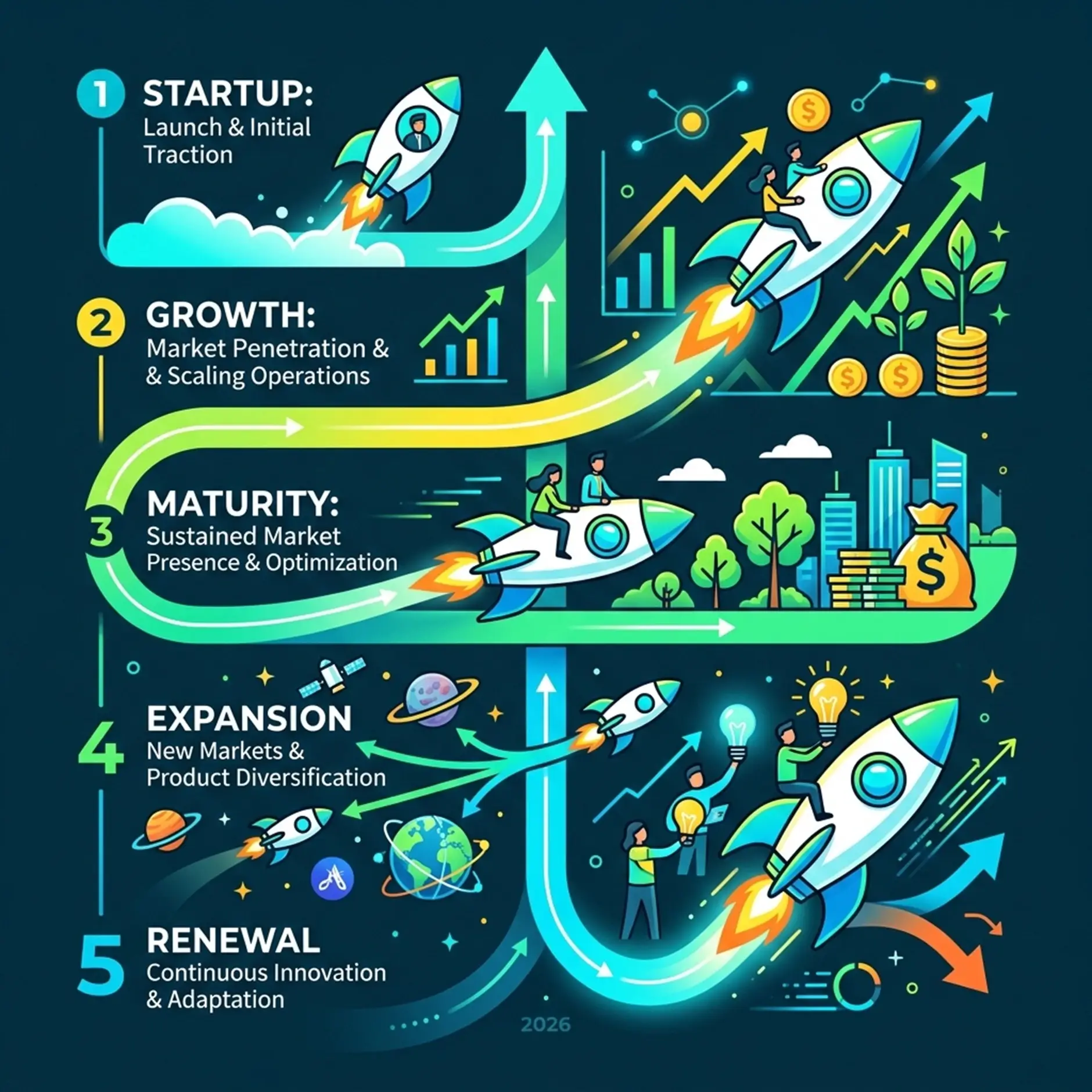
The five stages of business growth, from initial startup to potential renewal or decline, highlight the dynamic journey every company undertakes.
The Four Pillars of Business Growth Strategies
At its core, a business growth strategy is a comprehensive plan designed to increase a company's market share, revenue, and overall value. It's essential because it provides a roadmap for scaling operations, entering new markets, and developing innovative products. Without a clear strategy, businesses risk stagnation, inefficient resource allocation, and losing ground to competitors.
One of the most widely recognized frameworks for understanding growth strategies is the Ansoff Matrix, which categorizes strategies based on whether a company is targeting existing or new markets with existing or new products. This framework outlines four major approaches:
- Market Penetration: This strategy focuses on increasing sales of existing products within existing markets. Tactics include competitive pricing, increased marketing efforts, loyalty programs, and acquiring competitors. For instance, a coffee shop might offer a loyalty card to encourage repeat purchases or launch a targeted ad campaign to attract local customers who haven't visited yet.
- Market Development: Here, businesses aim to sell existing products to new markets. This could involve expanding geographically (e.g., a local bakery opening a second location in a neighboring town), targeting new customer segments (e.g., a B2B software company adapting its product for B2C users), or exploring new distribution channels (e.g., a traditional retailer launching an e-commerce platform).
- Product Development: This strategy involves introducing new products or services to existing markets. This might mean enhancing existing offerings with new features, creating entirely new products to meet evolving customer needs, or diversifying a product line. A tech company, for example, might release an updated version of its software with advanced functionalities or develop a complementary app for its existing user base. Stanley, the thermos company, famously expanded from $70 million to $750 million in annual sales by adding a new product line of colorful water bottles targeting a new customer base.
- Diversification: The riskiest but potentially most rewarding strategy, diversification involves introducing new products into new markets. This can be related diversification (e.g., a sports apparel company launching a line of fitness tracking devices) or unrelated diversification (e.g., a car manufacturer investing in renewable energy solutions). The goal is to spread risk and tap into entirely new revenue streams.
While these four strategies provide a robust framework, it’s crucial to remember that approximately 80% of growth typically comes from maximizing the value of the core business. This emphasizes the importance of continually innovating within your primary offerings and optimizing existing operations before aggressively pursuing new ventures. However, for the remaining 20% of growth, companies often look to "adjacency moves" – expanding into related products, services, or markets. Success in these adjacencies is significantly higher when companies apply two or more "right-to-win" rationales, such as leveraging existing customer relationships, unique capabilities, value chain insights, or disruptive potential. Companies that do so have seen excess Total Shareholder Return (TSR) growth 12 percentage points higher than their peers.
Growth can be broadly categorized into organic and inorganic methods, each with distinct characteristics:
Feature Organic Growth Inorganic Growth (M&A) Definition Expansion from internal operations and resources Growth through mergers, acquisitions, or strategic alliances Pace Slower, more gradual Faster, immediate market share or capability gain Risk Generally lower, more controllable Higher, integration challenges, cultural clashes Cost Often lower initial outlay, ongoing investment High upfront cost, due diligence expenses Control High, full control over new ventures Shared or acquired control, potential loss of autonomy Innovation Driven by internal R&D and market development Can acquire innovation or new technologies Examples New product launch, market expansion, increased sales Acquiring a competitor, merging with a supplier Both organic and inorganic growth strategies contribute to a company's overall expansion. Understanding these approaches and how they align with your business's capabilities and market position is fundamental to crafting effective, profitable digital growth strategies that drive sustainable success.
Digital Transformation and AI as Scalability Engines
In today's rapidly evolving business landscape, digital transformation and artificial intelligence (AI) are no longer optional but imperative for companies aiming for sustainable growth and scalability. Digital transformation involves integrating digital technology into all areas of a business, fundamentally changing how it operates and delivers value to customers. This shift clearly reflects how artificial intelligence is reshaping the future of business strategy, as companies increasingly rely on automation, data, and intelligent systems to stay competitive. This process encompasses automation, cloud computing, advanced data analytics, and the adoption of a comprehensive small business tech stack that enables operational efficiency and agility.
For many businesses, particularly small ones, leveraging software can significantly amplify impact without proportionally increasing payroll. Automation of repetitive tasks, for instance, frees up valuable human resources to focus on strategic initiatives, customer engagement, and market expansion. Cloud computing provides scalable infrastructure, enabling businesses to adapt quickly to fluctuating demand without heavy upfront investment. Data-driven decision-making, powered by sophisticated analytics, moves companies beyond intuition, enabling them to identify trends, optimize processes, and make informed choices for short- and long-term planning. This shift towards data-centric operations is a key 2025 trend, allowing businesses to understand their market dynamics and customer behavior with unprecedented clarity.
Here are some essential automation tools that can significantly boost scalability:
- CRM Systems (e.g., HubSpot, Salesforce): Automate lead capture, customer interactions, and sales pipelines, centralizing customer data for personalized engagement.
- Marketing Automation Platforms (e.g., Mailchimp, ActiveCampaign): Automate email campaigns, social media posts, and lead-nurturing sequences to ensure consistent communication.
- Project Management Software (e.g., Asana, Trello): Streamline workflows, assign tasks, and track progress, improving team collaboration and efficiency.
- Accounting Software (e.g., QuickBooks, Xero): Automate invoicing, expense tracking, and financial reporting, providing real-time financial insights.
- Integration Platforms (e.g., Zapier, Make.com): Connect disparate applications, automate data transfer and workflows between systems, and reduce manual effort.
Implementing AI-Driven Business Growth Strategies
Artificial intelligence, particularly generative AI (GenAI) and machine learning (ML), is revolutionizing how businesses approach growth. AI's ability to process vast amounts of data and identify patterns far beyond human capacity offers unprecedented opportunities for innovation and competitive advantage.
- Enhanced Customer Experience and Personalization: AI algorithms can analyze customer data to predict preferences, personalize product recommendations, and tailor communications. Chatbots and virtual assistants provide instant customer support, improving satisfaction and reducing operational costs. This level of personalization fosters stronger customer relationships and drives repeat business.
- Competitive Intelligence: AI tools can continuously monitor competitor activities, market trends, and consumer sentiment, providing businesses with real-time insights to quickly adapt their strategies. This includes analyzing competitor ad campaigns, product launches, and pricing strategies.
- R&D Acceleration: In product development, AI can accelerate research and development by simulating experiments, analyzing complex datasets, and even generating new design concepts. This significantly reduces time-to-market for innovative products and services.
- Operational Efficiency: Beyond basic automation, AI can optimize complex processes, such as supply chain management, inventory forecasting, and quality control, resulting in substantial cost savings and improved efficiency.
- Strategic Advice: For small businesses, GenAI can serve as a powerful assistant, drafting marketing emails, generating social media posts, and researching competitors, freeing up the team to focus on strategic guidance and client outcomes. In fact, 58% of small businesses are projected to use generative AI by 2026, a significant jump from 40% in 2024, highlighting its growing adoption and utility.
By strategically implementing digital transformation initiatives and integrating AI into their operations, businesses can create powerful scalability engines that drive efficiency, innovation, and ultimately, sustainable growth.
Financial Planning, Sustainability, and Strategic Divestitures
Effective financial planning is the bedrock of any successful growth strategy. Without a clear understanding of cash flow, budget allocation, and potential returns on investment, even the most innovative ideas can falter. For entrepreneurs seeking Financial growth for owners, meticulous planning ensures that resources are deployed strategically, risks are mitigated, and growth is sustainable.
A critical aspect of financial planning for growth involves budget allocation. Marketing, for instance, is a vital investment. Industry benchmarks suggest that small businesses (under 250 employees) should allocate approximately 7-8% of their revenue to marketing. This percentage can increase for younger companies (1-5 years old), often ranging from 12-20%, as they focus on establishing market presence. These figures provide a baseline, but the actual allocation should be dynamic, taking into account past effectiveness, industry trends, and planned product launches.
Cash flow management is equally paramount. Rapid growth can often lead to cash flow shortages if not managed carefully. Businesses must accurately project revenue and expenses, maintain adequate working capital, and establish credit lines to bridge potential gaps. Setting SMART financial goals (Specific, Measurable, Achievable, Relevant, Time-bound) ensures that financial targets are clear and actionable, guiding investment decisions and resource deployment.
Beyond traditional financial metrics, sustainability and ESG (Environmental, Social, and Governance) initiatives are increasingly recognized as powerful accelerants for profitable growth. Only 25% of companies grow sustainably over time, but those that do—sustainable growth outperformers—generate seven percentage points more annual total shareholder returns than their peers. Integrating ESG into business strategy is not just about corporate responsibility; it builds brand loyalty, attracts talent, and can unlock new market opportunities. "Triple outperformers" (those excelling in growth, profit, and sustainability) achieved 10%+ annual revenue growth, compared with 50% for companies that focused solely on growth or profit. This demonstrates that a holistic approach, where sustainability is embedded into the core strategy, yields superior long-term financial results.
Sometimes, to grow effectively, businesses must consider strategic divestitures, often referred to as "shrinking to grow." This involves periodically pruning non-core assets, underperforming divisions, or product lines that no longer align with the company's strategic direction or offer sufficient returns. While counterintuitive, divesting allows a company to reallocate capital and talent to higher-potential areas, strengthening its core business or investing in promising adjacencies. This portfolio reallocation is particularly common in larger conglomerates but can apply to businesses of all sizes. For example, a software company might divest an outdated product line to focus resources on developing a cutting-edge AI solution. This strategy requires careful risk mitigation and a clear vision for how the freed-up resources will fuel future expansion. It's a bold move that, when executed thoughtfully, can lead to healthier, more focused, and ultimately more profitable growth.
Customer-Centricity and Strategic Alliances
At the heart of any sustainable business growth strategy lies a deep commitment to customer-centricity. This approach places the customer at the forefront of all business decisions, recognizing that their satisfaction and loyalty are direct drivers of revenue and market share. Key elements include actively seeking customer feedback, fostering retention, and implementing effective loyalty programs.
The importance of customer retention cannot be overstated. Research consistently shows that acquiring a new customer costs significantly more – typically 5 to 7 times more – than retaining an existing one. Furthermore, a mere 5% improvement in customer retention can boost profits by 25% to 95%. Existing customers not only cost less to serve but also tend to spend 67% more than first-time buyers and are more likely to become brand advocates through referral networks.
To improve customer acquisition, retention, and lifetime value (LTV), businesses can employ several tactics:
- Feedback Loops: Regularly collect and act on customer feedback through surveys, reviews, and direct engagement. This informs product development, service improvements, and overall strategy.
- Personalized Communication: Utilize CRM systems to segment customers and deliver tailored messages, offers, and support, making each customer feel valued.
- Churn Reduction Strategies: Proactively identify at-risk customers and implement targeted interventions, such as special offers or personalized outreach, to prevent them from leaving.
- Post-Purchase Engagement: Maintain communication after a sale through follow-up emails, exclusive content, or community forums to reinforce value and build rapport.
- Loyalty Programs: Reward repeat business with points, discounts, exclusive access, or VIP experiences to encourage continued patronage.
Beyond direct customer relationships, strategic partnerships, alliances, and acquisitions offer powerful avenues for expansion. These collaborations can significantly contribute to growth by:
- Expanding Market Reach: Partnering with a complementary business can open doors to new customer segments or geographic markets that would be difficult or costly to enter on your own. For example, a local service provider might partner with a real estate agency to offer bundled services to new homeowners.
- Increasing Capabilities: Alliances can provide access to new technologies, expertise, or distribution channels. A software company might acquire a smaller firm with specialized AI capabilities to enhance its product offerings.
- Boosting Brand Credibility: Partnering with established brands or thought leaders can enhance a company's reputation and build trust among potential customers.
- Diversifying Offerings: Mergers and acquisitions can quickly expand a product or service portfolio, allowing a company to offer a more comprehensive solution to its customers.
Effective brand positioning and consistent messaging are crucial across all customer-centric and partnership efforts. A strong brand identity, built on market research and a clear understanding of the target audience, ensures that all communications resonate and reinforce the company's unique value proposition. Market segmentation further refines this, allowing businesses to tailor their strategies to specific customer groups, maximizing impact and resource efficiency.
Customer Retention as a Pillar of Business Growth Strategies
The strategic focus on customer retention is not merely a tactic; it is a fundamental pillar of sustainable growth. Reducing churn (the rate at which customers stop doing business with a company) directly impacts profitability. By integrating CRM systems, businesses can track customer journeys, personalize interactions, and automate post-purchase engagement sequences. These efforts build a sense of community around the brand, fostering loyal customers who are more likely to refer new business and provide valuable insights for future innovation. The long-term value generated by a retained customer far outweighs the initial acquisition cost, making retention a highly efficient and profitable growth strategy.
Measuring Performance and Building an Innovation Culture
To ensure business growth strategies are effective, continuous measurement and monitoring are essential. Without clear metrics, it's impossible to discern success from failure or identify areas for improvement. This is where Key Performance Indicators (KPIs) become invaluable. KPIs provide quantifiable measures that reflect the critical success factors of your growth initiatives. For many businesses, particularly those with shareholders, Total Shareholder Return (TSR) is a key KPI that demonstrates the overall value created for investors.
However, a comprehensive approach involves tracking a range of metrics tailored to specific growth strategies. Here's a list of growth KPIs to monitor weekly, ensuring you have a pulse on your business's trajectory:
- Revenue Growth Rate: Percentage increase in sales over a period.
- Customer Acquisition Cost (CAC): Cost to acquire a new customer.
- Customer Lifetime Value (CLTV): Total revenue expected from a customer over their relationship.
- Customer Churn Rate: Percentage of customers who stop using your product/service.
- Market Share: Your company's sales as a percentage of total market sales.
- Product Adoption Rate: The percentage of customers who use new products or features.
- Website Traffic & Conversion Rate: Number of visitors and percentage who complete a desired action.
- Employee Productivity/Engagement: Measures of workforce efficiency and satisfaction.
- Profit Margins: Gross and net profit as a percentage of revenue.
- Innovation Pipeline Progress: Tracking new ideas from concept to market launch.
Implementing performance dashboards enables real-time visualization of these KPIs, allowing quick identification of trends, opportunities, and potential issues. This data-driven approach supports agile decision-making and ensures strategies remain aligned with business objectives.
Equally important for sustained growth is fostering an innovation culture. Companies that consistently outperform their peers often embed innovation deeply within their organizational DNA. This requires more than just R&D departments; it demands an innovation mindset across the entire workforce. Key elements include:
- Talent Development: Investing in employee skills, creativity, and problem-solving abilities, and empowering employees to take ownership and contribute new ideas.
- Employee Engagement: Creating an environment where employees feel valued, heard, and motivated to contribute to the company's growth. Transformations that activate the full organization are eight times more likely to succeed, and those with over 20% employee ownership can nearly double excess TSR.
- Organizational Activation: Ensuring that innovation isn't confined to a few departments but is a shared responsibility, with processes that encourage cross-functional collaboration.
- Stage-Gate Investing: Implementing a structured approach to funding and developing new ideas, with clear milestones and decision points to either advance or discontinue projects. This allows for calculated risk-taking without committing excessive resources to unproven concepts.
Adopting agile business models further supports an innovation culture. These models emphasize flexibility, rapid iteration, and continuous adaptation to market changes. By embracing experimentation and learning from both successes and failures, companies can remain nimble and responsive, ensuring their growth strategies evolve with the dynamic business environment. This combination of rigorous measurement and a vibrant innovation culture creates a powerful engine for enduring success.
Frequently Asked Questions about Business Growth
What are the four major business growth strategies?
The four major business growth strategies, often illustrated by the Ansoff Matrix, are:
- Market Penetration: Increasing sales of existing products in existing markets.
- Market Development: Selling existing products to new markets or customer segments.
- Product Development: Introducing new products or services to existing markets.
- Diversification: Launching new products into entirely new markets. These strategies help businesses identify expansion opportunities based on their current product and market positions.
What does it mean to "shrink to grow" in business?
"Shrinking to grow" refers to a strategic decision to divest or prune non-core assets, underperforming divisions, or less profitable product lines. This portfolio reallocation allows a company to free up capital, talent, and managerial focus from areas that do not significantly contribute to strategic objectives. The resources saved are then reinvested in high-potential areas, strengthening the core business, funding promising new ventures, or acquiring capabilities aligned with future growth. It's a proactive divestiture strategy designed to create a leaner, more focused, and ultimately more profitable enterprise.
Why is customer retention more profitable than acquisition?
Customer retention is significantly more profitable than acquisition for several key reasons:
- Lower Acquisition Costs: Acquiring a new customer typically costs 5 to 7 times as much as retaining an existing one, as it involves marketing, sales, and onboarding expenses.
- Higher Lifetime Value (LTV): Retained customers tend to spend more over time, often increasing their purchase frequency and average order value. Repeat customers spend 67% more than first-time buyers.
- Increased Profit Margins: A 5% increase in customer retention can boost profits by 25% to 95% (Bain & Company), as loyal customers often require less support and are less price-sensitive.
- Brand Advocacy: Satisfied, retained customers are more likely to become brand advocates, referring new business through word-of-mouth, which is a highly effective and low-cost form of marketing.
Conclusion
Achieving sustainable business growth is a complex yet attainable goal for entrepreneurs who embrace a strategic, adaptive, and customer-focused mindset. We've explored how defining clear growth strategies, leveraging digital transformation and AI, and meticulously planning finances are all critical components. The journey of business growth is not linear; it demands a through-cycle mindset and strategic adaptability to navigate market shifts and competitive pressures.
From optimizing your core business and exploring adjacencies to embracing customer-centricity and fostering an innovation culture, every element plays a crucial role in building a resilient and expanding enterprise. By diligently measuring performance with relevant KPIs and being prepared to make bold decisions, such as strategic divestitures when necessary, businesses can ensure their growth is not just rapid but also profitable and enduring. The goal is to create long-term value for all stakeholders, securing a thriving future in an ever-changing world.
Business Outstanders brings you sharp insights on tech, business, entrepreneurship, law, crypto, and more. We uncover what’s next. Stay updated, sign up for our newsletter and be part of the future!