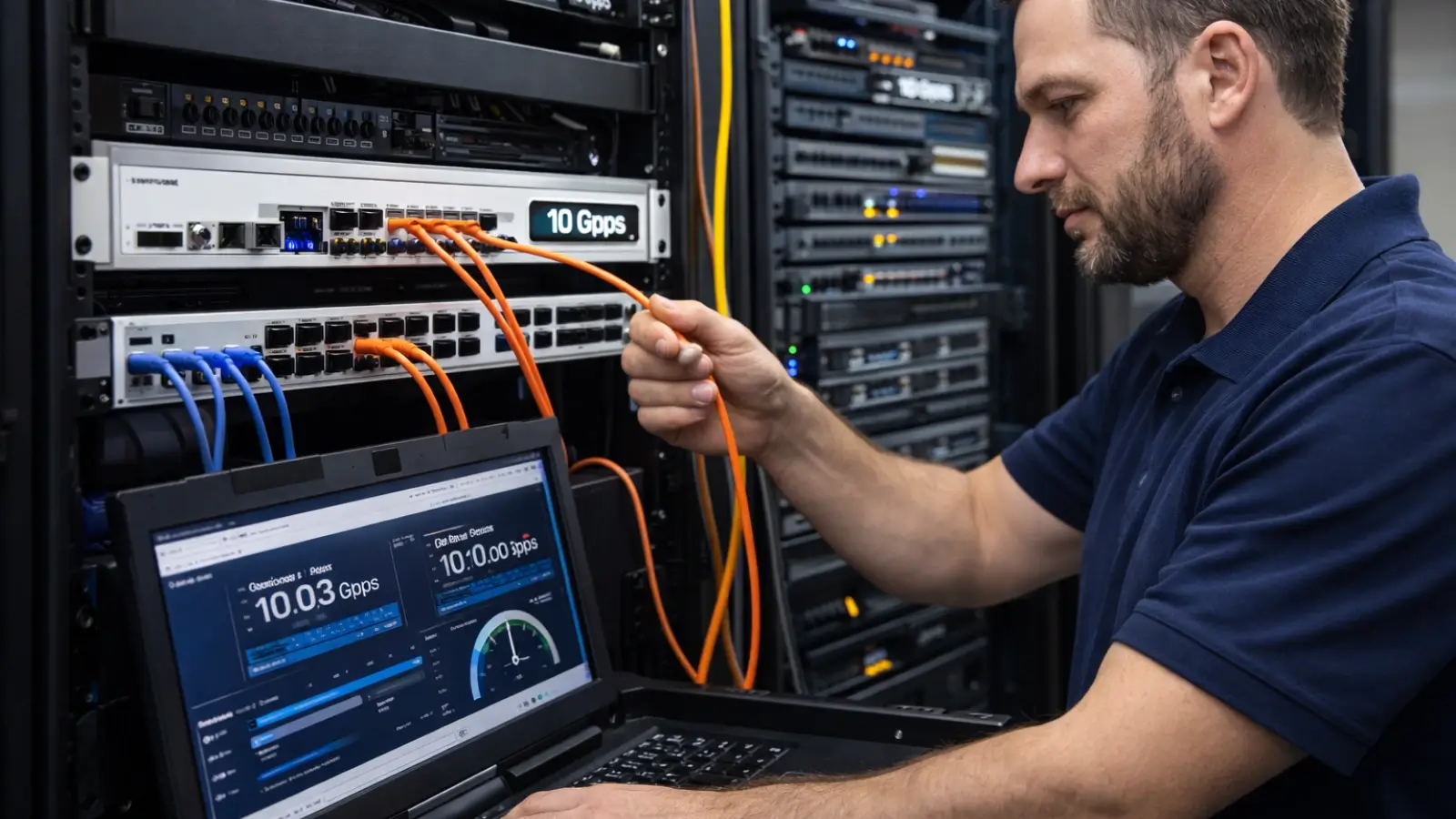
When my company first started discussing a 10 Gbps upgrade last year, half the team thought we'd lost our minds. "Who needs that kind of speed?" they asked. Fair question, honestly. We were managing fine on 1 Gbps at the time.
Six months after making the switch, those same skeptics won't shut up about how much faster everything runs. File uploads that used to take 20 minutes now finish before you can grab coffee. Our development team deploys updates in a fraction of the time. Video calls actually work when everyone's online.
But does every business need this? Absolutely not. Let's figure out if yours does.
Breaking Down What 10 Gbps Really Gives You
Think about downloading a two-hour HD movie. On a typical home connection, you're looking at maybe 10-15 minutes. On a business 1 Gbps line, perhaps 90 seconds. With 10 Gbps? About 8 seconds.
Now scale that up to business operations. Database backups. Video project files. Software deployments. Cloud synchronisation across dozens of employees. The time savings stack up fast.
But raw speed alone doesn't tell you if it's worth the money. You've got to look at what problems you're trying to solve.
Who Actually Benefits From This Much Bandwidth?
I've consulted with probably 40-50 businesses over the past few years about their Internet needs. The pattern is pretty clear about who sees real value from 10 Gbps.
1. Creative Agencies and Production Studios
Video editors, graphic designers, and content creators absolutely hammer their connections. A colleague runs a small production company with eight employees. They were constantly frustrated by upload speeds when sending footage to clients. Render a beautiful 4K video, then sit around for an hour watching a progress bar crawl forward.
After upgrading, that bottleneck vanished. They can now take on more projects because they're not wasting billable hours watching files transfer. The upgrade paid for itself within three months just from increased capacity.
2. Software Development Shops
Development teams are brutal on bandwidth without realising it. Git repositories, Docker containers, cloud environments, continuous integration pipelines. Every code push, every deployment, every test run generates network traffic.
One CTO told me their deployment process went from 45 minutes to 12 minutes after upgrading. When you're deploying multiple times per day, those savings compound quickly. Plus, happier developers are more productive developers.
3. Financial Services and Trading Operations
Trading firms live and die by milliseconds. Even businesses that aren't actively trading often need to process huge volumes of transaction data or run real-time analytics. Network bottlenecks translate directly into lost opportunities or delayed insights.
A financial planning firm I worked with processes market data feeds from multiple sources. Their old connection couldn't handle the volume during market opens. They'd see delays of 30-60 seconds, which might not sound like much, but it's an eternity when you're making time-sensitive decisions.
4. Medical Practices and Healthcare Facilities
Medical imaging generates massive files. MRI scans, CT scans, X-rays in high resolution. Doctors need to share these between facilities, send them to specialists, archive them for compliance.
A radiology clinic I know was spending 20-30 minutes uploading each study to their cloud archive. Multiply that by 50-60 studies per day. Their staff was staying late just to finish uploads. The 10 Gbps upgrade eliminated that entire problem.
5. Growing Companies Hitting Bandwidth Walls
Sometimes you don't realise you've outgrown your connection until everyone starts complaining. You hired aggressively this year. Moved applications to the cloud. Adopted new collaboration tools. Suddenly your previously adequate Internet feels painfully slow.
This happened to a marketing agency that grew from 15 to 45 people in 18 months. Their 500 Mbps connection worked fine for the small team. With triple the headcount, people were constantly fighting for bandwidth. Upgrading solved immediate pain and gave them room to keep growing.
The Stuff Nobody Mentions in Sales Pitches
Speed gets all the attention in marketing materials. But other factors matter just as much in practice.
1. Peak Load Capacity
Your connection doesn't need to handle maximum theoretical load 24/7. Most of the time, you're cruising along using a fraction of available bandwidth. But then Monday morning hits. Everyone logs in simultaneously. Three video conferences start. Marketing uploads a campaign video. Sales pulls a huge report from Salesforce. Finance syncs with the accounting system.
Suddenly you need that headroom. Having 10 Gbps available means these peaks don't bring everything to a crawl. Work continues smoothly instead of grinding to a halt.
2. Buying Future Capacity Now
Applications get heavier every year. Microsoft Teams uses more bandwidth than Skype did. Modern websites load more resources than older ones. Cloud-based software keeps adding features that increase data consumption.
A connection that feels spacious today might feel cramped in two years. Upgrading to 10 Gbps gives you breathing room. You're not constantly evaluating whether your Internet can handle the next new tool or application.
3. Supporting Distributed Teams
Remote work changed everything about bandwidth requirements. Your team isn't just sitting in the office using the local network anymore. They're VPN-ing in from home, accessing cloud storage, running virtual desktops, joining video meetings.
Each remote connection creates upstream and downstream traffic through your office connection. Twenty remote workers can saturate a 1 Gbps connection surprisingly fast, especially if they're accessing large files or bandwidth-heavy applications.
4. Application Performance Gets Personal
People notice when applications feel sluggish. Click a button, wait two seconds for something to happen. Open a file, watch it slowly render. Switch between browser tabs, see everything pause briefly.
These small delays add up psychologically. Employees get frustrated. Productivity suffers. Morale takes a hit. Nobody's going to quit over a slow CRM system, but the cumulative effect of constant minor frustrations affects workplace satisfaction.
Let's Talk About Money
Pricing for business 10 Gbps Internet in Singapore has dropped substantially over the past five years. It used to be exclusively enterprise territory. Now mid-sized businesses can actually afford it.
That said, it costs more than slower tiers. Obviously. The question becomes whether the investment makes financial sense.
Calculate what slow Internet actually costs you. How many employee hours are wasted waiting for things? Have you turned down projects because your infrastructure couldn't handle them? Are customers complaining about slow access to your services? Did you delay launching a feature because deployment took too long?
Hidden costs often exceed the visible monthly bill for an upgrade. One business calculated they were losing about 2.5 hours per employee per week to Internet-related slowdowns. Across 30 employees at average salary, that's significant money annually.
Speed Isn't Everything (But It Matters a Lot)
When you're shopping for 10 Gbps service, several factors beyond headline speed affect your actual experience.
Upload Speeds Equal Download Speeds
Some providers advertise 10 Gbps downloads but give you slower uploads. That's okay if you primarily download. But businesses typically push a lot of data upstream. Cloud backups, file uploads, video conferencing (yes, video calls upload data constantly), sending large files to clients.
Symmetrical speeds matter. Make absolutely certain you're getting 10 Gbps in both directions if your work involves uploading data.
Latency Affects Everything
Latency measures the delay before data starts transferring. You can have massive bandwidth, but if latency is high, applications still feel laggy.
This particularly matters for real-time applications. Video conferencing, remote desktop connections, cloud-based design tools, anything interactive. Low latency makes these applications feel responsive. High latency makes them frustrating to use.
Network Reliability Can't Be Ignored
Downtime costs money. Period. When you're evaluating providers, their infrastructure matters as much as their speeds.
How is their network built? Do they have diverse routing? What redundancy exists? If something breaks, how quickly can they fix it? What's their actual track record, not just what the SLA promises?
I've seen businesses choose the cheapest provider, then regret it after experiencing frequent outages. Saving 20% monthly doesn't matter if you're offline twice as often.
Scalability Solves Temporary Needs
Maybe you need 10 Gbps during product launches or seasonal peaks, but not constantly. Some providers offer flexible bandwidth options. You can scale up temporarily without renegotiating contracts.
This flexibility lets you avoid paying for capacity you don't always need while still having it available when circumstances demand it.
Your Office Infrastructure Needs Attention Too
Getting 10 Gbps to your building is step one. Actually using it requires proper internal infrastructure.
Network Equipment Upgrades
Your routers and switches need 10 Gbps capability. Many older devices max out at 1 Gbps or less. Even if your Internet connection delivers 10 Gbps, outdated internal equipment creates bottlenecks.
Budget for hardware upgrades when planning your connection upgrade. These costs can be substantial but they're necessary to realise the benefits.
Cabling Infrastructure Matters
The physical cables throughout your office affect performance. Cat6a or Cat7 cables handle 10 Gbps properly. Cat5e cables that worked fine for slower speeds become limiting factors.
If your building has older cabling, you might need rewiring. This gets expensive in larger offices but there's no way around it. You can't push 10 Gbps through cables that weren't designed for it.
Server and Infrastructure Connections
Individual employee computers usually don't need 10 Gbps network cards. They work fine at 1 Gbps for typical office tasks. But your servers, storage arrays, and network infrastructure should have 10 Gbps connections to avoid creating bottlenecks.
Making the Actual Decision
Stop and honestly answer these questions about your situation:
-
Do you regularly transfer large files, either internally or with external partners?
-
Are you running applications or services that consume substantial bandwidth?
-
Does your current connection noticeably slow down during busy periods?
-
Are you planning significant growth over the next 2-3 years?
-
Do critical business operations depend heavily on cloud services?
If you answered yes to multiple questions, upgrading probably makes sense. If your current connection handles everything comfortably with capacity left over, you might not need the jump yet. But keep monitoring your usage. Needs change faster than people expect.
Final Thoughts on the Upgrade
Your Internet connection stopped being a simple utility years ago. It's fundamental infrastructure now, affecting virtually every business function. For companies working with large data volumes or growing rapidly, 10 Gbps can provide genuine competitive advantage.
The upgrade makes sense when it eliminates obstacles, increases productivity, and provides capacity for future needs. You're not chasing speed for status. You're ensuring infrastructure enables business goals instead of constraining them.
Software keeps getting heavier. Business models increasingly depend on digital infrastructure. What seems excessive today often becomes standard tomorrow. The real question isn't whether you'll eventually need faster speeds. It's whether now is the right time for your business to make that move.
Business Outstanders brings you sharp insights on tech, business, entrepreneurship, law, crypto, and more. We uncover what’s next. Stay updated, sign up for our newsletter and be part of the future!