Why First-Time CEOs Struggle
Stepping into the CEO seat for the first time is one of the most exhilarating, and terrifying, transitions in business. You’ve been promoted, hired, or funded because of your expertise, vision, and drive. Yet within months, many first-time chief executives find themselves caught in a web of common leadership and management mistakes that erode team trust, slow company growth, and, in the worst cases, destroy the very culture they were hired to build. These are the leadership errors executives make when the pressure of the top role collides with habits formed before reaching it.
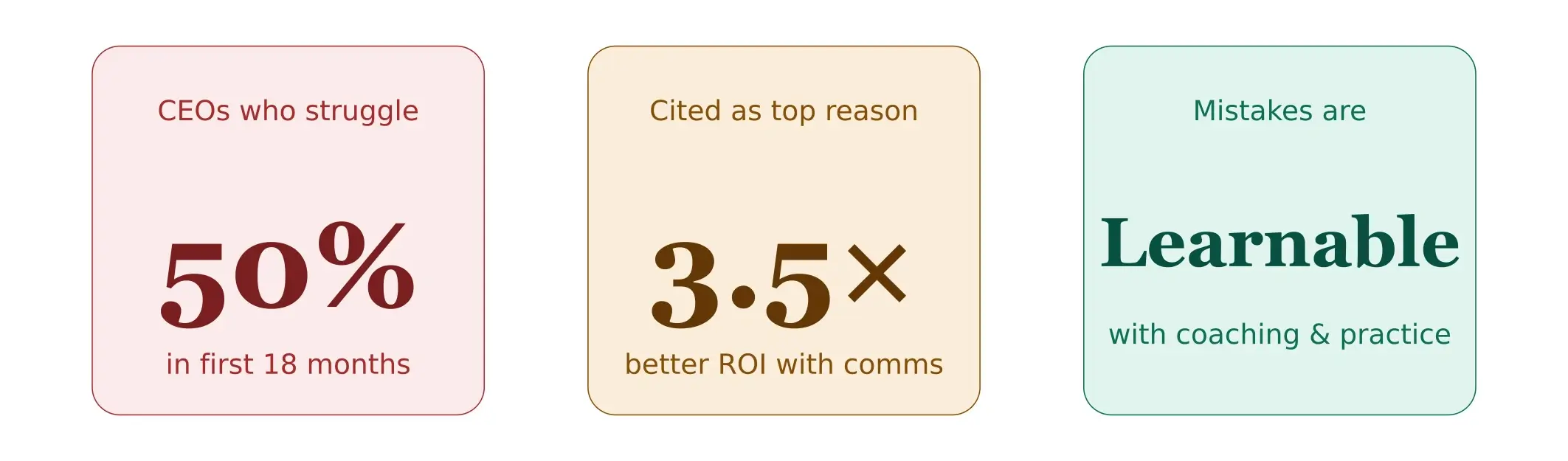
The stakes are undeniable: according to research from Harvard Business Review, roughly 50–60% of new executives struggle significantly in their first 18 months. Understanding why CEOs fail at leadership starts with recognizing that the mistakes aren’t random, they follow recognizable patterns. This guide covers the 7 most common leadership mistakes CEOs make, why they happen, and, most importantly, how to fix them.
"Leadership is not about being in charge. It is about taking care of those in your charge."
Whether you’re a founder stepping into the top role, an executive transitioning from a larger company, or a rising leader on the cusp of your first CEO position, understanding the most damaging CEO leadership mistakes in the first year is your competitive edge. This guide is your strategic playbook for avoiding the mistakes new CEOs make before they become expensive lessons.
7 Common Leadership Mistakes CEOs First Time Make are as Follows:
Mistake #1
Trying to Do Everything Themselves (Failure to Delegate)
Why it happens
Most first-time CEOs earned their roles by being high performers, the person who always delivered. That instinct to "get it done right yourself" doesn't switch off when you take the corner office. The result? Bottlenecks everywhere, a team that feels distrusted, and a CEO stretched dangerously thin.
The real cost
When a CEO micromanages or refuses to delegate, they inadvertently communicate that they don’t trust their team. Over time, talented people stop bringing ideas or taking initiative, why would they, when the boss will just override the decision anyway? Knowing how to stop micromanaging as a CEO starts with learning to delegate effectively as a leader, one of the most urgent leadership skills to develop in the early months.
How to fix it
- Identify your highest-leverage activities, the 20% of tasks that produce 80% of your strategic value and ruthlessly protect that time.
- Build a delegation framework: categorize tasks by complexity and trust level, then systematically move ownership to the right people.
- Accept that 80% done by someone else is often better than 100% done by you, because it frees you to lead.
- Schedule weekly check-ins rather than hovering daily to stay informed without micromanaging.
"If you want to go fast, go alone. If you want to go far, go together."
— African Proverb
Mistake #2
Ignoring Company Culture (And Why It’s a Top CEO Failure Reason)
Why it happens
Culture feels intangible to results-driven new CEOs. When you're focused on metrics, runway, and growth targets, culture can seem like an afterthought, a soft concern for HR. This is a fatal miscalculation.
The real cost
Culture is strategy. CEO ignoring company culture, even unintentionally, ranks among the top CEO failure reasons cited by boards and investors. Companies with strong, deliberate cultures outperform peers across virtually every financial metric over the long term. When a new CEO ignores culture, or worse, inadvertently undermines it, attrition spikes, morale collapses, and the best employees leave first. These are the CEO mistakes that kill company culture quietly before the damage becomes visible.
How to fix it
- Define your culture explicitly: what behaviors are celebrated, what is never tolerated, and what values guide every decision.
- Model the culture personally, your behavior sets the ceiling and the floor.
- Conduct a culture audit within your first 90 days: employee surveys, exit interview data, and candid 1-on-1s reveal the real culture versus the stated one.
- Tie performance management and promotion decisions to cultural values, not just output metrics.
To better understand how CEOs can intentionally shape and scale strong business cultures, explore The 10 Principles of Ted Lasso Management.
Mistake #3
Poor Communication with the Team
Why it happens
New CEOs are often consuming enormous amounts of information, board meetings, investor calls, strategic planning sessions — and forget that the people doing the actual work are left in the dark. Communication tends to flow up, but not down.
The real cost
Information vacuums are filled with speculation and anxiety. When employees don’t understand the company’s direction, their role in it, or how decisions are being made, disengagement follows quickly. Poor communication is consistently ranked among the top reasons employees cite for leaving, and it’s one of the most correctable leadership mistakes once a CEO recognizes it.
How to fix it
- Establish a regular communication cadence: all-hands meetings, written CEO updates, and department-level briefings.
- Practice radical transparency where possible, share not just the "what" but the "why" behind major decisions.
- Develop active listening skills as a formal practice, not just a personality trait. Knowing how to fix poor communication as a leader starts here, seek input before, during, and after major changes.
- Use clear, simple language. Avoid corporate jargon that obscures rather than clarifies.
Research by Towers Watson shows that companies with effective communication are 3.5x more likely to outperform their peers in total returns to shareholders.
To better understand how CEO communication directly impacts employee trust, alignment, and business performance, explore Why Transparent Communication Matters More Than Ever.
Mistake #4
Avoiding Difficult Conversations
Why it happens
Conflict avoidance is deeply human. First-time CEOs, especially those who rose through technical or creative roles, often lack formal training in delivering hard feedback, managing underperformers, or navigating interpersonal tension at the executive level.
The real cost
Every difficult conversation avoided becomes a compounding problem. An underperforming executive who isn't told clearly that their role is at risk doesn't course-correct. A toxic high performer who is tolerated damages the entire team around them. The longer you wait, the costlier the intervention.
How to fix it
- Adopt a feedback framework such as the SBI model (Situation, Behavior, Impact) to give clear, specific, non-personal feedback.
- Address performance issues within days, not months, early, direct feedback is kinder and more effective than a sudden termination.
- Practice the conversation beforehand with a coach, mentor, or trusted peer.
- Separate the person from the behavior: "The report was three days late" rather than "You are unreliable."
Mistake #5
Making Decisions Too Slowly (Or Too Fast)
Why it happens
Decision-making at CEO level is uniquely difficult because the stakes are higher, the information is often incomplete, and the consequences are felt company-wide. Some new CEOs freeze, seeking perfect information before acting. Others over-correct and make impulsive decisions to appear decisive.
The real cost
Analysis paralysis starves the organization of direction and momentum. Reckless speed, meanwhile, leads to costly strategic missteps that burn resources and erode board confidence. Neither extreme serves the business.
How to fix it
- Distinguish reversible decisions (where speed matters more than perfection) from irreversible ones (where deliberation is warranted).
- Use the "70% rule": if you have 70% of the information you'd ideally want, make the call. The remaining 30% rarely changes the outcome.
- Build a decision-making framework and communicate it to your team so they can make empowered decisions at their level.
- Debrief poor decisions as learning opportunities, this normalizes calculated risk-taking throughout the org.
Mistake #6
Neglecting Their Own Development and Mental Health
Why it happens
The CEO role is relentless. First-time chief executives often fall into the trap of equating busyness with effectiveness. Self-care, executive coaching, reading, and reflection are deprioritized in favor of back-to-back meetings and crisis management.
The real cost
A CEO who is burned out, intellectually stagnant, or emotionally dysregulated makes worse decisions, communicates less clearly, and models exactly the wrong behaviors for the organization. Leadership at scale requires sustainable energy, not a heroic sprint.
How to fix it
- Hire an executive coach within your first six months, not as a sign of weakness, but as one of the highest-leverage ways to improve CEO leadership skills and catch blind spots early.
- Block deep work time and protect it ruthlessly. Your best thinking requires uninterrupted focus.
- Build a personal board of advisors: seasoned executives, entrepreneurs, or mentors you can consult frankly.
- Invest in physical, mental, and social wellbeing with the same rigor you bring to business strategy. This is how to improve CEO leadership skills from the inside out, sustainable energy is a leadership asset.
"You can't pour from an empty cup. The CEO's emotional and intellectual state is a company asset, not a personal matter."
Mistake #7
Confusing Activity with Progress
Why it happens
The first-time CEO is surrounded by infinite demands; emails to answer, meetings to attend, fires to extinguish. The gravitational pull toward reactive activity is enormous. Busyness becomes a substitute for strategic focus.
The real cost
Organizations mirror their leaders. When the CEO is perpetually reactive, the entire company defaults to firefighting mode. Strategic initiatives stall. Long-term compounding value is sacrificed for short-term noise management.
How to fix it
- Define three to five annual strategic priorities and return to them relentlessly. If a task doesn't advance a strategic priority, question its place on your calendar.
- Implement a weekly review practice to distinguish what moved the needle from what simply kept you occupied.
- Learn to say no — to meetings, projects, and commitments that don't align with top priorities.
- Protect strategic thinking time. Block it on your calendar before reactive demands fill every hour.
"The most productive people are not those who do the most, they are those who are ruthlessly focused on doing the most important things."
Conclusion: Great CEOs Are Made, Not Born
Every mistake on this list is learnable. The most common leadership mistakes CEOs make are not signs of incompetence, they are predictable patterns that emerge under pressure. The first-time CEOs who succeed are not those who arrive perfectly formed, they are the ones who develop the self-awareness to recognize their patterns, the humility to seek help, and the courage to change.
Leadership is a discipline, not a title. Knowing how to become a better CEO starts with an honest inventory of the leadership skills every CEO need: communication, delegation, culture stewardship, and decisive thinking. Whether your current challenge is one or all of these, the good news is that every competency can be developed with intention, coaching, and practice.
The executives who acknowledge their gaps early and act on them, are the ones who build lasting companies, loyal teams, and enduring legacies. Learning how to avoid leadership mistakes as a CEO is not a one-time fix; it is an ongoing practice of self-correction, candid feedback, and deliberate growth.
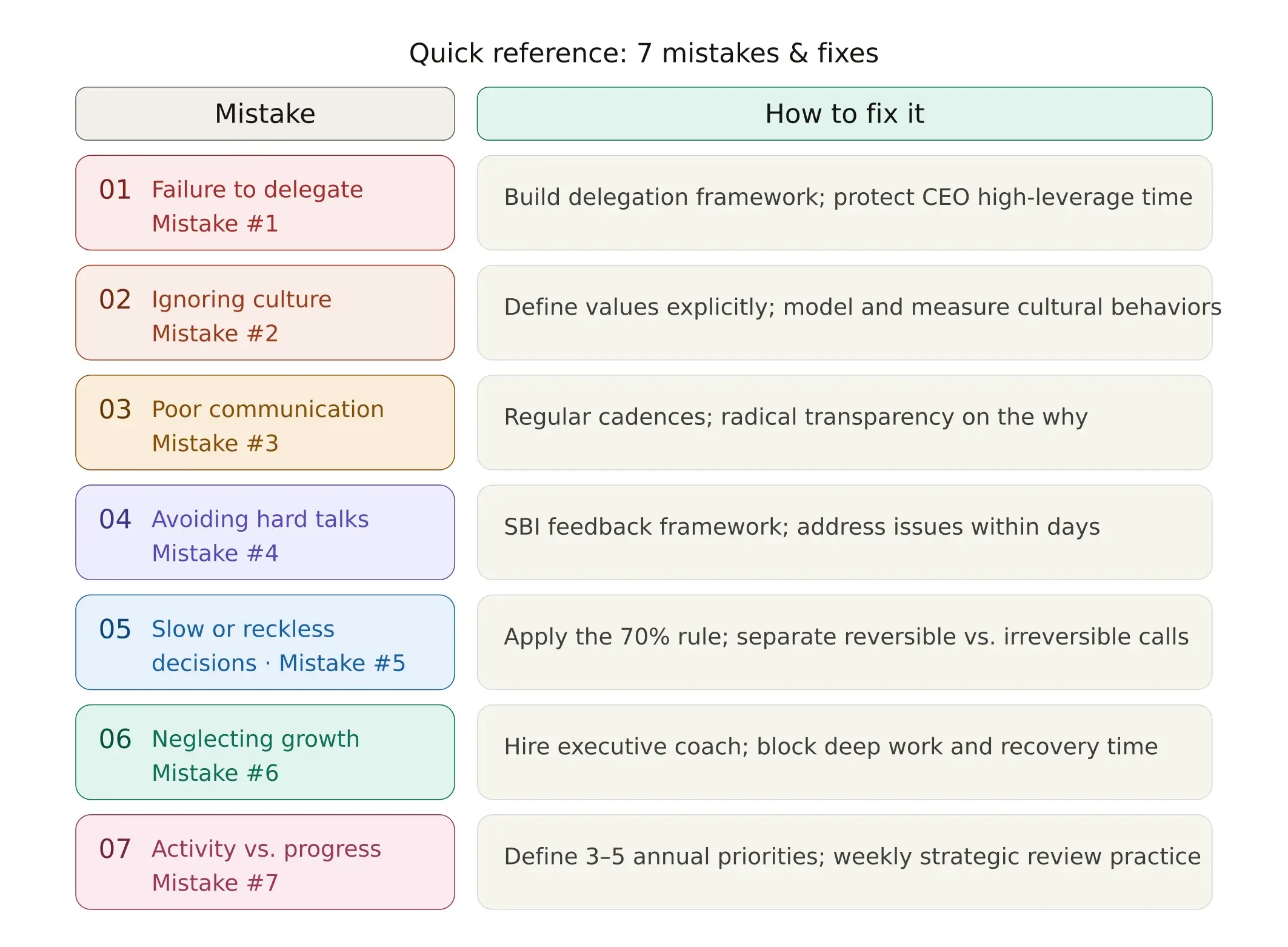
Quick Reference: 7 CEO Mistakes & Their Fixes
- Failure to delegate: Build a delegation framework; protect high-leverage CEO time
- Ignoring culture: Define values explicitly; model and measure cultural behaviors
- Poor communication: Establish regular cadences; practice radical transparency
- Avoiding hard conversations: Use SBI feedback framework; address issues early
- Slow or reckless decisions: Apply the 70% rule; distinguish reversible vs. irreversible decisions
- Neglecting self-development: Hire an executive coach; protect deep work and recovery time
- Activity vs. progress confusion: Define 3–5 annual priorities; implement weekly strategic reviews
Sources
- Carucci, R., Why Executives Fail in Their First 18 Months — Harvard Business Review, 2017
- Towers Watson, 2013–2014 Change & Communication ROI Study — Willis Towers Watson, 2014
- Sinek, S., Leadership is not about being in charge — Start With Why, 2011
Explore More Leadership Insights: Discover powerful leadership lessons, decision-making frameworks, and real-world strategies from founders and executives in the BusinessOutstanders.com Leadership category.
Business Outstanders brings you sharp insights on tech, business, entrepreneurship, law, crypto, and more. We uncover what’s next. Stay updated, sign up for our newsletter and be part of the future!